Showing posts with label All Souls. Show all posts

3 Nov 2018

November 4th 2018 - Death, Dying and Grief - November the month to remember our dead and reflect on our deaths

On this weeks programme, we reflect on death, grief and the reality of the final journey that awaits us all. We have our regular reflection on this weeks Sunday gospel as well as the saints of the weeks and other odds and ends. 

You can listen to the podcast of the programme HERE.

Death, Dying and Grief - Remembering our dead and reflecting on our deaths


We praise You, Lord, for Sister Death,
from whom no-one living can escape….
Blessed are those that she finds doing Your Will.
No second death can do them harm.
 - St. Francis of Assisi,
“Canticle of the Sun”


In paradisum deducant te Angeli; in tuo adventu suscipiant te martyres, et perducant te in civitatem sanctam Ierusalem.  Chorus angelorum te suscipiat, et cum Lazaro quondam paupere æternam habeas requiem.  

May angels lead you into paradise; upon your arrival, may the martyrs receive you and lead you to the holy city of Jerusalem.  May the ranks of angels receive you, and with Lazarus, the poor man, may you have eternal rest.

In the Roman Catholic tradition November is the month of the Holy Soul's where we pray for those who have left this mortal world but may not enjoy full the vision of God. November can be a hard month for many people as we recall the memory of our beloved dead - for the dead can drive you hard. But with the darkening of days and the drawing in of nights it seems to be an appropriate time to reflect and pray for our dead as the year and seasons move towards the death of winter. It is the time of year when we can reflect on our encounters with Sister Death and ultimately an encounter which we will all have.

Sister Death is the shadow at our elbow, the constant friend at our door, our faithful companion throughout the journey of life who may at any time say come, your time is complete. Irish folklore has many comments and reminders about it with sayings like "there are no pockets in a shroud" to "there is no trailer after a hearse", or "it doesn't matter how much land you have, you will still end up in a plot 6 X 3".

St Francis of Assisi reminds us that “Remember that when you leave this earth, you can take with you nothing that have received--only what you have given.

But coping with death and grief is difficult and the gift of rememberance can ease the pain although for some it can also renew that pain like reopening an old wound.  It is fair to say that grief never leaves us - we only get better at carrying it with us, for the dead remain dead. When you have lost someone, when it feels like a person has been ripped away from you, when you very heart bleeds at the loss, no matter how long has passed the heart can still pain - a smell, a noise, a memory, a favourite song or something of theirs which you happen across can be the trigger to that moment of renewed  pain. Especially for families where this November will be their first with that missing person we need to be gentle with them and with ourselves and remind ourselves that there was a logic to the Victorian tradition of observing a period of mourning; to allow people to become accustomed to carrying that pain in their lives.

But death is not the end, for "death where is thy victory! where is thy sting!" We celebrate and remember because as Christians we say life has changed not ended, in Christ's victory we have our hope! 

As we pray this November, let the words of In paradisum be our heart prayer for our dead, balm to the soul for those who have gone before us .
May angels lead you into paradise; upon your arrival, may the martyrs receive you and lead you to the holy city of Jerusalem.  May the ranks of angels receive you, and with Lazarus, the poor man, may you have eternal rest.
Over at iBenedictines, Digitalnun wrote a wonderful reflection for All Souls in 2012:
Catholicism can be an uncomfortable religion to live by, but it is a wonderful religion in which to die. As death draws closer we are surrounded by prayer, our bodies are anointed and we receive the Viaticum to help us on our way. At the moment of death a singularly beautiful prayer is prayed, and after death our bodies are accorded the simple rituals I described in an earlier post. But that is not the end of of the matter. The Church goes on praying for us, perseveringly. November, in particular, is a month when we pray for the dead with special earnestness. Today, on the feast of All Souls, everyone will join in praying for all the faithful departed — not just the people known to us, but those unknown, those who have no-one else to pray for them. The feast of All Souls thus unites the living and the dead. 
Last year I summed it up by saying 
"Instead of pushing the dead out of sight or surrounding them with euphemisms, we state the facts baldly and pray for the dead as we pray for ourselves, asking God to remove every trace of sin from those not yet ready for the blessedness of heaven. We believe that our prayers can help those who have died and are undergoing the final purification of purgatory, when the soul is prepared for the vision of God. To pray for the dead is thus a work of charity, a way of helping those who cannot help themselves."


"The souls of the just are in the hand of God and no torment shall touch them. They seemed, in the view of the foolish, to be dead; and their passing away was thought an affliction and their going forth from us, utter destruction. But they are in peace. 
For if before men, indeed, they be punished, yet is their hope full of immortality; chastised a little, they shall be greatly blessed, because God tried them and found them worthy of himself. As gold in the furnace, he proved them, and as sacrificial offerings he took them to himself. In the time of their visitation they shall shine, and shall dart about as sparks through stubble; they shall judge nations and rule over peoples, and the Lord shall be their King forever.
Those who trust in him shall understand truth, and the faithful shall abide with him in love: because grace and mercy are with his holy ones, and his care is with his elect."
-- From the Book of Wisdom


And death shall have no dominion

Dead man naked they shall be one
With the man in the wind and the west moon; 
When their bones are picked clean and the clean bones gone,
They shall have stars at elbow and foot; 
Though they go mad they shall be sane,
Though they sink through the sea they shall rise again; 
Though lovers be lost love shall not; 
And death shall have no dominion.

And death shall have no dominion.
Under the windings of the sea
They lying long shall not die windily; 
Twisting on racks when sinews give way,
Strapped to a wheel, yet they shall not break; 
Faith in their hands shall snap in two,
And the unicorn evils run them through; 
Split all ends up they shan't crack; 
And death shall have no dominion.

And death shall have no dominion.
No more may gulls cry at their ears
Or waves break loud on the seashores; 
Where blew a flower may a flower no more
Lift its head to the blows of the rain; 
Though they be mad and dead as nails,
Heads of the characters hammer through daisies; 
Break in the sun till the sun breaks down,
And death shall have no dominion. 

- Dylan Thomas

The Commemoration of All the Faithful Departed
Pope Francis at All Souls’ Mass: Today is a day of hope
Pope: Don’t forget the souls in Purgatory!
All Souls Day and the Shock of Death
What is All Souls’ Day and how is it celebrated around the world?
Pray St. Gertrude the Great’s powerful prayer for the Holy Souls in Purgatory
5 Prayers for the dead (that you can take to the cemetery)

Memento Mori

Focusing on your death may seem morbid, unhealthy, disturbing, and perhaps even diabolical. And in some cases it can become so. Death in itself is an evil. Saint Augustine wrote that death is “the very violence with which body and soul are wrenched asunder.” But Jesus has changed the nature of death for those who believe. Before becoming pope, then-Cardinal Joseph Ratzinger once wrote: “The sting of death is extinguished in Christ.”

A long-standing Christian tradition recognizes the powerful spiritual value in remembering one’s death in order to live well. The Rule of Saint Benedict, written in the 6th century, includes the imperative to “keep death daily before one’s eyes.” As the Catechism points out, both Scripture and the teachings of the Church remind us of “the responsibility incumbent upon man to make use of his freedom in view of his eternal destiny” (1036, emphasis mine).

The practice of remembering that you will die helps you to keep in mind that your life will end, and that it has a goal: heaven.
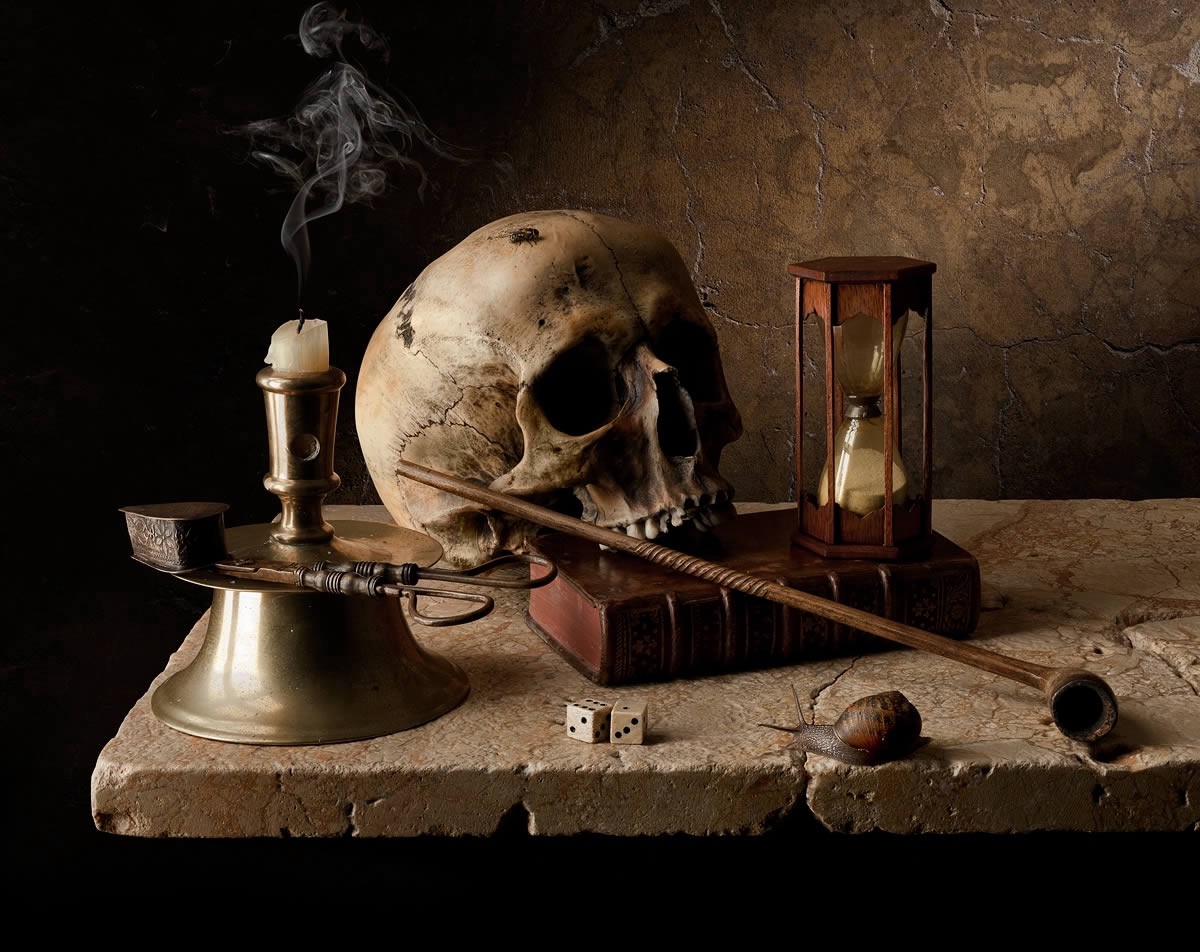
Visual reminders — often called memento mori, the Latin phrase for “Remember that you will die” — are one way we can keep our impending death in mind. Saints Jerome, Aloysius, and Mary Magdalene, among others, are often depicted in classic paintings with skulls. Saint Francis of Assisi once signed a blessing to Brother Leo with the tau cross and a small drawing of a skull. Pope Alexander VII commissioned Italian artist Bernini to make a coffin that he kept in his bedroom along with a marble skull for his desk to remind him of the brevity of life. Blessed James Alberione, the founder of the Daughters of Saint Paul, also kept a skull on his desk.

Atlas Obscura - Memento Mori
Memento mori - How religious orders remember death
Young Nun, Former Atheist Says: “Remember Your Death”

You can listen to the reflection in part 2 excerpted from the main programme podcast HERE.

Gospel - Mark 12:28-34


One of the scribes came to Jesus and asked him,"Which is the first of all the commandments?" Jesus replied, "The first is this:Hear, O Israel!The Lord our God is Lord alone!You shall love the Lord your God with all your heart,with all your soul, with all your mind,and with all your strength.The second is this:You shall love your neighbor as yourself.There is no other commandment greater than these." The scribe said to him, "Well said, teacher.You are right in saying,'He is One and there is no other than he.'And 'to love him with all your heart,with all your understanding,with all your strength,and to love your neighbor as yourself'is worth more than all burnt offerings and sacrifices."And when Jesus saw that he answered with understanding,he said to him,"You are not far from the kingdom of God." 
And no one dared to ask him any more questions.

Reflections on this weeks gospel:

English Dominicans
Sunday Reflections
Centre for Liturgy

Liturgical odds & ends

Liturgy of the Hours - Psalter week 3

Saints of the Week
November 5th - St Martin de Porres
November 6th - All the Saints of Ireland
November 7th - St Willibrord
November 8th - Bl John Duns Scotus
November 9th - Dedication of St John on the Lateran
November 10th - St Leo the Great

2 Nov 2017

Why Do Catholics Pray for the Dead? - (#AskFrBarron)

All Souls


And death shall have no dominion

Dead man naked they shall be one
With the man in the wind and the west moon;
When their bones are picked clean and the clean bones gone,
They shall have stars at elbow and foot;
Though they go mad they shall be sane,
Though they sink through the sea they shall rise again;
Though lovers be lost love shall not;
And death shall have no dominion.

And death shall have no dominion.
Under the windings of the sea
They lying long shall not die windily;
Twisting on racks when sinews give way,
Strapped to a wheel, yet they shall not break;
Faith in their hands shall snap in two,
And the unicorn evils run them through;
Split all ends up they shan't crack;
And death shall have no dominion.

And death shall have no dominion.
No more may gulls cry at their ears
Or waves break loud on the seashores;
Where blew a flower may a flower no more
Lift its head to the blows of the rain;
Though they be mad and dead as nails,
Heads of the characters hammer through daisies;
Break in the sun till the sun breaks down,
And death shall have no dominion.

Dylan Thomas


On the death of the beloved
Though we need to weep your loss,
You dwell in that safe place in our hearts,
Where no storm or night or pain can reach you.

Your love was like the dawn
Brightening over our lives
Awakening beneath the dark
A further adventure of colour.

The sound of your voice
Found for us
A new music
That brightened everything.

Whatever you enfolded in your gaze
Quickened in the joy of its being;
You placed smiles like flowers
On the altar of the heart.
Your mind always sparkled
With wonder at things.

Though your days here were brief,
Your spirit was live, awake, complete.

We look towards each other no longer
From the old distance of our names;
Now you dwell inside the rhythm of breath,
As close to us as we are to ourselves.

Though we cannot see you with outward eyes,
We know our soul's gaze is upon your face,
Smiling back at us from within everything
To which we bring our best refinement.

Let us not look for you only in memory,
Where we would grow lonely without you.
You would want us to find you in presence,
Beside us when beauty brightens,
When kindness glows
And music echoes eternal tones.

When orchids brighten the earth,
Darkest winter has turned to spring;
May this dark grief flower with hope
In every heart that loves you.

May you continue to inspire us:

To enter each day with a generous heart.
To serve the call of courage and love
Until we see your beautiful face again
In that land where there is no more separation,
Where all tears will be wiped from our mind,
And where we will never lose you again.

John O'Donohue

************************

1 Nov 2016

2nd November - Remembering all our beloved dead


We praise You, Lord, for Sister Death,
from whom no-one living can escape….
Blessed are those that she finds doing Your Will.
No second death can do them harm.
 
 - St. Francis of Assisi,
“Canticle of the Sun”
 

The Triduum of the Dead - (All Hallows Eve (Halloween), All Saints and All Souls) is a reminder to us that our nearest and dearest who have died are not really that far away and that we honour and pray for and with each other in the Communion of Saints especially at this time of the year. Whilst you remember your own loved ones at this time, also remember to pray for those that are mourning. While time may change the pain of loss, it can never be said to truly go away; remember those who mourn and feel that pain at this time too especially for those who have lost loved ones in the last twelve months.
 

Psalm 130
Out of the depths I cry to you, O Lord,
Lord, hear my voice!
O let your ears be attentive
to the voice of my pleading.

If you, O Lord, should mark our guilt,
Lord, who would survive?
But with you is found forgiveness:
for this we revere you.

My soul is waiting for the Lord,
I count on his word.
My soul is longing for the Lord
more than watchmen for daybreak.

Let the watchmen count on daybreak
and Israel on the Lord.

Because with the Lord there is mercy
and fullness of redemption,
Israel indeed he will redeem
from all its iniquity
.
There is a Mexican saying that we die three deaths: the first when our bodies die, the second when our bodies are lowered into the earth out of sight, and the third when our loved ones forget us. Catholics forestall that last death by seeing the faithful dead as members of the Church, alive in Christ, and by praying for them -- and asking their prayers for us -- always. Cardinal Wiseman wrote in his Lecture XI: Sweet is the consolation of the dying man, who, conscious of imperfection, believes that there are others to make intercession for him, when his own time for merit has expired; soothing to the afflicted survivors the thought that they possess powerful means of relieving their friend. In the first moments of grief, this sentiment will often overpower religious prejudice, cast down the unbeliever on his knees beside the remains of his friend and snatch from him an unconscious prayer for rest; it is an impulse of nature which for the moment, aided by the analogies of revealed truth, seizes at once upon this consoling belief. But it is only a flitting and melancholy light, while the Catholic feeling, cheering though with solemn dimness, resembles the unfailing lamp, which the piety of the ancients is said to have hung before the sepulchres of their dead. Though we should daily pray for the dead in Purgatory, above all for our ancestors, today is especially set aside for hanging that "unfailing lamp before the sepulchres of our dead"  
Today is the feast of All-Souls, when we commemorate all those who have gone before us for their eternal reward, those who have died, marked with the sign of faith. We already commemorate the dead at every single Mass, as part of the Eucharistic Prayer, and we will hear these words again today. We recognize that they are part of the mystical body in the church. But today we reflect in a special way, not so much on the dead, but those waiting for their reward at this moment. The topic may sound morbid, but in fact it contains a secret to tremendous joy. Unless Jesus happens to return in glory first, we will all have to face death, whether our own or that of some close to us. And our faith has a direct impact on how we face this ultimate moment. 


8 Nov 2015

8th November 2015 - Reflections on memory and grief: an interview with Alice Taylor

On this week programme John, Ann and Shane are joined by a very special guest, the Irish writer Alice Taylor. We have some liturgical odds and ends and on the blog this week we give some links for reflections on this weeks gospel.

You can listen to the podcast of this weeks full programme HERE.

Reflections on memory & grief: An Interview with Alice Taylor

November can be a hard month for many people as we recall the memory of our dead. In the Roman Catholic tradition it is the month of the Holy Soul's. And it seems to be an appropriate time to reflect and pray for our dead as the year and seasons move towards the death of winter.

But coping with death and grief can be difficult and on this weeks programme we are joined by Alice Taylor to reflect on memory and dealing with grief especially after writing her book As time stood still.


Alice Taylor lives in the village of Innishannon in County Cork, in a house attached to the local supermarket and post office. Since her eldest son has taken over responsibility for the shop, she has been able to devote more time to her writing.

Alice Taylor worked as a telephonist in Killarney and Bandon. When she married, she moved to Innishannon where she ran a guesthouse at first, then the supermarket and post office. She and her husband, Gabriel Murphy, who sadly passed away in 2005, had four sons and one daughter. In 1984 she edited and published the first issue of Candlelight, a local magazine which has since appeared annually. In 1986 she published an illustrated collection of her own verse.

To School Through the Fields was published in May 1988. It was an immediate success, launching Alice on a series of signing sessions, talks and readings the length and breadth of Ireland. Her first radio interview, forty two minutes long on RTÉ Radio's Gay Byrne Show, was the most talked about radio programme of 1988, and her first television interview, of the same length, was the highlight of the year on RTÉ television's Late Late Show. Since then she has appeared on radio programmes such as Woman's Hour, Midweek and The Gloria Hunniford Show, and she has been the subject of major profiles in the Observer and the Mail on Sunday.

To School Through the Fields quickly became the biggest selling book ever published in Ireland, and her sequels, Quench the Lamp, The Village, Country Days and The Night Before Christmas, were also outstandingly successful. Since their initial publication these books of memoirs have also been translated and sold internationally.

In 1997 her first novel, The Woman of the House, was an immediate bestseller in Ireland, topping the paperback fiction lists for many weeks. A moving story of land, love and family, it was followed by a sequel, Across the River in 2000, which was also a bestseller.

Alice's new book is called The Women and is available HERE

The interview with Alice excerpted from the main programme can be listened to HERE.

Gospel - Mark 12.38-44

In the course of his teaching Jesus said to the crowds,
"Beware of the scribes, who like to go around in long robes
and accept greetings in the marketplaces,
seats of honor in synagogues,
and places of honor at banquets.
They devour the houses of widows and, as a pretext
recite lengthy prayers.
They will receive a very severe condemnation."

He sat down opposite the treasury
and observed how the crowd put money into the treasury.
Many rich people put in large sums.
A poor widow also came and put in two small coins worth a few cents.
Calling his disciples to himself, he said to them,
"Amen, I say to you, this poor widow put in more
than all the other contributors to the treasury.
For they have all contributed from their surplus wealth,
but she, from her poverty, has contributed all she had,
her whole livelihood."


Reflections on this weeks gospel:

Word on Fire
English Dominicans
Centre for Liturgy
Sunday Reflections 
“She Contributed All She Had”: Reflecting on the Sunday Gospel
The Paradox of Poverty – A Homily for the 32nd Sunday of the Year
A generous heart is never lonesome. A generous heart has luck. The lonesomeness of contemporary life is partly due to the failure of generosity. Increasingly we complete with each other for the goods, for image, and status." (John O'Donohue, Eternal Echoes)

Todays Gospel tells of the widow who had little but shared what she had. Her generosity comes not from what she has, but from a deep trust in God who provides. She does not give because it is extra money over, or because it is safe to: she gives because this is how she chooses to live.

Sometimes we get scared of being generous. We worry that we will not have enough, and so we become fear-ful. We may seem sensible, reasonable and correct about our fears - but these fears separate us from the love of God. For if we close our hearts to sharing, we close our hearts to God.

"The practice of generosity is a good way to counteract whatever tendency to stealing we might have. To practice generosity is to make a conscious effort to give away whatever we can — money, time, food, feeling — as a way of realizing that generosity is perfectly safe and it's even a relief to give things away."(B Norman Fischer, Taking Our Places:)

This week lets notice where our hearts are closed or worried. Instead of beating ourselves up, lets just ask God to heal our worried hearts. Then as an act of trust in God, lets choose small acts of generosity every day this week.

Thanks be to God, who takes care of us and inspires us to be generous! Amen.
Liturgical odds & ends

Liturgy of the Hours - psalter week 3, 32nd week in ordinary time

Saints of the Week

November 9th - Dedication of the Basilica of John Lateran
November 10th - Pope St Leo the Great
November 11th - St Martin of Tours
November 12th - St Josaphat
November 13th - St. Frances Xavier Cabrini
November 14th - St Lawrence O'Toole

2 Nov 2015

2nd November - All Souls (Commemoration of the Faithful Departed)

 
From Pilgrims Progress - "November comes between the rejoicing of the harvest and the short, dark days of winter. It is a time when people focus on death and the dead. Celebrating the feasts of All Saints and All Souls, we profess our solidarity with the saints and ancestors; with those on whose shoulders we stand. All of this helps us grow in readiness to acknowledge, with St. Francis, that death is a sister to us, another of God’s servant:
 
 
We praise You, Lord, for Sister Death,
from whom no-one living can escape….
Blessed are those that she finds doing Your Will.
No second death can do them harm.
 - St. Francis of Assisi, “Canticle of the Sun” "
 
All Saints, All Souls are seen as the thin times of the year, especially for those of a Celtic inheritance it is easy to feel that our pagan ancestors were right when they marked the changing of the seasons at this time. As the earth heads into hibernation and rebirth, the ancient Celts saw this time as a "thin place" between this world and the next. The Triduum of the Dead - (All Hallows Eve (Halloween), All Saints and All Souls) is a reminder to us that our nearest and dearest who have died are not really that far away and that we honour and pray for and with each other in the Communion of Saints especially at this time of the year.

Whilst you remember your own loved ones at this time, also remember to pray for those that are mourning. While time may change the pain of loss, it can never be said to truly go away; remember those who mourn and feel that pain at this time too especially for those who have lost loved ones in the last twelve months.

From ancient times, Christians have had the tradition of praying for the dead. Today, we lift up our hearts and prayers to those who have gone before us. In the Mystical Body of Christ, we are united with them and pray for their eternal souls. As well as our dearly departed, we are encouraged to pray for others, perhaps especially those who died as victims of injustice, war and hunger. In praying for the dead, we are reminded of the joys of eternal life, which through Christ Jesus, is made accessible to all of us. 

On All Souls Day, we not only remember the dead, but we apply our efforts, through prayer, almsgiving, and the Mass, to their release from Purgatory. There are two plenary indulgences attached to All Souls Day, one for visiting a church and another for visiting a cemetery. (The plenary indulgence for visiting a cemetery can also be obtained every day from November 1-8, and, as a partial indulgence, on any day of the year.) While the actions are performed by the living, the merits of the indulgences are applicable only to the souls in Purgatory.

Praying for the dead is a Christian obligation. In the modern world, when many have come to doubt the Church's teaching on Purgatory, the need for such prayers has only increased. The Church devotes the month of November to prayer for the Holy Souls in Purgatory, and participation in the Mass of All Souls Day is a good way to begin the month.


Out of the depths I cry to you, O Lord,
Lord, hear my voice!
O let your ears be attentive
to the voice of my pleading.

If you, O Lord, should mark our guilt,
Lord, who would survive?
But with you is found forgiveness:
for this we revere you.

My soul is waiting for the Lord,
I count on his word.
My soul is longing for the Lord
more than watchmen for daybreak.

Let the watchmen count on daybreak
and Israel on the Lord.

Because with the Lord there is mercy
and fullness of redemption,
Israel indeed he will redeem
from all its iniquity
.

 
Psalm 130


Photos: Victorian Cemeteries of London

"Morti irrequieti somnum reperiat et lux memorandi nostri eum porteat ad pacem aeternam"

"May the restless dead find sleep and may the light of our remembering guide them to everlasting sleep."


Over at iBenedictines, Digitalnun wrote a wonderful reflection for All Souls in 2012:
Catholicism can be an uncomfortable religion to live by, but it is a wonderful religion in which to die. As death draws closer we are surrounded by prayer, our bodies are anointed and we receive the Viaticum to help us on our way. At the moment of death a singularly beautiful prayer is prayed, and after death our bodies are accorded the simple rituals I described in an earlier post. But that is not the end of of the matter. The Church goes on praying for us, perseveringly. November, in particular, is a month when we pray for the dead with special earnestness. Today, on the feast of All Souls, everyone will join in praying for all the faithful departed — not just the people known to us, but those unknown, those who have no-one else to pray for them. The feast of All Souls thus unites the living and the dead. 
Last year I summed it up by saying 
"Instead of pushing the dead out of sight or surrounding them with euphemisms, we state the facts baldly and pray for the dead as we pray for ourselves, asking God to remove every trace of sin from those not yet ready for the blessedness of heaven. We believe that our prayers can help those who have died and are undergoing the final purification of purgatory, when the soul is prepared for the vision of God. To pray for the dead is thus a work of charity, a way of helping those who cannot help themselves."


In a very moving, personal reflection on his imminent death in 1996, the late Cardinal Joseph Bernardin of Chicago wrote the book “The Gift of Peace” several weeks before going to God. At the end of his personal testament he wrote:
“Many people have asked me to tell them about heaven and the afterlife. I sometimes smile at the request because I do not know any more than they do. Yet, when one young man asked if I looked forward to being united with God and all those who have gone before me, I made a connection to something I said earlier in this book. 
The first time I traveled with my mother and sister to my parents’ homeland of Tonadico di Primiero, in northern Italy, I felt as if I had been there before. After years of looking through my mother’s photo albums, I knew the mountains, the land, the houses, the people. As soon as we entered the valley, I said, “My God, I know this place. I am home.” Somehow I think crossing from this life into eternal life will be similar. I will be home.”


“We must not make purgatory into a flaming concentration camp on the brink of hell—or even a ‘hell for a short time.’ It is blasphemous to think of it as a place where a petty God exacts the last pound—or ounce—of flesh.... St. Catherine of Genoa, a mystic of the 15th century, wrote that the ‘fire’ of purgatory is God’s love ‘burning’ the soul so that, at last, the soul is wholly aflame. It is the pain of wanting to be made totally worthy of One who is seen as infinitely lovable, the pain of desire for union that is now absolutely assured, but not yet fully tasted”  
(Leonard Foley, O.F.M., Believing in Jesus). from American Catholic.org


"The souls of the just are in the hand of God and no torment shall touch them. They seemed, in the view of the foolish, to be dead; and their passing away was thought an affliction and their going forth from us, utter destruction. But they are in peace.

For if before men, indeed, they be punished, yet is their hope full of immortality; chastised a little, they shall be greatly blessed, because God tried them and found them worthy of himself. As gold in the furnace, he proved them, and as sacrificial offerings he took them to himself. In the time of their visitation they shall shine, and shall dart about as sparks through stubble; they shall judge nations and rule over peoples, and the Lord shall be their King forever.

Those who trust in him shall understand truth, and the faithful shall abide with him in love: because grace and mercy are with his holy ones, and his care is with his elect."


-- From the Book of Wisdom, (a reading for Mass on All Soul's Day).
Eternal rest grant unto them, O Lord, and let perpetual light shine upon them. May their souls and the souls of all the faithful departed. Through the mercy of God, rest in peace.
Amen


In paradisum (English: "Into paradise") is an antiphon from the traditional Latin liturgy of the Roman Catholic Requiem Mass. It is sung by the choir as the body is being taken out of the church:

In paradisum deducant te Angeli; in tuo adventu suscipiant te martyres, et perducant te in civitatem sanctam Ierusalem. Chorus angelorum te suscipiat, et cum Lazaro quondam paupere æternam habeas requiem.  
May angels lead you into paradise; upon your arrival, may the martyrs receive you and lead you to the holy city of Jerusalem. May the ranks of angels receive you, and with Lazarus, the poor man, may you have eternal rest.
 
 
At his weekly general audience on 2nd November 2011, addressing pilgrims from various different countries, Pope Benedict XVI focused his remarks on the Solemnity of All Souls and the reality of death.     
"Despite the fact that death is a subject almost banned from our societies, and there are continuous attempts to remove even the thought of it from our minds, it actually concerns each one of us", Pope Benedict explained.

"Faced with this mystery all of us, even unconsciously, seek something that allows us to hope, a sign that can bring consolation, a horizon open to a future". We are afraid of death because "we are afraid of the void, of departing towards something we do not know". At the same time, "we cannot accept that all the great and beautiful achievements of a lifetime can suddenly be wiped out, that they can fall into the abyss of emptiness. Above all we feel that love calls out for eternity, and we cannot accept that it is destroyed by death in a single moment. ... When we find ourselves towards the end of life, we have a perception that there is judgment of our actions, of how we conducted our life, especially in those dark movements which, with great ability, we often remove or seek to remove from our conscience".   

In today's world, the Holy Father went on, "there is a widespread tendency to think that everything must be approached with the criteria of experimental science, and that even the great question of death must be answered, not with faith, but on the basis of empirical data. We are not sufficiently aware, however, that precisely by doing so we have ended up falling into a form of spiritism, in the attempt to have some contact with the world beyond death". However, for Christians the Solemnities of All Saints and All Souls "tell us that only those capable of recognising great hope in death are also able to live lives founded on hope. ... Man needs eternity; for him any other hope is too brief, too limited. Man is explainable only if there is a Love which overcomes all isolation, even the isolation of death, in a totality which transcends time and space. Man is explainable, he finds his most profound meaning, only if God exists. And we know that God ceased to be distant, that He came close to us". "God truly showed Himself, He became accessible, He so loved the world 'that he gave his only Son, so that everyone who believes in him may not perish but may have eternal life'. And by the supreme act of love upon the Cross, by emerging Himself in the abyss of death, He conquered death, He rose again and opened the doors of eternity for us too. Christ supports us through the night of death, which He Himself experienced. He is the Good Shepherd, to Whose guidance we can entrust ourselves without fear, because He knows the way, even through the darkness".

"It is precisely faith in eternal life which gives Christians the courage to love this earth of ours even more intensely, and to work to build an earthly future of true and secure hope", the Holy Father concluded.
         

On this day is observed the commemoration of the faithful departed, in which our common and pious Mother the Church, immediately after having endeavoured to celebrate by worthy praise all her children who already rejoice in heaven, strives to aid by her powerful intercession with Christ, her Lord and Spouse, all those who still groan in purgatory, so that they may join as soon as possible the inhabitants of the heavenly city."  
— Roman Martyrology (from Catholic Culture)


Miserere (full title: Miserere mei, Deus, Latin for "Have mercy on me, O God") is a setting of Psalm 51 (50) by Italian composer Gregorio Allegri. It was composed during the reign of Pope Urban VIII, probably during the 1630s, for use in the Sistine Chapel during matins, as part of the exclusive Tenebrae service on Holy Wednesday and Good Friday of Holy Week.
 
Have mercy on me, O God,
   according to your steadfast love;
according to your abundant mercy
   blot out my transgressions.
Wash me thoroughly from my iniquity,
   and cleanse me from my sin.

For I know my transgressions,
   and my sin is ever before me.
Against you, you alone, have I sinned,
   and done what is evil in your sight,
so that you are justified in your sentence
   and blameless when you pass judgement.
Indeed, I was born guilty,
   a sinner when my mother conceived me.

You desire truth in the inward being;
*
   therefore teach me wisdom in my secret heart.
Purge me with hyssop, and I shall be clean;
   wash me, and I shall be whiter than snow.
Let me hear joy and gladness;
   let the bones that you have crushed rejoice.
Hide your face from my sins,
   and blot out all my iniquities.

Create in me a clean heart, O God,
   and put a new and right
* spirit within me.
Do not cast me away from your presence,
   and do not take your holy spirit from me.
Restore to me the joy of your salvation,
   and sustain in me a willing
* spirit.

Then I will teach transgressors your ways,
   and sinners will return to you.
Deliver me from bloodshed, O God,
   O God of my salvation,
   and my tongue will sing aloud of your deliverance.

O Lord, open my lips,
   and my mouth will declare your praise.
For you have no delight in sacrifice;
   if I were to give a burnt-offering, you would not be pleased.
The sacrifice acceptable to God
* is a broken spirit;
   a broken and contrite heart, O God, you will not despise.

Do good to Zion in your good pleasure;
   rebuild the walls of Jerusalem,
then you will delight in right sacrifices,
   in burnt-offerings and whole burnt-offerings;
   then bulls will be offered on your altar.

Over at Blue Eyed Ennis, Phil found this little gem of a video of John O'Donohue introducing and reciting his poem Beannacht:


And death shall have no dominion.
Dead man naked they shall be one
With the man in the wind and the west moon;
When their bones are picked clean and the clean bones gone,
They shall have stars at elbow and foot;
Though they go mad they shall be sane,
Though they sink through the sea they shall rise again;
Though lovers be lost love shall not;
And death shall have no dominion.

And death shall have no dominion.
Under the windings of the sea
They lying long shall not die windily;
Twisting on racks when sinews give way,
Strapped to a wheel, yet they shall not break;
Faith in their hands shall snap in two,
And the unicorn evils run them through;
Split all ends up they shan't crack;
And death shall have no dominion.

And death shall have no dominion.
No more may gulls cry at their ears
Or waves break loud on the seashores;
Where blew a flower may a flower no more
Lift its head to the blows of the rain;
Though they be mad and dead as nails,
Heads of the characters hammer through daisies;
Break in the sun till the sun breaks down,
And death shall have no dominion.