Showing posts with label Icons. Show all posts

24 Dec 2017

WMoF2018 - Icon of the Holy Family – Mihai Cucu


Last week the WMoF2018 Icon was in Limerick and in Newcastle West - the home parish of SS102fm.

Over on the WMoF2018 channel on iCatholic, iconographer Mihai Cucu discusses the creation of the Holy Family Icon for WMOF2018 and how icons offer an unique perspective for contemplating the divine.

15 Dec 2017

Reminder - Festival of Families in Limerick December 2017

Just a small reminder about the Festival of Families in Limerick to celebrate the arrival of the WMoF2018 Icon to the diocese

It is in Kilmallock: St’s Peter and Paul Church 14-16 December and in Newcastle West: Church of the Immaculate Conception 17-19 December 2017.

Find out more HERE, HERE, and HERE.


9 Dec 2017

10 December 2017 - 2nd Sunday of Advent - Festival of Families Limerick 11th -19th December 2017

This weeks programme is a little busy with John being joined in studio by Noirin Lynch from Limerick Diocesan Pastoral Centre to discuss the forthcoming Festival of Families being held in Limerick diocese during the hosting of the WMoF2018 icon. Fr Frank Duhig joins us for his annual visit to the programme to reflect on Advent. We have our regular liturgical odds and ends as well as some reflective music. 

You can listen to the podcast of this weeks full programme HERE.


Limerick Diocese Festival of Families - 11th - 19th December 2017


Noirin Lynch visits the "Come & See" studio to tell us about the up coming Festival of Families which is being held in Limerick from 11th to 19th December 2017. The festival  is happening to mark the visit of the WMOF2018 Icon  to Limerick Diocese. 


The icon will be at the following venues for a Festival of Families


• Limerick: St. John’s Cathedral 11-13 December

• Kilmallock: St’s Peter and Paul Church 14-16 December
• Newcastle West: Church of the Immaculate Conception 17-19 December

This is a unique opportunity, in a unique journey of preparation. The Icon will not return to Limerick again, so please note the dates and make your plans to come along!! It presents us with an opportunity to gather as a family of families in this diocese so all are included and welcome at every single event, and also to come to pray in the church when it is open. A petition box for your prayers for families will be available at all times.


You can read more about the Festival at post we did earlier in the week HERE and you can find out more about the icon HERE.


World Meeting of Familes - Limerick diocese Facebook page


You can listen to the interview with Noirin excerpted from the main programme podcast HERE.


Gospel - Mark 1:1-8


The beginning of the gospel of Jesus Christ the Son of God.
As it is written in Isaiah the prophet:Behold, I am sending my messenger ahead of you;he will prepare your way.A voice of one crying out in the desert:"Prepare the way of the Lord,make straight his paths."
 
John the Baptist appeared in the desert proclaiming a baptism of repentance for the forgiveness of sins. People of the whole Judean countryside and all the inhabitants of Jerusalem were going out to him and were being baptized by him in the Jordan River as they acknowledged their sins. 
John was clothed in camel's hair,with a leather belt around his waist.He fed on locusts and wild honey. And this is what he proclaimed:"One mightier than I is coming after me. I am not worthy to stoop and loosen the thongs of his sandals. I have baptized you with water;he will baptize you with the Holy Spirit."

You can listen to the reflection with Fr Frank excerpted from the main programme podcast HERE.

Other reflections on this weeks gospel:


Word on Fire

Sunday Reflections
Centre for Liturgy
English Dominicans

Liturgical odds & ends


Liturgy of the Hours - Psalter week 2; 2nd week of Advent


Saints of the Week


December 11th - Pope Saint Damasus I
December 12th - Our Lady of Guadalupe
December 13th - St Lucy
December 14th - St John of the Cross
December 15th - Blessed Ramón Eirin Mayo
December 16th - Blessed Mary Fontanella


5 Dec 2017

Limerick Diocese Festival of Families - Dec 11th - 19th 2017

Bishop of Limerick Brendan Leahy has urged people across the diocese to take time during next week’s Festival of Families to redouble their appreciation and celebration of those who are dearest in their lives. The festival is built around the arrival in the diocese of a special icon developed for the World Meeting of Families in Ireland next year and, Bishop Leahy said, is perfectly timed given that we approach the most special time for the family – Christmas."

The WMOF Icon will visit Limerick Diocese 11-19 December at the following venues for a Festival of Families

• Limerick: St. John’s Cathedral 11-13 December
• Kilmallock: St’s Peter and Paul Church 14-16 December
• Newcastle West: Church of the Immaculate Conception 17-19 December

This is a unique opportunity, in a unique journey of preparation. The Icon will not return to Limerick again, so please note the dates and make your plans to come along!! It presents us with an opportunity to gather as a family of families in this diocese so all are included and welcome at every single event, and also to come to pray in the church when it is open. A petition box for your prayers for families will be available at all times.


Festival of Families 2017
The timetable for the Visit of the Icon of the Holy Family to the Diocese of Limerick.
St John’s Cathedral, Limerick
Monday, December 11th - 5:45pm Opening Mass
Tuesday, December 12th 
  • 9am Adoration
  • 9:45am Morning Prayer
  • 10am Mass with Bishop Leahy
  • 1pm Caring for the Sick
  • 5:45pm Mass & St. Anthony Novena
  • 6:15-7pm Reflections on the Icon
Wednesday, December 13th
  • 9am Adoration
  • 9:45am Morning Prayer
  • 10am Mass
  • 10:30am Icon Reflections for Schools
SS Peter & Paul church, Kilmallock
Thursday, December 14th - 7pm Mass with Bishop Leahy
Friday, December 15th 
  • 9:30am Primary Schools' Celebration of Family Life
  • 10:30-11:30am Adoration
  • 12-1:30pm Secondary Schools' Celebration of Family Life
  • 4-6pm Adoration
  • 7pm Advent Carol Service
Saturday, December 16th 
  • 11am Caring for the Sick
  • 6pm Closing Mass
Church of the Immaculate Conception, Newcastle West

Sunday, December 17th 
  • 12pm Mass with Bishop Leahy
  • 2-4pm Adoration
  • 7:15pm Mass with Children's Choir
Monday, December 18th 
  • 10:30am Schools Celebration
  • 3pm Caring for the Sick
  • 7:30pm Family Liturgy
Tuesday, December 19th 10am Closing Mass

WMoF2018 Icon

The icon of the Holy Family was specially commissioned by WMOF2018, written by iconographer Mihai Cucu, and assisted by the Redemptoristine Sisters of the Monastery of St Alphonsus, Iona Road, Dublin, as part of their ongoing prayer for families. The icon was unveiled and anointed on the 21st August 2017, during the launch of the one-year programme of preparation at the National Novena in Knock, Ireland. 


This icon takes the form of a triptych which looks, from the outside, somewhat like a house with front doors. On these outside doors, we are presented with the Archangels Michael and Gabriel, who carry with them the desire of God to protect. Their heads are bowed in adoration and service of God, the Holy One. 


On the base is the inscription “Amoris Laetitia”, ‘The Joy of Love’, the title of Pope Francis’ post-Synodal exhortation on love in the family, the source of our reflections during the World Meeting of Families 2018.  


When the doors of this icon are opened we see in the centre the Holy Family of Jesus, Mary and Joseph seated at table, sharing a meal and sharing their faith. Their faith was celebrated in their home. It is in our home that the reality of God-with-us is communicated and passed on to future generations. Their gathering around the table is reminiscent of the Three Angels in the famous 15th century Icon of the Holy Trinity by Andrei Rublev. Christian Marriage is sometimes compared with the Holy Trinity, as a communion of the giving and receiving of love that is life-giving. Indeed, the family is called to be the “living icon” of the Most Holy Trinity. 

The Icon has now started to travel to each diocese in Ireland to encourage reflection and prayer as part of the journey of preparations to WMOF2018. 


The icon is accompanied by petition boxes, where families can write their intentions and prayer. Contemplative communities around Ireland will pray for the intentions collected during the coming year. The petitions will also be brought to World Meeting of Families 2018.

*****************************


You can listen to a discussion on the WMOF2018 Let's Talk Family podcast about the icon

10 Jun 2017

11th June 2017 - Solemnity of Holy Trinity

As our radio listeners will have realised, last weeks programme did not go out on air at our usual time on Sunday morning due to lack of due care and attention at WL102fm which is beyond the control of the team on SS102fm. 

As our regular listeners will appreciate unlike many other programmes on the station, SS102fm can't easily be replayed or aired the following week when such mistakes happen as our programmes each week work around the gospel for the week, the liturgical calendar and often up coming events which can't be replayed. We apologies to our radio listeners for the inconvenience caused.


On this weeks programme, we are joined by Fr Seamus Enright to speak about the upcoming annual novena to Our Lady of Perpetual Help in Limerick. We also reprise Fr Frank Duhig's reflection from last Sunday's programme about the Holy Spirit in part two. We have a short reflection on this weeks gospel and the solemnity being celebrated today of Holy Trinity as well as other liturgical odds and ends.

You can listen to the podcast of this weeks full programme HERE.


Novena 2017 to Our Lady of Perpetual Help


On this weeks programme we are joined by Fr Seamus Enright to tell us about the 2017 novena to Our Lady of Perpetual Help. 

Indirectly linking in with the national preparation for WMoF2018 next year in Dublin, this year's novena theme focuses on the family. 

At the same time the Redemptorist community in Limerick is celebrating the centenary of the arrival of the icon of Our Lady of Perpetual Help in the city.


You can listen to Fr Seamus being interviewed HERE.


Further information is available online including webcam of the sessions HERE.


Over 100,000 people expected to attend Limerick Novena


Limerick City Corpus Christi Procession


During his interview about the novena, Fr Seamus mentioned about the Children's Novena on 18th June.  At the same time we would like to remind people about the Limerick city Corpus Christi procession which takes place on the Feast of the Most Blessed Sacrament (Corpus Christi)  - Sunday 18th June 2017.  

The event begins with participation in the 6.00pm session of the Novena in the Redemptorist Church.  Others will join at 6.40 pm and everyone will proceed to St Joseph’s church, O Connell Avenue for the veneration of the Most Blessed Sacrament.


All are warmly welcome especially families, and this year there will be a special emphasis on Grandparents and Grandchildren as well as all those who have received the sacraments of Baptism, Holy Communion, Confirmation, Marriage.


Children who have celebrated their First Holy communion are invited to attend in their First Communion attire to mark their and their families special year.


Reflecting on the Holy Spirit & our need for an internal Pentecost


We repeat last weeks reflection from Fr Frank Duhig who leads us in a reflection on the forgotten person of the Trinity  - the Holy Spirit on this weeks programme.

We reflect on how the Holy Spirit is an the Agent of God present in us to fulfill Jesus' promise. The question for us this week is where do allow ourselves to create space for the "gentle one of the Trinity"; where do we allow ourselves to discover the beautiful thing called silence.


The Holy Spirit is being crowded out by the voices and noises of the modern world - we are interconnected but are we truly communicating both with each other and with God?


You can listen to Fr Frank's reflection on the Holy Spirit excerpted from the main programme HERE.


Previous posts from SS102fm on Pentecost including a reflection from Dom Patrick Hederman OSB and from Fr Michael Liston.


Gospel - John 3:16-18


‘For God so loved the world that he gave his only Son, so that everyone who believes in him may not perish but may have eternal life. 
‘Indeed, God did not send the Son into the world to condemn the world, but in order that the world might be saved through him. Those who believe in him are not condemned; but those who do not believe are condemned already, because they have not believed in the name of the only Son of God.
Reflections on this weeks gospel:

Word on Fire
English Dominicans
Sunday Reflections
Centre for Liturgy

Liturgical odds & ends

Liturgy of the Hours - Psalter week 2 - 10th week in ordinary time

Saints of the Week

June 12th - St John of Sahagun
June 13th - St Anthony of Padua (of Lisbon)
June 14th - St Davnet
June 15th - St Pierre de Cervis
June 16th - Bl Antoine Auriel
June 17th - St Molling of Wexford


21 Jan 2016

150th jubilee of ‘Mother of Perpetual Help’ begins - CatholicIreland.net

Jubilee pilgrimage will begin in Limerick on the evening of 4 April 2016 and the icon will then travel to every cathedral in the Irish Church's 26 dioceses.
 
As part of the celebrations to mark the 150th anniversary of the veneration to the icon of ‘Mother of Perpetual Help’ Archbishop Diarmuid Martin of Dublin on Monday 19th January launched a jubilee pilgrimage which will see the popular icon visit every cathedral in the country between April and May.

Speaking at today’s launch, Archbishop Martin said, “The pilgrimage of this icon will certainly bring help to many who are troubled, and will hopefully lead those of us tempted to be closed in our own security to open our hearts more fully to those in need and to change our Church for it to be more fully a true icon of God’s mercy.”

He commended the Redemptorists for organising the jubilee pilgrimage, which he said would undoubtedly have the support of people on all parts of the island.

Fr Seamus Enright CSsR, Rector of Mount St Alphonsus in Limerick and Chair of the 150th Jubilee celebrations, explains in a recent article in Reality magazine that Blessed Pope Pius IX presented the Icon of Our Lady of Perpetual Help to the Redemptorists for veneration in their newly-built Church of Sant’Alfonso in December 1865.

“It was much in need of restoration so it was April 26th 1866 before it was solemnly installed there.The Holy Father gave the Redemptorists a mandate: they were to promote devotion to Our Lady of Perpetual Help throughout the world. Just over a year later, the first copy arrived in Ireland.”

5 Oct 2015

A new image of the Coptic Martyrs of Libya

From New Liturgical Movement:
 
I recently stumbled across this interesting new piece of work by Mr Nikola Sarić, a Serbian artist currently living in Hannover, Germany. It represents the martyrdom of the Coptic Martyrs of Libya, a group of Egyptian Copts who, as I am sure most of our readers will remember, were working in Libya when they were captured by Islamic fanatics, and had their throats cut on the seashore this past February. With them was a man named Matthew Ayariga, from the Subsaharan nation of Ghana, who was not himself a Copt, but on witnessing the martyrs’ courage in choosing death over denial of their Christian faith, joined them in confessing Christ, and professing their faith as his own, saying “Their God is my God. ” The Coptic Pope, His Holiness Tawadros II, officially recognized them as martyrs, and ordered that their commemoration be inserted into the Synaxarium; their feast is kept on February 15th.

Notice how the waves of the sea stained with the martyrs’ blood are shown around the edge of the image; Matthew Arayiga is distinct among the group on the top right. The men were killed wearing orange prisoners’ jumpsuits; all them are looking at Christ except for the one at the bottom, who is looking out at us.The original 100x70 cm watercolor is currently displayed at the Brenkhausen Monastery in Höxter, a town in the Westphalia region of Germany; this is a former Cistercian house which since 1994 has been a Coptic Orthodox monastery and the seat of the Coptic bishop of Germany. Mr Sarić plans to sell the work and donate the money to the families of the martyrs.You can read more about Mr Sarić and his various works at his website (in both German and English.)
http://www.nikolasaric.de/?lang=enhttp://www.nikolasaric.de/?department=works&lang=en
 
 
Work on church honouring murdered Egyptian Copts to begin in days
Work will begin in the coming days in Minya on a church that was planned to honour the deaths of 20 Egyptian Coptic Christians who died in a brutal sectarian attack by militants in Libya earlier this year.

Plans and licences for the ‘Church of the Martyrs’ have been finalised to begin the work, head of the Samalout municipality in Minya said, as reported by MENA state news. Major General Gamal Mubaral Qinawy confirmed that the church will be built in the village of Al-Awar, in the district of Samalout.

Qinawy said that work on the construction of the church will begin in the coming days, with the project having secured EGP 5m so far, out of a total required cost of EGP 10m. The rest of the money will be collected while construction is underway. He noted that the work was initially stalled due to a required licence from the Ministry of Agriculture.
 Continue reading here.

20 Apr 2014

Surrexit Dominus! (The Lord is Risen)

Pope Francis takes part in the Resurrexit rite before Easter Sunday Mass in St Peter's square

From Vatican.va:

In the twelfth century, the Bishop of Rome, following an ancient tradition, would pause in prayer at the Oratory of Saint Lawrence in the Lateran, nowadays the Shrine of the Holy Stairs, before setting out in procession from Saint John Lateran to Saint Mary Major, where he would chant the Solemn Mass of Easter Morning. The Oratory, still known as the Sancta Sanctorum, was considered one of the most sacred places in Rome. A celebrated relic of the Holy Cross was venerated there and then, as now, the Shrine housed the Acheiropita (not painted by human hands) icon of the Saviour.

 
The icon, probably brought to Rome from the East, was already mentioned in the Liber Pontificalis under the entry for Pope Stephen III (752-757). A full representation of the enthroned Saviour, it was painted on cloth applied to a wooden tablet measuring approximately 1.52 m. by 70 cm. The icon has been frequently restored, most recently in 1995-1996. The only part presently visible is the Face of the Lord painted on a silken cloth superimposed upon the original. The rest of the icon is covered by a sheet of silver.

The cult of the icon of the Most Holy Saviour, unlike that of the Veronica veil kept in the Vatican Basilica or other ancient Roman icons, was the only one to become part of the official celebrations of the Roman Liturgy. This is evident from the Liber Politicus (Ordo Romanus XI), a ceremonial book written between 1143-1144, and the Liber Censuum Romanae Ecclesiae (Ordo Romanus XII), compiled about 1192 by Cencius Camerarius, the future Pope Honorius III. These ceremonial books not only show that a procession with the Acheiropita took place on the night of the Assumption, but also that the icon was venerated during Holy Week.
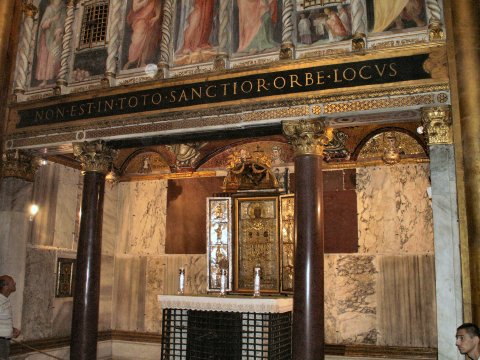

The Acheiropita icon in the Sancta Sanctorum
On Easter morning, the Pope, vested in pontificals, entered the Sancta Sanctorum, opened the small silver doors covering the feet of the icon (the doors are still sealed) and kissed the feet three times. He then chanted the versicle: Surrexit Dominus de sepulchro, alleluia, to which the assembly responded: Qui pro nobis pependit in ligno, alleluia. The Cross, which had bee removed on Good Friday, was then placed on the altar for the Pope’s veneration.

After the Pope, the members of the papal entourage venerated the icon and the Cross and then approached the Supreme Pontiff for the kiss of peace. The Pope gave the sign of peace reciting the versicle: Surrexit Dominus vere, to which each person responded: Et apparuit Simoni. Meanwhile the choir chanted a series of antiphons. Following these rites the papal procession was formed along the Via Merulana while the Pope was informed by a notary of the Baptisms which had been celebrated the previous night.

When the Apostolic See moved to Avignon, the rite of the Resurrexit fell into disuse. With the return of the Popes to Rome, the Easter statio was transferred to the Basilica of Saint Peter.

The basis and the authentic significance of these ritual sequences can be found in the words of the Gospel of Luke which describe Peter’s amazement at seeing the empty tomb and the testimony of the Eleven that the Lord was truly risen and had appeared to Simon (cf. Lk 24:12,34; Jn 20:3-10). The appearance of the Risen Lord to Peter and to the other witnesses is the theological foundation of the Church’s Easter faith (cf. Acts 1:21-22; 1 Cor 15:3-6).

The Bishop of Rome, the Successor of Peter, likewise meets the Risen Lord in the icon of the Most Holy Saviour and, after the solemn Easter proclamation of the previous night’s Vigil, he becomes on Easter Day the «first» witness to all the Church of the Gospel of the Lord’s Resurrection.

The rite of papal veneration the icon of the Resurrexit was restored for Easter of the Great Jubilee in 2000.

7 Feb 2012

Praying with Icons: Vladimir's 'Our Lady of Tenderness'

From Sr Louise over at Pilgrims Progress:


Praying with icons


God is revealed not only by words to the ears but by images to the eyes aswell. Christ is not just the word (logos) of God but also the 'image' (eikon) of the unseen God. From there we receive the word 'icon' derived from the Greek. An icon is not a painting in the sense we normally regard pieces of art, although it is an image that is painted. An icon is a window into the divine whilst living everyday life and uniting it to the realm of God. Every brushstroke leaves an imprint which is the fruit of centuries of prayer. Icons are religious images that hover between two worlds, putting into colours and shapes what cannot be grasped by the intellect. They render the invisible visible.To the Christian, an icon is a constant reminder of God's presence in his church, his home and in his life.
You gaze on the icon, but it gazes on you too. When you are looking at someone you love, and they are looking at you, there is a lot that is communicated that cannot be put in words. We need to gaze truly conversational, truly loving images…images that will return our love. Father William Hart McNichols, icon writer

Here is a short reflection on Vladimir's 'Virgin of Tenderness'.
 
Continue reading HERE.

29 Jan 2012

Narnia, icons and Rublev's Trinity!

Guest post from Sr Mary Louise O'Rourke from her blog Pilgrims Progress


Those of you who know me know that I cultivate a special love for icons. In English the word icon can be used as a general term for an image. It is often used in connection with religious imagery, and the term iconography can relate to any consistent scheme of imagery, religious or secular. However, two modern secular applications of the word icon have gained wide currency.

First, in the world of fashion and entertainment, people can be described as icon if they epitomize certain trends in style or culture. Second, in the world of computers and electronic technology certain images on the screen are known as icons. You'll also know that my acquaintance with the modern applications of the word is more with the latter! Click on the icon and you enter a whole new world of information and imagery. This modern usage of the word icon has interesting parallels with the theological use of the term!

John Paul II in his encyclical "Duodecimum saeculum" wrote: "Just as the reading of material books allows the hearing of the living word of the Lord, so also the showing of the painted icon allows those who contemplate it to accede to the mystery of salvation by the sense of sight". Our first encounter with icons may not be easy, for they are seriously different from many of our assumptions about art and imagery.Icons are different, they are a non-naturalistic form of art. The intention behind the icon is to make the invisible visible. They are a door to another world, allowing us to enter more deeply into a living relationship with the Father, Son and Spirit. In the Apocalypse St. John says: "I looked, and lo, in heaven an open door!" (Rev 4:1). Through that door he enters into the heavenly worship and the place of revelation.

In C. S Lewis' The Lion, the Witch and the Wardrobe, the children enter the strange world of Narnia through the wardrobe. There is a change in levels of consciousness and perception which can only be communicated through the metaphors and imagery of transition. Sacred iconography uses its own language of symbols and imagery to take us deeper into the mystery of Christ.


I would like to share with you a short interpretation of this icon of the Trinity.This icon represents the scene described in Genesis 18, 1-5 where Abraham is visited by three angels at the oak of Mamre and had always been interpreted as a prefiguration of God in the Three persons. In fact if we look closely at the text it interchanges between the singular and the plural as if there were only one visitor.

The Father, the Son and the Holy Spirit (l-r) complete each other in an endless circle of loving communion. The bond of trust among them is transparent.
 
We can identify:

1)in the top left background- Abraham's house. Abraham and Sarah's hospitality to the angelic visitors is rewarded with the promise of an heir.

2) middle top background- the oak of Mamre. This may also recall the tree of the Cross. This is the transformation of the Tree of Death becoming the Tree of Life because of Jesus' willingness to trust the Father in all things.

3) on the top right background- the mountain. In the Bible mountain are usually symbols of a place of encounter, of a divine revelation, it is the place of theophany. Moses met his Lord there, Jesus went often to pray and was transfigured on the mountain.

The three faces are identical and each one wears a blue garment symbolizing divinity and recalling the idea of the heavens yet each one retains their uniqueness by wearing something of their own.

LEFT: The blue garment is almost hidden by the shimmering outer garment. This is the Father who cannot be seen by his creatures and must encounter him using the eyes of the Son. Both hands grasp the staff showing his dual authority over heaven and earth.

MIDDLE:The brown garment speaks of the earth - of His humanity. 'He humbled himself and became obedient even unto death on a cross.' The gold stripe speaks of kingship.

RIGHT:The green garment is a symbol of new life. The Spirit touches the table indicating the divine life of God.


The gesture of the hands in an icon is always to be noticed. Sometimes the simple gesture of pointing can draw attention to the person or the mystery that is at the heart of an icon. The hand raised in blessing in this icon belong to the central figure, the fingers extended so as to pronounce the blessing over the chalice. 'The blessing cup which we bless is communion is a sharing in the blood of Christ' (1 Cor 10,16). The three Persons united in this communion are united through the chalice which signifies the sacrament of the Eucharist and the mystery of the Incarnation.

 
PRAYER MOMENT:

Just think: the Father, the Son and the Spirit are looking towards the one who is contemplating the icon. They are looking at you, offering you a porthole into the cosmic movement of love which exist between them. Their hands bless you in your joys and in your worries. They ask you for the same hospitality which was offered to them by Abraham and Sarah, they await the hospitality in your heart. Each one is reclining slightly towards the other. Call to mind the beloved disciple John who rested upon the heart of Christ and acknowledge that you too have this privileged space. Enjoy the sense of profound peace that this scene can bring you.