Showing posts with label Easter. Show all posts

24 Apr 2019

Easter 2019 Urbi et Orbi


Dear Brothers and Sisters, Happy Easter!

Today the Church renews the proclamation made by the first disciples: “Jesus is risen!” And from mouth to mouth, from heart to heart, there resounds a call to praise: “Alleluia, Alleluia!” On this morning of Easter, the perennial youth of the Church and of humanity as a whole, I would like to address each of you in the opening words of my recent Apostolic Exhortation devoted especially to young people:

“Christ is alive! He is our hope, and in a wonderful way he brings youth to our world. Everything he touches becomes young, new, full of life. The very first words, then, that I would like to say to every young Christian are these: Christ is alive and he wants you to be alive! He is in you, he is with you and he never abandons you. However far you may wander, he is always there, the Risen One. He calls you and he waits for you to return to him and start over again. When you feel you are growing old out of sorrow, resentment or fear, doubt or failure, he will always be there to restore your strength and your hope” (Christus Vivit, 1-2).

Dear brothers and sisters, this message is also addressed to every person in the world. The resurrection of Christ is the principle of new life for every man and every woman, for true renewal always begins from the heart, from the conscience. Yet Easter is also the beginning of the new world, set free from the slavery of sin and death: the world open at last to the Kingdom of God, a Kingdom of love, peace and fraternity.

Christ is alive and he remains with us. Risen, he shows us the light of his face, and he does not abandon all those experiencing hardship, pain and sorrow. May he, the Living One, be hope for the beloved Syrian people, victims of an ongoing conflict to which we risk becoming ever more resigned and even indifferent. Now is instead the time for a renewed commitment for a political solution able to respond to people’s legitimate hopes for freedom, peace and justice, confront the humanitarian crisis and favour the secure re-entry of the homeless, along with all those who have taken refuge in neighbouring countries, especially Lebanon and Jordan.

Easter makes us keep our eyes fixed on the Middle East, torn by continuing divisions and tensions. May the Christians of the region patiently persevere in their witness to the Risen Lord and to the victory of life over death. I think in particular of the people of Yemen, especially the children, exhausted by hunger and war. May the light of Easter illumine all government leaders and peoples in the Middle East, beginning with Israelis and Palestinians, and spur them to alleviate such great suffering and to pursue a future of peace and stability.

May conflict and bloodshed cease in Libya, where defenceless people are once more dying in recent weeks and many families have been forced to abandon their homes. I urge the parties involved to choose dialogue over force and to avoid reopening wounds left by a decade of conflicts and political instability.

May the Living Christ grant his peace to the entire beloved African continent, still rife with social tensions, conflicts and at times violent forms of extremism that leave in their wake insecurity, destruction and death, especially in Burkina Faso, Mali, Niger, Nigeria and Cameroon. I think too of Sudan, presently experiencing a moment of political uncertainty; it is my hope that all voices will be heard, and that everyone will work to enable the country to find the freedom, development and well-being to which it has long aspired.

May the Risen Lord accompany the efforts of the civil and religious authorities of South Sudan, sustained by the fruits of the spiritual retreat held several days ago here in the Vatican. May a new page open in the history of that country, in which all political, social and religious components actively commit themselves to the pursuit of the common good and the reconciliation of the nation.

May this Easter bring comfort to the people of the eastern regions of Ukraine, who suffer from the continuing conflict. May the Lord encourage initiatives of humanitarian aid and those aimed at pursuing a lasting peace.

May the joy of the resurrection fill the hearts of those who on the American continent are experiencing the effects of difficult political and economic situations. I think in particular of the Venezuelan people, of all those who lack the minimal conditions for leading a dignified and secure life due to a crisis that endures and worsens. May the Lord grant that all those with political responsibilities may work to end social injustices, abuses and acts of violence, and take the concrete steps needed to heal divisions and offer the population the help they need.

May the Risen Lord shed his light on the efforts made in Nicaragua to find as rapidly as possible a peaceful negotiated solution for the benefit of the entire Nicaraguan people.
Before the many sufferings of our time, may the Lord of life not find us cold and indifferent. May he make us builders of bridges, not walls. May the One who gives us his peace end the roar of arms, both in areas of conflict and in our cities, and inspire the leaders of nations to work for an end to the arms race and the troubling spread of weaponry, especially in the economically more advanced countries. May the Risen Christ, who flung open the doors of the tomb, open our hearts to the needs of the disadvantaged, the vulnerable, the poor, the unemployed, the marginalized, and all those who knock at our door in search of bread, refuge, and the recognition of their dignity.

Dear brothers and sisters, Christ is alive! He is hope and youth for each of us and for the entire world. May we let ourselves be renewed by him! Happy Easter!

On Easter Night, "In My Life, Where Am I Going? What Is The Stone I Need To Remove?" - Pope Francis


HOMILY OF POPE FRANCIS
THE EASTER VIGIL IN THE HOLY NIGHT
ST PETER'S BASILICA
20 APRIL 2019

The women bring spices to the tomb, but they fear that their journey is in vain, since a large stone bars the entrance to the sepulcher. The journey of those women is also our own journey; it resembles the journey of salvation that we have made this evening. At times, it seems that everything comes up against a stone: the beauty of creation against the tragedy of sin; liberation from slavery against infidelity to the covenant; the promises of the prophets against the listless indifference of the people. So too, in the history of the Church and in our own personal history. It seems that the steps we take never take us to the goal. We can be tempted to think that dashed hope is the bleak law of life.


Today however we see that our journey is not in vain; it does not come up against a tombstone. A single phrase astounds the woman and changes history: “Why do you seek the living among the dead?” (Lk 24:5). Why do you think that everything is hopeless, that no one can take away your own tombstones? Why do you give into resignation and failure? Easter is the feast of tombstones taken away, rocks rolled aside. God takes away even the hardest stones against which our hopes and expectations crash: death, sin, fear, worldliness. Human history does not end before a tombstone, because today it encounters the “living stone” (cf. 1 Pet 2:4), the risen Jesus. We, as Church, are built on him, and, even when we grow disheartened and tempted to judge everything in the light of our failures, he comes to make all things new, tooverturn our every disappointment. Each of us is called tonight to rediscover in the Risen Christ the one who rolls back from our heart the heaviest of stones. So let us first ask: What is the stone that I need to remove, what is its name?


Often what blocks hope is the stone of discouragement. Once we start thinking that everything is going badly and that things can’t get worse, we lose heart and come to believe that death is stronger than life. We become cynical, negative and despondent. Stone upon stone, we build within ourselves a monument to our own dissatisfaction: the sepulcher of hope. Life becomes a succession of complaints and we grow sick in spirit. A kind of tomb psychology takes over: everything ends there, with no hope of emerging alive. But at that moment, we hear once more the insistent question of Easter: Why do you seek the living among the dead? The Lord is not to be found in resignation. He is risen; he is not there. Don’t seek him where you will never find him: he is not the God of the dead but of the living (cf. Mk 22:32). Do not bury hope!


There is another stone that often seals the heart shut: the stone of sin. Sin seduces; it promises things easy and quick, prosperity and success, but then leaves behind only solitude and death. Sin is looking for life among the dead, for the meaning of life in things that pass away. Why do you seek the living among the dead? Why not make up your mind to abandon that sin which, like a stone before the entrance to your heart, keeps God’s light from entering in? Why not prefer Jesus, the true light (cf. Jn1:9), to the glitter of wealth, career, pride and pleasure? Why not tell the empty things of this world that you no longer live for them, but for the Lord of life?


3 Apr 2018

Easter Tuesday - St Mary Magdalene - The witness of the Apostle to the Apostles


John 20:1-9
But Mary stood weeping outside the tomb. As she wept, she bent over to look into the tomb; and she saw two angels in white, sitting where the body of Jesus had been lying, one at the head and the other at the feet. They said to her, “Woman, why are you weeping?” She said to them, “They have taken away my Lord, and I do not know where they have laid him.” When she had said this, she turned around and saw Jesus standing there, but she did not know that it was Jesus. Jesus said to her, “Woman, why are you weeping? Whom are you looking for?” Supposing him to be the gardener, she said to him, “Sir, if you have carried him away, tell me where you have laid him, and I will take him away.” Jesus said to her, “Mary!” She turned and said to him in Hebrew, “Rabbouni!” (which means Teacher). Jesus said to her, “Do not hold on to me, because I have not yet ascended to the Father. But go to my brothers and say to them, ‘I am ascending to my Father and your Father, to my God and your God.’” Mary Magdalene went and announced to the disciples, “I have seen the Lord”; and she told them that he had said these things to her.

I never suspected
Resurrection
         and to be so painful
          to leave me weeping
With Joy
to have met you, alive and smiling, outside an empty tomb
With regret
not because I've lost you
       but because I've lost you in how I had you -
in understandable, touchable, kissable, clingable humanity
cling to what we had, our past.

But I know that......if I cling
you cannot ascend and
I will be left clinging to your former self
......unable to receive your present spirit.

Daily Reflection for Lent and Easter Week Ron Rolheiser OMI


Fr James Martin SJ reminds us of a few important things about Mary:

  • First, she was the first one, according to the Gospel of John, to whom the Risen Christ appeared after the Resurrection. He could have chosen anyone to whom to appear, and he chose Mary. She is then asked to announce the good news to the disciples, thus her great title "Apostle to the Apostles,..." the one who is sent to the one who is sent. 


  • Second, she was not a prostitute. This unfortunate tradition comes from, among other sources, a homily from Pope St. Gregory the Great in which he conflated Mary with a prostitute in the Gospels. This is false. Jesus "drove seven demons from her" (which certainly prompted her gratitude and may have led her to follow him) but she was not a prostitute. (Interestingly, when you visit the Holy Land you see that the first town that you come upon on the Sea of Galilee when you travel from Nazareth to the Sea of Galilee, is Magdala. She may have been one of the first he met in that area.)


  • Third, between the time that the Risen Christ appeared to Mary after the Resurrection and when she announced the Good News to the rest of the disciples, she was the church on earth. That is, only she, among all mortals, understood the full Paschal Mystery. 


1 Apr 2018

Jesus Christ is risen today


Easter Vigil Homily of Fr Abbot Brendan Coffey OSB - Glenstal

Glenstal Abbey
Easter Vigil 2018
Fr Abbot Brendan Coffey OSB  
1 Apr 2018

Three women, Mary of Magdala, Mary the mother of James, and Salome; three women stumble across a discovery which will literally shake the very foundations of the earth. They were on their way to perform a simple and traditional act of compassion. They felt sadness and they felt sorrow, as we so often do in our own lives. What they did not know was that everything was about to change.


On this Most Holy Night all around the world, from Sidney to San Francisco, from Boston to Bodyke, Christians gather under the Easter Moon in the light of the paschal flame. This, the most significant event in human history, began in the depts of the tomb, hidden and unseen; just like creation itself. Everyone had either gone back to their homes or had run away! We have listened to the story of salvation from the very dawn of creation until this moment. We have listened to the fulfilment of promises and covenants, for this is the night!

        The Resurrection opens our eyes to behold the truth of the account of creation, “God saw everything that he had made, and behold, it was very good”. Everything revolves around that great moment and those brave women. They had followed Jesus, they had listened to his words, they had felt understood by him and they had accompanied him to the very end, to the cross. They arrive at the entrance to the tomb and see that the stone is rolled back. This is the supreme moment. The women face their fear, they enter the tomb and it is empty!

        Something new has happened. “Do not be alarmed;” said the young man in the white robe, “you are looking for Jesus of Nazareth, who was crucified. He has been raised; he is not here.” These three women do not get to see the Risen Lord at this moment. Instead the young man asks them to remember; remember Galilee and it is precisely this loving remembrance of the Master that eventually enables them to overcome their fear and bring the message of the Resurrection to the Apostles.

        Easter tells us that God has done something. Time is changed, as is history, we now call it Anno Domini. He is our history and so we tell our long story. “In Abel he was slain; in Isaac bound; in Jacob a stranger; in Joseph sold; in Moses exposed; in David persecuted; in the prophets dishonoured.” He is our tears and our hidden joy. He is the beggar to whom I give a coin and he is the secret rich reward which returns to the giver. He is in our suffering and misery as in our victory. He is in our weakness and he is our strength. He is even in the midst of our sin as mercy, patience and life. Caro cardo salutis, the flesh is the hinge of salvation.

        The Resurrection as an event belongs not only to the past but also to the present. The three women did not need to see him in that tomb, because I can meet the Risen Christ for myself here and now; just like Saint Paul, the two disciples on the road to Emmaus, the apostles and so many, many others through the centuries. Christ rose again, twenty centuries ago, but he is the Risen Christ as long as time continues. We do not discover the Gospel beginning at the beginning and it does not unfold as a story which one can believe or disbelieve. It begins when I meet the Risen Lord. He it is who lives on every page I read. He it is who is present here tonight with us.

          In a few moments we will move to the font, the Church’s womb, and bless the Easter water; the water of life. Then we will arrive at the altar and we will eat and drink and He will once more be present among us as he promised. This is the night when I can behold his light in darkness, hear the story of my salvation in his word, be touched by the cleansing waters of baptism and sit at table with him as He breaks the bread. If I meet him here tonight, then I will leave here a changed person and I will see the world and my brothers and sisters differently under this Easter Moon. The presence of the Risen Lord has become the blood marking the doorposts of our hearts. Open your heart, open your life and let the Risen Lord enter in. He has been waiting since the dawn of creation for this moment to give to you the gift of life.

Now that we have visited the tomb with the women, let us also go back with those women to our homes and places of work and bring this encounter with us as we proclaim the Resurrection.

          “Christ my hope, has risen: he goes before you into Galilee.”

2018 Easter Urbi et Orbi - The last word is the resurrection


The Pope greeted the faithful with “Jesus is risen from the dead!”

He then said that the image that Jesus used of the grain of what that falls to the earth and dies to prophesy his own death and resurrection.

Jesus, God’s grain of wheat

“Jesus, the grain of wheat sowed by God in the furrows of the earth, died, killed by the sin of the world,” Pope Francis said. After two days in the tomb, he was raised on the third day, for “God’s love in all its power” was released and made manifest allowing us to celebrate today “the Easter of Christ the Lord.”

The Pope reminds us that Jesus is the grain of wheat which by the power of His love “humbles itself and gives itself to the very end, and thus truly renews the world.” It is a power that still bears fruit even though the world bears so many “furrows” of violence and injustice. That fruit is hope, for “we Christians believe and know that Christ’s resurrection is the true hope of the world,” Pope Francis said.

The Holy Father then prayed for the gift of peace, naming several areas in the world.

God has the last word

Finally, Pope Francis reminds us of what the women heard at the tomb — that “Death, solitude and fear are not the last word.” The word that overpowers these words is “a word that only God can speak: it is the word of the resurrection.” 

Concluding remarks

After the blessings, the pope extended Easter greetings to pilgrims from Italy, and from other parts of the world, as well as to all those viewing through various media outlets.

He prayed that the joy of the Risen Lord might comfort families, especially the elderly who are “the precious memory of society, ” and the young, “the future of the church and the humanity.”

He thanked everyone present for having participated in the celebration of Easter which is the most important feast of our faith.

Lastly, he gave special thanks for the flowers which came from Holland and he led the crowd in applauding the people from Holland present in the square.

Pope Francis then ended with his customary, “Please do not forget to pray for me,” and “Enjoy your lunch.”

Venerating the Resurrexit Icon


Christus resurrexit! Alleluia
Surrexit Dominus vere, Alleluia
Et apparuit Simoni, Alleluia

In Rome this morning, during the papal Mass to celebrate Easter Sunday from St Peter's Square Pope Francis participated in an ancient rite of honouring the icon of the Holy Saviour - the Resurrexit. 
As the successor to St Peter - one of the first witnesses to the Resurrection after the Apostle to the Apostle Mary of Magdala - the rite commemorates the witness to the Resurrection by Peter's successors instituted over 1,000 years ago which fell into disuse when the Popes went to Avignon in 1309 which was restored during the Great Jubilee in 2000. Details of the ceremony are below from the Office of Papal Liturgies.


************************
From Vatican.va:

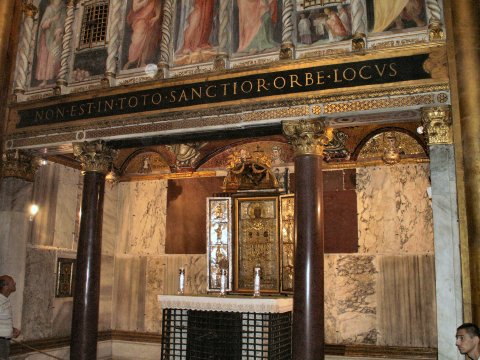
In the twelfth century, the Bishop of Rome, following an ancient tradition, would pause in prayer at the Oratory of Saint Lawrence in the Lateran, nowadays the Shrine of the Holy Stairs, before setting out in procession from Saint John Lateran to Saint Mary Major, where he would chant the Solemn Mass of Easter Morning. The Oratory, still known as the Sancta Sanctorum, was considered one of the most sacred places in Rome. A celebrated relic of the Holy Cross was venerated there and then, as now, the Shrine housed the Acheiropita (not painted by human hands) icon of the Saviour.

Icon of the Holy Saviour commissioned for the Resurrexit rite
for the Great Jubilee 2000. The original sits in the chapel
of the Scala Sancta in Rome
The [original] icon, probably brought to Rome from the East, was already mentioned in the Liber Pontificalis under the entry for Pope Stephen III (752-757). A full representation of the enthroned Saviour, it was painted on cloth applied to a wooden tablet measuring approximately 1.52 m. by 70 cm. The icon has been frequently restored, most recently in 1995-1996. The only part presently visible is the Face of the Lord painted on a silken cloth superimposed upon the original. The rest of the icon is covered by a sheet of silver.

The cult of the icon of the Most Holy Saviour, unlike that of the Veronica veil kept in the Vatican Basilica or other ancient Roman icons, was the only one to become part of the official celebrations of the Roman Liturgy. This is evident from the Liber Politicus (Ordo Romanus XI), a ceremonial book written between 1143-1144, and the Liber Censuum Romanae Ecclesiae (Ordo Romanus XII), compiled about 1192 by Cencius Camerarius, the future Pope Honorius III. These ceremonial books not only show that a procession with the Acheiropita took place on the night of the Assumption, but also that the icon was venerated during Holy Week.


The original Acheiropita icon in the Sancta Sanctorum
On Easter morning, the Pope, vested in pontificals, entered the Sancta Sanctorum, opened the small silver doors covering the feet of the icon (the doors are still sealed) and kissed the feet three times. He then chanted the versicle: Surrexit Dominus de sepulchro, alleluia, to which the assembly responded: Qui pro nobis pependit in ligno, alleluia. The Cross, which had bee removed on Good Friday, was then placed on the altar for the Pope’s veneration.

After the Pope, the members of the papal entourage venerated the icon and the Cross and then approached the Supreme Pontiff for the kiss of peace. The Pope gave the sign of peace reciting the versicle: Surrexit Dominus vere, to which each person responded: Et apparuit Simoni. Meanwhile the choir chanted a series of antiphons. Following these rites the papal procession was formed along the Via Merulana while the Pope was informed by a notary of the Baptisms which had been celebrated the previous night.

When the Apostolic See moved to Avignon, the rite of the Resurrexit fell into disuse. With the return of the Popes to Rome, the Easter statio was transferred to the Basilica of Saint Peter.

The basis and the authentic significance of these ritual sequences can be found in the words of the Gospel of Luke which describe Peter’s amazement at seeing the empty tomb and the testimony of the Eleven that the Lord was truly risen and had appeared to Simon (cf. Lk 24:12,34; Jn 20:3-10). The appearance of the Risen Lord to Peter and to the other witnesses is the theological foundation of the Church’s Easter faith (cf. Acts 1:21-22; 1 Cor 15:3-6).

The Bishop of Rome, the Successor of Peter, likewise meets the Risen Lord in the icon of the Most Holy Saviour and, after the solemn Easter proclamation of the previous night’s Vigil, he becomes on Easter Day the «first» witness to all the Church of the Gospel of the Lord’s Resurrection.

The rite of papal veneration the icon of the Resurrexit was restored for Easter of the Great Jubilee in 2000.

31 Mar 2018

Easter Sunday 2018


ALLELUIA, ALLELUIA !!!! 
CHRISTUS RESURREXIT, RESURREXIT VERES  
ALLELUIA, ALLELUIA!!!

ALLELUIA, ALLELUIA!!!! 
CHRIST IS RISEN, HE IS RISEN INDEED, 
ALLELUIA, ALLELUIA!!!


Christians, to the Paschal Victim Offer your thankful praises!A Lamb the sheep redeems: Christ, who only is sinless, Reconciles sinners to the Father.Death and life have contended in that combat stupendous: The Prince of life, who died, reigns immortal.Speak, Mary, declaring What you saw, wayfaring. "The tomb of Christ, who is living, The glory of Jesus' resurrection;Bright angels attesting, The shroud and napkin resting. Yes, my Christ my hope is arisen:To Galilee he goes before you." Christ indeed from death is risen, our new life obtaining. Have mercy, victor King, ever reigning!Amen. Alleluia
(Sequence from Mass on Easter Sunday)

On this joyous Easter morn, the SS102fm team wish you every joy and blessing of this Easter Day to you and yours! On this weeks programme, we mark Resurrection Day with an extended gospel reflection with Fr Frank Duhig. 

You can listen to the podcast of this weeks full programme HERE.

Gospel - John 20:1-9


Early on the first day of the week, while it was still dark, Mary Magdalene came to the tomb and saw that the stone had been removed from the tomb. So she ran and went to Simon Peter and the other disciple, the one whom Jesus loved, and said to them, “They have taken the Lord out of the tomb, and we do not know where they have laid him.” Then Peter and the other disciple set out and went toward the tomb. The two were running together, but the other disciple outran Peter and reached the tomb first. He bent down to look in and saw the linen wrappings lying there, but he did not go in. Then Simon Peter came, following him, and went into the tomb. He saw the linen wrappings lying there, and the cloth that had been on Jesus’ head, not lying with the linen wrappings but rolled up in a place by itself. Then the other disciple, who reached the tomb first, also went in, and he saw and believed; for as yet they did not understand the scripture, that he must rise from the dead.

Reflections on this Sunday's gospel:


Easter Message of the Patriarchs and Heads of Churches in Jerusalem 2018

“Blessed be the God and Father of our Lord Jesus Christ! By his great mercy he has given us a new birth into a living hope through the resurrection of Jesus Christ from the dead.” (1 Peter 1.3)

We, the Patriarchs and Heads of Churches in Jerusalem, jointly send our Easter greetings and joyful proclamation of the Resurrection of our Lord and Saviour to all people everywhere. From Jerusalem, the place where Christ was raised from the dead, we offer our blessings to the faithful who are celebrating the Feast of the Resurrection at this blessed time.

For over two millennia pilgrims have been following the footsteps of Jesus and streaming to Jerusalem to behold the empty tomb. The Resurrection of our Lord was an historic event which encompassed the whole cosmic order and renewed the face of the entire creation. This is the time where the Christian Family worldwide remembers God’s redeeming work in the life, death, and resurrection of Jesus Christ. Jerusalem, the City of Hope and the Resurrection, remains a sacred symbol of God’s salvation and a reflection of the heavenly Jerusalem that is yet to come. In fact this sacred, communal, and spiritual character of Jerusalem continues to be a beacon for hope, peace, and life for the people of this region and the entire world. We pray that we here in the Holy Land may continue unhindered to fulfil our sacred duty as manifestations of the living Gospel to serve the poor, seek justice and walk in the light and love of the risen Christ.

The Holy Gospel tells us that before Jesus Christ ascended to joy he suffered pain, and before entering into glory he was crucified. We pray to almighty God that people who are walking in the way of the cross may find it the way of hope, peace, and life. We hold in our prayers all those who are suffering in our region and throughout the world, and also, all those who are suffering in silence; for refugees, asylum seekers, and displaced people, for those who live under oppression, for those in want and deprivation, for all victims of violence and discrimination, and for all who strive for justice and reconciliation.

The Resurrection of our Lord Jesus Christ from the dead is a constant reminder that the powers of evil and death will not overcome life, instead life has victory over death and darkness. God has reconciled us to Himself in Jesus Christ and called us to the ministry of reconciliation. May the risen Lord strengthen us with His Holy Spirit in order to go forth in his risen life to love and serve and bring the good news to all.

Christ is risen. Alleluia! He is risen, indeed. Alleluia!

+Patriarch Theophilos III, Greek Orthodox Patriarchate

+Patriarch Nourhan Manougian, Armenian Apostolic Orthodox Patriarchate

+Archbishop Pierbattista Pizzaballa, Apostolic Administrator, Latin Patriarchate

+Fr. Francesco Patton, ofm, Custos of the Holy Land

+Archbishop Anba Antonious, Coptic Orthodox Patriarchate, Jerusalem

+Archbishop Swerios Malki Murad, Syrian Orthodox Patriarchate

+Archbishop Aba Embakob, Ethiopian Orthodox Patriarchate

+Archbishop Yaser AL-Ayyash, Greek-Melkite-Catholic Patriarchate

+Archbishop Mosa El-Hage, Maronite Patriarchal Exarchate

+Archbishop Suheil Dawani, Episcopal Church of Jerusalem and the Middle East

+Bishop Ibrahim Sani Azar, Evangelical Lutheran Church in Jordan and the Holy Land

+Bishop Pierre Malki, Syrian Catholic Patriarchal Exarchate

+Most Rev. Krikor-Okosdinos Coussa, Armenian Catholic Patriarchal Exarchate

Easter Vigil Homily of Pope Francis in St. Peter's Basilica


Following is the text of the Holy Father’s homily during the Easter Vigil, March 31, 2018, in St. Peter’s Basilica. The Pope also administered the sacraments of Christian initiation to eight new members of the Church from Albania, Italy, Nigeria, Peru, and United States.

*********************

We began this celebration outside, plunged in the darkness of the night and the cold. We felt an oppressive silence at the death of the Lord, a silence with which each of us can identify, a silence that penetrates to the depths of the heart of every disciple, who stands wordless before the cross.
These are the hours when the disciple stands speechless in pain at the death of Jesus. What words can be spoken at such a moment? The disciple keeps silent in the awareness of his or her own reactions during those crucial hours in the Lord’s life. Before the injustice that condemned the Master, his disciples were silent. Before the calumnies and the false testimony that the Master endured, his disciples said nothing. During the trying, painful hours of the Passion, his disciples dramatically experienced their inability to put their lives on the line to speak out on behalf of the Master. What is more, not only did they not acknowledge him: they hid, they escaped, they kept silent (cf. Jn 18:25-27).

It is the silent night of the disciples who remained numb, paralyzed and uncertain of what to do amid so many painful and disheartening situations. It is also that of today’s disciples, speechless in the face of situations we cannot control, that make us feel and, even worse, believe that nothing can be done to reverse all the injustices that our brothers and sisters are experiencing in their flesh.

It is the silent night of those disciples who are disoriented because they are plunged in a crushing routine that robs memory, silences hope and leads to thinking that “this is the way things have always been done”. Those disciples who, overwhelmed, have nothing to say and end up considering “normal” and unexceptional the words of Caiaphas: “Can you not see that it is better for you to have one man die for the people than to have the whole nation destroyed?” (Jn 11:50).

Amid our silence, our overpowering silence, the stones begin to cry out (cf. Lk 19:40)1 and to clear the way for the greatest message that history has ever heard: “He is not here, for he has been raised” (Mt 28:6). The stone before the tomb cried out and proclaimed the opening of a new way for all. Creation itself was the first to echo the triumph of life over all that had attempted to silence and stifle the joy of the Gospel. The stone before the tomb was the first to leap up and in its own way intone a song of praise and wonder, of joy and hope, in which all of us are invited to join.

Yesterday, we joined the women in contemplating “the one who was pierced” (cf. Jn 19:36; cf. Zech 12:10). Today, with them, we are invited to contemplate the empty tomb and to hear the words of the angel: “Do not be afraid... for he has been raised” (Mt 28:5-6). Those words should affect our deepest convictions and certainties, the ways we judge and deal with the events of our daily lives, especially the ways we relate to others. The empty tomb should challenge us and rally our spirits. It should make us think, but above all it should encourage us to trust and believe that God “happens” in every situation and every person, and that his light can shine in the least expected and most hidden corners of our lives. He rose from the dead, from that place where nobody waits for anything, and now he waits for us – as he did the women – to enable us to share in his saving work. On this basis and with this strength, we Christians place our lives and our energy, our intelligence, our affections and our will, at the service of discovering, and above all creating, paths of dignity.

He is not here... he is risen! This is the message that sustains our hope and turns it into concrete gestures of charity. How greatly we need to let our frailty be anointed by this experience! How greatly we need to let our faith be revived! How greatly we need our myopic horizons to be challenged and renewed by this message! Christ is risen, and with him he makes our hope and creativity rise, so that we can face our present problems in the knowledge that we are not alone.
To celebrate Easter is to believe once more that God constantly breaks into our personal histories, challenging our “conventions”, those fixed ways of thinking and acting that end up paralyzing us. To celebrate Easter is to allow Jesus to triumph over the craven fear that so often assails us and tries to bury every kind of hope.

The stone before the tomb shared in this, the women of the Gospel shared in this, and now the invitation is addressed once more to you and to me. An invitation to break out of our routines and to renew our lives, our decisions and our existence. An invitation that must be directed to where we stand, what we are doing and what we are, with the “power ratio” that is ours. Do we want to share in this message of life or do we prefer simply to continue standing speechless before events as they happen?

He is not here... he is raised! And he awaits you in Gaiilee. He invites you to go back to the time and place of your first love and he says to you: Do not be afraid, follow me.

“I tell you, if these were silent, the stones would shout out”.

17 Apr 2017

WoF - Easter Sunday is concluded.......now what?


From Word on Fire:

It is now the quiet time... The Triduum services are completed. The Easter Vigil (the "mother" of all vigils) has been concluded for another year — to varying degrees of liturgical success in each individual parish, I am sure. The crowds that seem to magically appear and arrive for Easter Sunday Mass have come and gone. Candidates and catechumens have been received into the Church. Easter egg hunts are wrapped up as well as family Easter gatherings. Now what?

Is Easter Sunday 201[7] to now be shelved away as a nice memory testified to by photos posted on Facebook? An opportunity for people to dress up and have good family time? Does the message of Easter end with the last Easter Sunday Mass? Liturgically, the Church says "no." We have the Easter Season — a needed time to reflect on the truth of the resurrection and to look to the coming of the Holy Spirit at Pentecost. "Liturgical" here is important and it does certainly influence who we are but here I am specifically wondering about our day-to-day life outside the parish walls. Does Easter affect and shape who we are or does it remain a beautiful annual ritual that is left behind in the crowded Easter Sunday church parking lot? Do we take Easter with us into the streets of our lives and of our world or do we keep it hidden away behind locked doors — doors of a private faith, spirituality and morality, doors of our resignations and sense of hopelessness in the face of the pain of our world, doors of our fear to offend the accepted norm? 

Easter cannot stay hidden away. Easter demands that we go into the streets - no matter how uncomfortable it makes us or others. 

In Matthew's account of the resurrection there is an interesting instruction that is given to the women who came to the tomb early that morning by the angel sitting on top of the rolled-away, heavy stone that had been used to seal the tomb. "...go quickly and tell his disciples that he has risen from the dead, and behold, he is going before you to Galilee; there you will see him." (Mt. 28:7) 

The resurrected Lord does not fear the world and its violence and sad resignation because he has overcome all the sin of the world through the love of the Father. The resurrected Lord goes before you to Galilee. He goes into the streets of the world and the expectation and instruction given by the angel of the resurrection is that the followers of Christ do the same! 

Easter, if it is to be authentic and be more than a nice memory, cannot stay hidden behind any locked door and neither will it allow us to remain hidden.

There is a culture of fear that continually whispers to us that nothing can change, that we cannot really do anything in the face of the injustice of our world, that we should look upon ourselves and our world with hopeless eyes. The culture of fear is arrogant in its pride and thinks that it alone has words to speak. The culture of fear lies. The culture of fear would convince us that we are its children. 

We are not children of the culture of fear. We are children of the resurrection! We are sons and daughters of God! We have nothing to fear and we have words, new words to speak to our world and to one another! The angel announces that the risen Lord is going to Galilee and that there the disciples will see him. The implication is more than apparent, the disciples are meant to go and meet the Lord who goes ahead of them. (The Lord always goes ahead of us.) They are meant to go out into the street and carry the truth of the resurrection into the world! 

It is not enough to stay behind locked doors, no matter how pretty and gilded those doors may be and no matter how many other people may also be content to remain there also. If we do so then the culture of fear wins and our lives become exceedingly small, constrained and life-denying. Joy is found only in following the risen Lord to wherever he might lead.

One further thought: there is no time to waste. The angel instructs the women: go quickly. We are each allotted only a certain number of Easters in our lives here on earth. There is no time to lose, both for the work needing to be done in our own hearts as well as the work needing to be done in our world. In the light of the resurrection we must make use of every moment given to us. When all is said and done, we will each have to give an accounting of how we have lived the Easters we have been given in our lifetime. 

We are sons and daughters of the resurrection of our Lord! The Easter mystery is placed in our hearts and entrusted to us and it cannot remain behind locked doors, it demands to be taken out to the streets of our world!

16 Apr 2017

Pope delivers his Urbi et Orbi message - Vatican Radio


(Vatican Radio) Pope Francis on Easter Sunday gave his tradition Urbi et Orbi (to the city and the world) message from the central loggia of St Peter's Basilica. In it he prayed that Risen Lord would walk beside those who are marginalized who are victimized by old and new forms of slavery. The Holy Father also prayed the Lord would bring peace to the Middle East, come to the aid of Ukraine, shed his blessing upon the continent of Europe and  build bridges of dialogue in Latin America. 

The English language translation of the Pope's Urbi et Orbi message is available HERE

Easter 'Urbi et Orbi' Message of Pope Francis - full text and video

Because He Lives!


Pope Francis venerates the 'Resurrexit' in Rome


Christus resurrexit! Alleluia
Surrexit Dominus vere, Alleluia
Et apparuit Simoni, Alleluia

In Rome this morning, during the papal Mass to celebrate Easter Sunday from St Peter's Square Pope Francis participated in an ancient rite of honouring the icon of the Holy Saviour - the Resurrexit. 


As successor to St Peter - one of the first witnesses to the Resurrection after the Apostle to the Apostle Mary of Magdala - the rite commemorates the witness to the Resurrection by Peter's successors instituted over 1,000 years ago which fell into disuse when the Popes went to Avignon in 1309 which was restored during the Great Jubilee in 2000. Details of the ceremony are below from the Office of Papal Liturgies.


************************

From Vatican.va:

In the twelfth century, the Bishop of Rome, following an ancient tradition, would pause in prayer at the Oratory of Saint Lawrence in the Lateran, nowadays the Shrine of the Holy Stairs, before setting out in procession from Saint John Lateran to Saint Mary Major, where he would chant the Solemn Mass of Easter Morning. The Oratory, still known as the Sancta Sanctorum, was considered one of the most sacred places in Rome. A celebrated relic of the Holy Cross was venerated there and then, as now, the Shrine housed the Acheiropita (not painted by human hands) icon of the Saviour.

Icon of the Holy Saviour commissioned for the Resurrexit rite
for the Great Jubilee 2000. The original sits in the chapel
of the Scala Sancta in Rome
The [original] icon, probably brought to Rome from the East, was already mentioned in the Liber Pontificalis under the entry for Pope Stephen III (752-757). A full representation of the enthroned Saviour, it was painted on cloth applied to a wooden tablet measuring approximately 1.52 m. by 70 cm. The icon has been frequently restored, most recently in 1995-1996. The only part presently visible is the Face of the Lord painted on a silken cloth superimposed upon the original. The rest of the icon is covered by a sheet of silver.

The cult of the icon of the Most Holy Saviour, unlike that of the Veronica veil kept in the Vatican Basilica or other ancient Roman icons, was the only one to become part of the official celebrations of the Roman Liturgy. This is evident from the Liber Politicus (Ordo Romanus XI), a ceremonial book written between 1143-1144, and the Liber Censuum Romanae Ecclesiae (Ordo Romanus XII), compiled about 1192 by Cencius Camerarius, the future Pope Honorius III. These ceremonial books not only show that a procession with the Acheiropita took place on the night of the Assumption, but also that the icon was venerated during Holy Week.


The original Acheiropita icon in the Sancta Sanctorum
On Easter morning, the Pope, vested in pontificals, entered the Sancta Sanctorum, opened the small silver doors covering the feet of the icon (the doors are still sealed) and kissed the feet three times. He then chanted the versicle: Surrexit Dominus de sepulchro, alleluia, to which the assembly responded: Qui pro nobis pependit in ligno, alleluia. The Cross, which had bee removed on Good Friday, was then placed on the altar for the Pope’s veneration.

After the Pope, the members of the papal entourage venerated the icon and the Cross and then approached the Supreme Pontiff for the kiss of peace. The Pope gave the sign of peace reciting the versicle: Surrexit Dominus vere, to which each person responded: Et apparuit Simoni. Meanwhile the choir chanted a series of antiphons. Following these rites the papal procession was formed along the Via Merulana while the Pope was informed by a notary of the Baptisms which had been celebrated the previous night.

When the Apostolic See moved to Avignon, the rite of the Resurrexit fell into disuse. With the return of the Popes to Rome, the Easter statio was transferred to the Basilica of Saint Peter.

The basis and the authentic significance of these ritual sequences can be found in the words of the Gospel of Luke which describe Peter’s amazement at seeing the empty tomb and the testimony of the Eleven that the Lord was truly risen and had appeared to Simon (cf. Lk 24:12,34; Jn 20:3-10). The appearance of the Risen Lord to Peter and to the other witnesses is the theological foundation of the Church’s Easter faith (cf. Acts 1:21-22; 1 Cor 15:3-6).

The Bishop of Rome, the Successor of Peter, likewise meets the Risen Lord in the icon of the Most Holy Saviour and, after the solemn Easter proclamation of the previous night’s Vigil, he becomes on Easter Day the «first» witness to all the Church of the Gospel of the Lord’s Resurrection.

The rite of papal veneration the icon of the Resurrexit was restored for Easter of the Great Jubilee in 2000.

Paschal Message of Patriarch Kirill of Moscow And All Russia


Paschal Message of Patriarch Kirill of Moscow And All Russia
to the Archpastors, Pastors, Deacons, Monks and Nuns
and All the Faithful Children of the Russian Orthodox Church

Behold, what manner of love the Father hath bestowed upon us, that we should be called the sons of God (1 Jn 3:1)

Your Graces the archpastors, all-honourable priests,
God-loving monks and nuns, dear brothers and sisters:

 CHRIST IS RISEN!

With these joyous and life-affirming words I greet you, my beloved, from the depths of my heart and congratulate you all on the great and saving feast of Pascha.

The Church calls this day ‘the feast of feasts and the festival of festivals’ through the lips of one of her great ecumenical teachers, St. Gregory the Theologian. Herein is contained a profound spiritual meaning, for ‘Pascha is as far exalted above all – not only those which are merely human and crawl on the ground but also those which are of Christ himself and are celebrated in for him – as the sun is exalted above the stars’ (Oration 45: On Holy Pascha). The glorious resurrection of the Lord Jesus, which has become the most important event in the history of the salvation of the human race, contains the very meaning and profound essence of our faith, the heart and mighty power of the Christian message to the world. In these days what we preach may be encapsulated in these three words: Christ is risen! ‘In saying this, what more can I say? All has been said!’ proclaims St. Philaret, Metropolitan of Moscow (Homily for Holy Pascha, 18 April 1826).

Patriarchal Encyclical For Holy Pascha 2017 - Bartholomew I Archbishop of Constantinople-New Rome and Ecumenical Patriarch


+ B A R T H O L O M E W

By God’s Mercy
Archbishop of Constantinople-New Rome and Ecumenical Patriarch
To the Plenitude of the Church: May the Grace, Peace and Mercy
of the Christ Risen in Glory be with you All


Beloved brothers and sisters, children in the risen Lord,

"In the world you shall have tribulation; but be of good cheer, I have overcome the world" (John 16.33) is the reassurance of the Lord, who alone trampled upon death by death, to generations of men and women. "Christ is Risen!" is the cry that we, too, pronounce to all people far and wide from this Sacred See, which has experienced worldly crucifixion and tribulation; but it is also the See of resurrection inasmuch as it is from this corner of the planet, the City of Constantine, that we proclaim "the victory of life" that dispels every form of corruption and death itself.

During his earthly presence, the Lord frequently warned His disciples about the tribulation that would result from his sacrifice on the cross at Golgotha but also because of their ministry and life in this world – both their own as well as all those who believe in Christ. However, he also added a very significant detail: "You will weep and lament, but the world will rejoice; you will be sorrowful, but your sorrow will turn into joy . . . So you have sorrow now, but I will see you again and your hearts will rejoice, and no one will take your joy from you." (John 16.20-22)

This paschal and spiritual joy was first experienced by the Myrrh-bearing women, who came to the tomb of the life-giving Christ, with the Lord’s greeting in a single word: "Rejoice!" (Matt. 28.9) The same paschal joy is emphatically professed by the Mother Church of Constantinople today: "This is the day of the Lord; let us rejoice and be glad in it." (Psalm 117.24) The final enemy, death, sorrow, our problems, corruption, tribulation, and trials: all of these are crushed and abolished by the victorious divine-human Lord.


However, we live in a world where the mass media of communication constantly transmit misfortunate news about terrorist attacks, local wars, destructive natural phenomena, problems of religious fanaticism, hunger, the refugee crisis, incurable diseases, poverty, psychological pressure, feelings of insecurity and other similarly undesirable conditions.