Showing posts with label Christmastide 2015. Show all posts

10 Jan 2016

10th January 2016 - The Baptism of the Lord - "The Bible... Exposed."

In today's programme John, Lorraine and Shane are back after the Christmas break and remind our listeners that today, the Feast of the Baptism of the Lord, is the last day of the Christmas season so we hope that you haven't taken down your decorations just yet :) We also give a teaser of our new Patron saints for 2016, but more about this next week...

Due to circumstances beyond our control at the station last week, the planned interview with Eilish Carter and Sharon Clohessy was not broadcast as planned so we are playing this interview for those who listen to us on the radio. Sharon and Eilish met while studying for a diploma in Biblical Theology at the Dominican Biblical Institute in Limerick and their shared love for the Word of God has inspired them to lead a ten week course called ‘The Bible… Exposed’ in Limerick Diocesan Pastoral Centre, St. Michael’s Courtyard, Denmark St., Limerick.

You can listen to the podcast of this weeks full programme HERE.

"The Bible... Exposed"

Lorraine interviews Eilish Carter and Sharon Clohessy to find out more about their new course on the Bible. Sharon and Eilish met while studying for a diploma in Biblical Theology at the Dominican Biblical Institute in Limerick and their shared love for the Word of God has inspired them to lead a ten week course called ‘The Bible… Exposed’ in Limerick Diocesan Pastoral Centre, St. Michael’s Courtyard, Denmark St., Limerick. This course is designed to answer questions like: Can ancient writings like the Old Testament help us in everyday life? Are the Sacraments in the Bible? Is Jesus really present in the Mass? Who is the Holy Spirit? Can Mass be meaningful? Why do we have readings from the Old Testament, New Testament and Psalms?

This great new course will incorporate a mixture of PowerPoint, DVD, music, prayer and reflection. All you need is a Bible and an open heart.

The course will begin on Monday, January 18th 2016 for ten consecutive weeks and will meet from 7.30pm to 9.00pm. Booking is essential as places are limited. Cost is 10 euro per night. Contact Sharon Clohessy (087-9027217) or Eilish Carter (087-8170420 after 6pm). Booking Deadline: Monday, January 11th 2016.

Sharon is also leading a six week course on ‘The Joy of the Gospel’ (Evangelii Gaudium) in Limerick Diocesan Pastoral Centre beginning at 7.30pm on Wednesday, January 20th 2016 for six consecutive Wednesdays. This offers a great opportunity to read, study and reflect on ‘The Joy of the Gospel’ and to look at how we can put it into action in our lives and faith communities. Cost is 10 euro per night and copies of ‘The Joy of the Gospel’ will be provided.

For further details, contact Sharon Clohessy (087-9027217). Booking Deadline: Monday, January 11th 2016 – Limited places.

You can listen to the interview with Lorraine excerpted from the main programme HERE.

Gospel - Luke 3: 15-16, 21-22


A feeling of expectancy had grown among the people, who were beginning to think that John might be the Christ, so John declared before them all, ‘I baptise you with water, but someone is coming, someone who is more powerful than I am, and I am not fit to undo the strap of his sandals; he will baptise you with the Holy Spirit and fire. Now when all the people had been baptised and while Jesus after his own baptism was at prayer, heaven opened and the Holy Spirit descended on him in bodily shape, like a dove. And a voice came from heaven, ‘You are my Son, the Beloved; my favour rests on you’.

In today's Gospel we have the third epiphany or manifestation of the Lord of the Christmas season (the first being the nativity and the showing to the Shepherds and the second to the Magi). Jesus is revealed to be the Son of God by the descent of the Holy Spirit and the words of God the Father: 'You are my Son, the Beloved; my favour rests on you." The question remains, however, of why Jesus underwent baptism at all. We are baptised so that we may be forgiven of our sins and put into a profound new relationship with God. Jesus, as God, was perfectly and infinitely sinless, and was already the Son of God. The baptism of Jesus marks the beginning of His public ministry in the proclamation of the Kingdom of God.

Jesus transforms the waters of baptism so that by being baptised we may become true children of God. Do you know when you were baptised? When did you become a child of God, a brother/sister of Jesus Christ, a temple of the Holy Spirit?

Shane also reminded us that we should still be 'wet from our baptism' in terms of the lives that we lead as Christians. We are not 'done and dusted' once we are baptised, but called to a life of metanoia - continually turning back to God and away from that which leads us from God.

Reflections on this weeks gospel:

Word on Fire

Liturgical Odds & Ends
Liturgy of the Hours - Psalter week 1
Saints of the Week
January 11th - St. Brandan (St. Bran)
January 12th - St. Berndard of Corleone
January 13th - St. Hilary
January 14th - Blessed Godfrey of Cappenberg
January 15th - St. Ita (Patroness of the Diocese of Limerick)
January 16th - St. Fursa (St. Fursey)

Notices

Adoration of the Blessed Sacrament for the Feast of St. Ita - There will be 24 hours adoration of the Blessed Sacrament in Ashford Church (in the parish of Killeedy - named after St. Ita) in preparation for the Feast of St. Ita from 10.30am on Thursday, January 14th to 10.00am on Friday, January 15th. If you are interested in covering an hour, please put your name on the rota at the back of the Church.

6 Jan 2016

Homily for the Solemnity of the Epiphany - Glenstal Abbey

 
Homily for the Solemnity of the Epiphany
Fr Martin Browne OSB
Glenstal Abbey
 
On Monday, Pope Francis made a surprise visit to the small hill town of Greccio, north of Rome. It was there, in 1223 that his namesake and patron, Saint Francis of Assisi, set up the first Christmas Crib. Crib scenes or Nativity sets are so common nowadays that it’s easy to miss how significant this innovation by Saint Francis really was.
 
Pious Christians have always gone on pilgrimage to the Holy Land, and venerated the places associated with Jesus’s life, death and resurrection. But then, as now, most people couldn’t afford to go on pilgrimage to Bethlehem. Added to this, in the 1220s, the Holy Land was a dangerous place for Christians, as it was in in Turkish hands. But Saint Francis didn’t want anyone to miss out on the opportunity of experiencing Bethlehem. And so, if the poor couldn’t come to Bethlehem, Bethlehem would come to the poor…. He set up a simple scene, with a carved image of the Holy Infant, and live animals. Saint Francis’s biographer wrote:

"The manger was prepared, the hay had been brought, the ox and ass were led in. There, simplicity was honoured, poverty was exalted, humility was commended, and Greccio was made, as it were, a new Bethlehem." [Thomas of Celano, Vita Prima di S Francesco]

And a new Bethlehem has been made in every time and place since then where crib and manger scenes have been set up. That includes this church. It includes the school across the way too. The turkey and plum pudding might all be finished, but the crib is still there. Dare to spend some time before it today. As we come to the end of the Christmas season, today is an opportunity to really do what we sang about in our opening carol: "O come ye, O come ye to Bethlehem. Come and behold him, born the king of angels."

Saint Francis’s biographer describes the reaction of the people of Greccio when they saw that first crib scene.

"The night was lighted up like the day, and it delighted men and beasts. The people came and were filled with new joy over the new mystery. The woods rang with the voices of the crowd and the rocks made answer to their jubilation. The brothers sang, paying their debt of praise to the Lord, and the whole night resounded with their rejoicing." [ibid.]

It sounds like quite a reaction! But what made the people of Greccio so thrilled and excited by that first Nativity scene? It was the simple fact that this rustic and homely display showed them in a new and powerful way what God is like. It was a moment of clarity and new understanding for them. It was as if God said to them: "With all my almighty power, genuinely mine as it is, I am still as poor and humble and trusting as this Child; indeed, not just as this Child, for I really am this Child." [Hans Urs von Balthasar, To Crown the Year]

As you look on the crib, may it be the same for you. May you see not just plaster, resin and straw, but God himself. "Arise, shine, for your light has come, and the glory of the Lord has risen upon you! … Lift up your eyes and look around."

That kind of revelation or manifestation, where God allows himself to be seen and makes himself known, is what we call epiphany. The entire round of the Church’s year is a series of epiphanies, where we learn anew who God is and how he loves us as we cycle though the feasts and seasons of the year. In all these feasts and seasons, which you will hear announced in song towards the end of Mass, God is…
"… telling us something about himself; in all that the Child is and is to become, the youth, the man, the teacher and worker of miracles, keeping silence before the judge, scourged, mocked, rejected, crying out in his abandonment by God on the Cross, buried, and living forever after having risen from the dead – all this is epiphany, God revealing himself." [ibid.]

Music for Epiphany

From New Liturgical Movement:

Latin Rite Hymn for Vespers


Hostis, Herodes impie,                      Why, impious Herod, vainly fear
Christum venire quid times?             that Christ the Savior cometh here?
Non eripit mortalia,                            He takes no earthly realms away
qui regna dat caelestia.                      Who gives the crown that lasts for aye

Ibant Magi, quam viderant,                To greet His birth the Wise Men went,
stellam sequentes praeviam:              led by the star before them sent;
Lumen requirunt lumine:                called on by light, towards Light they pressed,
Deum fatentur munere.                      and by their gifts their God confessed.

Lavacra puri gurgitis                           In holy Jordan’s purest wave
caelestis Agnus attigit:                        the heavenly Lamb vouchsafed to lave;
peccata, quae non detulit,                  That He, to whom was sin unknown,
nos abluendo sustulit.                         might cleanse His people from their own.

Novum genus potentiae:                     New miracle of power divine!
aquae rubescunt hydriae,                   The water reddens into wine:
vinumque iussa fundere,                     He spake the word: and poured the wave
mutavit unda originem.                       in other streams than nature gave.

Jesu, tibi sit gloria,                                All glory, Lord, to Thee we pay
qui apparuisti gentibus,                       for Thine Epiphany today;
cum Patre, et almo Spiritu,                  all glory as is ever meet,
in sempiterna saecula. Amen.              to Father and to Paraclete. Amen.


The Troparion and Kontakion of the Byzantine Rite


Troparion : Tone 1 When Thou, O Lord, were baptized in the Jordan, the worship of the Trinity was made manifest: for the voice of the Father bore witness to Thee, and called Thee His beloved Son. And the Spirit, in the form of a dove, confirmed the truthfulness of His word. O Christ, our God, Who hast revealed Thyself and enlightened the world, glory to You!
 
Kontakion : Tone 4 Today Thou hast shown forth to the world, O Lord, and the light of Thy countenance hath been marked on us, as we sing Thy praises in knowledge (of Thee). Thou hast come and revealed Thyself, o unapproachable Light.
 

"Westward leading, still proceeding, guide us to thy perfect light!"- Celebrating the Epiphany - January 6th 2016

Cross post from Pilgrims Progress:

On the Feast of the Epiphany we are reminded that our own life is a pilgrimage, a pilgrimage of faith. Faith is a light by which we recognise God, a star drawing us to Christ. We are the Magi. Faith is our guiding star. Bethlehem is our goal. And like the Magi, after we encounter Jesus, we go back to our lives by a different way, we are never the same. At times we might lose our direction. We can learn from the Magi for even when they lost their star, they did not turn back. And the star will always reappear!

6th January 2016 - Feast of Epiphany - Pope Francis: the experience of the Magi urges us not to settle for mediocrity and not to scrape a living but instead examine with passion the great mystery of life.

(Vatican Radio) Pope Francis said on Wednesday the experience of the Magi urges us not to settle for mediocrity and not to scrape a living but instead examine with passion the great mystery of life. He also said the Magi teach us to recognize the majesty in humility and learn how to knee in front of it. The Pope’s comments came during his Angelus address to the crowds gathered in St. Peter's Square on the feast of the Epiphany.

Pope Francis said the gospel account of the Magi who came from afar to worship the Baby Jesus gives “an air of universality” to the feast of the Epiphany. He said “the Church has always seen in herself the image of all humanity” and through this feast wishes, as it were, “to guide, with respect, every man and woman of this world towards the Child Jesus who was born to save us all.”

The Pope explained that both the Magi and the shepherds who came to pay homage to the Christ Child teach us that in order to meet Jesus “we need to raise our eyes towards the sky and not be bent over ourselves and our own egoism" but instead have our “hearts and our minds open to the horizon of God.”

Just as the Magi experienced a great joy when seeing the star in the sky, it is also a great consolation for us, said the Pope, to feel we are “being guided and not abandoned to our own destinies.” The experience of the Magi, he continued, “is an appeal for us not to settle for mediocrity and not to scrape a living” but instead “seek the sense of things” and “to examine with passion the great mystery of life.” Pope Francis said it also teaches us “to not to be scandalized by the smallness and poverty” but “to recognize the majesty in humility and learn how to knee in front of it.”

In further remarks after the recitation of the Angelus prayer, Pope Francis expressed his “spiritual closeness” to our “brothers and sisters of the Christian Orient,” Catholics and Orthodox many of whom celebrate Christmas on January 7th, saying he wished them peace and happiness.

**************
 
Pope Francis kisses a statue of Baby Jesus during the Epiphany mass (Three Kings' Day) on January 6, 2016 at St Peter's basilica in Vatican. AFP PHOTO / GABRIEL BOUYS / AFP / GABRIEL BOUYS
(Vatican Radio) In his homily at Mass celebrating the solemnity of the Epiphany, Pope Francis said the Church is called to be a missionary Church and announcing Christ is not a profession and nor is it about proselytism. He said the Church cannot delude herself that she shines with her own light but instead draws her brightness from the light of Christ.  
 
Please find  translation in English of Pope Francis’ prepared remarks for his homily at the Mass in St Peter's Basilica celebrating the solemnity of the Epiphany here.

Other pictures from the day available from Getty Images here.

5 Jan 2016

Happy Christmas to our Orthodox Brethern! Christmas Message from Patriarch Bartholemew


Orthodox Christians are beginning their Christmas celebrations Tuesday. Members of the Greek Orthodox clergy are pictured here outside the Church of the Nativity in the West Bank town of Bethlehem January 6, 2015.
Orthodox Christian communities around the world began their Christmas celebrations on Tuesday, with Jan. 6 marking the start of Christmas Eve for much of the Eastern Christian world. From Bethlehem to Moscow to Athens, different sects of Orthodox Christianity have maintained the traditional Christmas date from the old Julian Calendar, resulting in the difference in Christmas dates between Eastern and Western Christian traditions.

Most Orthodox traditions, including the Russian and Greek Orthodox and Ethiopian and Egyptian Coptic churches, celebrate the Christmas holiday on Jan. 6 and 7. These dates are known as “Old Christmas Day” because of its original designation as the day of Jesus’ birth by the first Christian Roman emperor, Constantine in 325 A.D., according to the Jerusalem Post. After Pope Gregory XIII switched the earlier Julian Calendar to the new date system in 1582, which became known as the Gregorian Calendar, the Catholic church moved its Christmas celebrations 13 days ahead to Dec. 25, a shift that was not adopted by much of the Eastern Church, which never recognized the primacy of the pope.
Continue reading about the celebrations here.

******************
 
 
CHRISTMAS ENCYCLICAL

BARTHOLOMEW
By God’s Mercy
Archbishop of Constantinople-New Rome and Ecumenical Patriarch
To the plenitude of the Church
Grace, mercy and peace from the newborn Savior Christ in Bethlehem


 Beloved brothers and sisters in the Lord,

The sweetness of the holy night of Christmas once again embraces the world. In the midst of human toil and suffering, crisis and challenge, greed and hatred, anxiety and despair, the mystery of the divine incarnation presents the same charm as a truly tangible and ever contemporary reality, urging “the inhabitants of the world to learn righteousness” (cf. Is. 26:9), for “today our Saviour is born” (Luke 2:11).

Unfortunately, however, in our age, many people think like Herod, that illicit and utter slayer of children, annihilating their fellow human beings in manifold ways. When Herod’s self-centeredness distorted his mind as an earthly leader, he was paradoxically threatened by the birth of an innocent Child. Therefore, Herod chose the annihilation of the Child as the most appropriate way of protecting his earthly power.

To escape his murderous intentions, the Infant Jesus, about whom the angels spoke, was forced to flee to Egypt, becoming (as we might say in today’s terminology) a “political refugee,” together with Mary, his most-holy mother and Theotokos, as well as the righteous Joseph.

In our time, which is considered a time of progress, many children are forced to flee as refugees with their parents in order to save their lives, which are undermined by diverse enemies. This is truly a disgrace for the entire human race.

For this reason, on the occasion of the nativity of the Child Jesus, our genuine Redeemer and Saviour, we proclaim from the most-holy Apostolic, Patriarchal and Ecumenical Throne that every society must guarantee the safe development of children and respect their right to life, education and normal upbringing, which may be secured by their nurture and formation within the context of the traditional family, based on the principles of love, compassion, peace and solidarity, which are gifts offered to us today by the incarnate Lord.

The new born Saviour invites everyone to receive this message of salvation for all people. It is true that, in the long course of human history, people experienced many migrations and settlements. Yet we would have hoped that, after two world wars as well as numerous proclamations for peace by church and political leaders and institutions, modern societies would be able to secure the peaceful coexistence of people in their own lands. Unfortunately events have shown otherwise and shattered our hopes, because huge masses are today obliged to set out on a bitter road as refugees in the face of annihilation.

This ever-escalating situation, with the constantly swelling wave of refugees, increases the responsibility of those of us who are still blessed to live in peace and some comfort, in order not to remain insensitive to the daily drama of thousands of our fellow human beings. Instead, we are called to express our practical solidarity and love, knowing that every gesture of love toward them is ultimately attributed to the new born and incarnate Son of God, who came to the world neither as king and ruler, nor as tyrant or aristocrat, but rather as a naked and defenceless Infant in a tiny manger, homeless like many thousands of people at this very moment, and forced from his earliest years to migrate to a distant land in order to survive the hatred of Herod. The innocent blood of today’s refugee infants spills onto the earth and into the sea, while Herod’s insecure soul “bears the guilt.”

This divine Infant, born in Bethlehem and headed to Egypt, is the authentic guardian of today’s refugees, who are persecuted by modern-day Herods. This Child Jesus, our God, “became weak to the weak” (cf. 1 Cor. 9:22), in every way becoming like us who are weak, wearied, at risk, as refugees. Our support and assistance to the persecuted and displaced, irrespective of race, ethnicity and religion, resembles the most precious gifts of the wise men to the new born Lord, like the invaluable treasures of “gold and frankincense and myrrh” (cf. Matt. 2:11), an inviolable and permanent spiritual wealth that remains incorrupt to the ages and awaits us in the heavenly kingdom.

Let each of us offer whatever we can to our refugee brothers and sisters, in whom we see the person of Jesus Christ. Let us offer the precious gifts of love, sacrifice and compassion to the small Child Christ born in Bethlehem, imitating his tender mercy. And let us worship him with the angels, the wise men and the simple shepherds, as we cry out “glory to God in the highest and on earth peace, goodwill to all people” (Luke 2:14), together with all the saints.

May the grace and abundant mercy of the refugee Infant Jesus be with you all!
Christmas 2015

Your Fervent Supplicant before God

31 Dec 2015

Vespers and Te Deum for New Years Eve in Rome - Pope Francis: the good always wins

Vatican Radio:

“How meaningful it is to be gathered together to give praise to the Lord at the end of the year!”

Those were the words of Pope Francis as he celebrated First Vespers for the Solemnity of Mary the Mother of God in St Peter’s Basilica on Thursday evening. The liturgy at the conclusion of the civil year included the singing of the Te Deum, the Church’s solemn hymn of praise and thanksgiving.

“The Church on so many occasions feels the joy and the duty of lifting up her song to God with these words of praise,” the Pope said in his homily. In particular, the final words of the hymn – “Let Thy mercy, O Lord, be upon us, for we have hoped in Thee” – have a special resonance during this Jubilee Year of Mercy.

The Te Deum, he continued, also helps us see the works of God in history and in our own lives, and gives us hope for the new year that lies before us.
Today, Pope Francis said, “our eyes need to focus on the particular signs God has given us, to see His merciful love first-hand.” The Holy Father recalled scenes of violence and death that marked the previous year, the untold suffering of many innocent people, the plight of refugees forced to leave their homes, of the homeless, and the hungry. But he also noted the many acts of kindness, love, and solidarity that often go unnoticed, but which should not be obscured by “the arrogance of evil.” “The good always wins,” the Pope said, “even if at times it can appear weak and hidden.”

Pope Francis concluded his homily with a few words for the people of the local church of Rome, inviting Romans to “go beyond the difficulties of the present moment,” and never miss the opportunity to be “privileged interpreters of faith, welcome, fraternity, and peace.”


***************

Crux - Pope says violence and tragedy shouldn’t define 2015

Pope Francis meditates on the teachings of the Baby Jesus during last general audience of 2016


Text of full reflection at the general audience is available HERE.


The Complexities of the Liturgical Calendar - a note about the weekend of 3 January 2016

 
While trying to understand the minutiae of the complexities of the liturgical calendar would probably be a good cure for insomnia for most Catholics in the pew, on SS102fm we do have to keep an eye on it so we don't cause confusion to our listeners and our international readership. However, Christmastide in particular can be a little confusing so just to note a couple of things for this weekend:

1. In Ireland, 3rd January 2016 is the second Sunday of Christmas as Ireland still holds to the ancient tradition of celebrating Epiphany on January 6th.

2. In UK and USA, the respective conference of bishops have moved the celebration of Epiphany to the nearest Sunday so in those respective countries this weekend is the Feast of the Epiphany.

3. To make things a little more complicated for SS102fm, as we are based in Limerick we need to keep an eye on the local calendar and this year the feast day of St Munchin, principal patron of our home diocese falls on a Sunday. This means that for the Diocese of Limerick it displaces the 2nd Sunday of Christmas and we celebrate St Munchin's feast day as a Solemnity.   

We will be posting for the feast of St Munchin and the 2nd Sunday of Christmas this weekend but we wont be putting up any posts for Epiphany until 6th January - Nollaig na mBan.

28 Dec 2015

Feast of the Holy Innocents


(Vatican Radio) Why bother remembering the Holy Innocents every year on the 28th of December? Why spoil the Christmas season by bringing to mind such a horrendous episode? As Monsignor Peter Fleetwood explains : "...these young boys lost their lives because somebody realised how powerful Jesus Christ really was: He didn't understand why Jesus was powerful , or how he would eventually exercise that power, but he knew there was something special about Jesus , and recognised there was not enough room in the kingdom for both of them- or so he thought."...

Listen to Monsignor Peter Fleetwood in a programme produced by Veronica Scarisbrick for the series: "Why Bother? Staying Catholic despite it All" on Vatican Radio
HERE.

26 Dec 2015

27th December 2015 - Feast of the Holy Family - Medugorje

Given it is Christmastide this weeks programme is a pre-recorded programme where John explores the story of the controversial pilgrimage site which is Medjugorje in Bosnia-Herzegovina during a visit to the shrine during 2015. We have a recording of the story of the apparitions as well as the personal story of Emily Aldridge who was a Welsh pilgrim.

You can listen to the podcast of this weeks programme HERE.

Exploring the story of Medjugorje
 

In the second part of the programme we have an account of the story of Medjugorje which was recorded during a visit to the shrine in 2015.

Some other reading about Medjugorje:
 
Why Medjugorje matters - Crux
The Medjugorje web - is the very first web site created in 1995 about Medjugorje, and is still the largest, most comprehensive, and visited Medjugorje web site on the internet.
CNA - CDF reportedly judges Medjugorje apparitions false, but permits pilgrimage
NCR- Vatican Remains Mum on Medjugorje: No Decision Has Been Made
 
In the third part of the programme, John has an interview with Emily Aldridge about her experience in Medjugorje. 


John and Emily


The Feast of the Holy Family - Gospel (Luke 2:41-52)
 
 
The Sunday which falls within the Octave of Christmas (i.e. between 25th December and 1st January) is set aside as the Feast of the Holy Family and this year displaces the feast day of St John the Evangelist.
"Scripture tells us practically nothing about the first years and the boyhood of the Child Jesus. All we know are the facts of the sojourn in Egypt, the return to Nazareth, and the incidents that occurred when the twelve-year-old boy accompanied his parents to Jerusalem. In her liturgy the Church hurries over this period of Christ's life with equal brevity. 
 
The general breakdown of the family, however, at the end of the past century and at the beginning of our own, prompted the popes, especially the far-sighted Leo XIII, to promote the observance of this feast with the hope that it might instil into Christian families something of the faithful love and the devoted attachment that characterize the family of Nazareth. The primary purpose of the Church in instituting and promoting this feast is to present the Holy Family as the model and exemplar of all Christian families" - CatholicCulture.org


"Think about it. The creator of the universe spent most of his human life as a craftsman, working with dad in the family business and ultimately taking it over. Mary, the holiest of all creatures, spent most of her time changing diapers, cooking, and cleaning. The secret to holiness is not to do extraordinary things, but to do ordinary things with extraordinary love and gratitude...."
Continue reading this reflection here.
 
"Nazareth is a kind of school where we may begin to discover what Christ’s life was like and even to understand his Gospel . . . How I would like to return to my childhood and attend the simple yet profound school that is Nazareth! How wonderful to be close to Mary, learning again the lesson of the true meaning of life, learning again God’s truth. . . May Nazareth serve as a model of what the family should be. May it show us the family’s holy and enduring character and exemplify its basic function in society: a community of love and sharing, beautiful for the problems it poses and the rewards it brings, in sum, the perfect setting for rearing children – and for this there is no substitute." from an address given by Blessed Paul VI in Nazareth, January 5 1964
 
Now every year his parents went to Jerusalem for the festival of the Passover. And when he was twelve years old, they went up as usual for the festival. When the festival was ended and they started to return, the boy Jesus stayed behind in Jerusalem, but his parents did not know it.  
Assuming that he was in the group of travellers, they went a day’s journey. Then they started to look for him among their relatives and friends. When they did not find him, they returned to Jerusalem to search for him. After three days they found him in the temple, sitting among the teachers, listening to them and asking them questions. And all who heard him were amazed at his understanding and his answers.  
When his parents saw him they were astonished; and his mother said to him, “Child, why have you treated us like this? Look, your father and I have been searching for you in great anxiety.” He said to them, “Why were you searching for me? Did you not know that I must be in my Father’s house?” But they did not understand what he said to them.  
Then he went down with them and came to Nazareth, and was obedient to them. His mother treasured all these things in her heart. And Jesus increased in wisdom and in years, and in divine and human favour.
 
Reflections on this weeks gospel:
 
Sunday Reflections
English Dominicans
Centre for Liturgy, St Louis University
ACP Reflections on the Holy Family
 
Liturgical odds & ends
 
Liturgy of the Hours: Psalter week 1, Octave of Christmas
 
Saints of the Week
 
December 28th - The Holy Innocents (martyrs)
December 29th - St Thomas á Becket
December 30th - St Egwin
December 31st - St Sylvester
January 1st - Solemnity of Mary, Mother of God. Also World Day of Peace
January 2nd - Ss Basil the Great and Gregory Nazianzen
January 3rd - For the diocese of Limerick - St Munchin - patron of the diocese. As the feast day of the principal patron of the diocese falls on a Sunday it is celebrated/ranked as a Solemnity in the diocese of Limerick.
January 3rd - For every where else - 2nd Sunday of Christmas

Homily for Christmas Eve - Abbot Patrick Hederman, Glenstal Abbey

 
Christmas Eve Midnight Mass
Homily
Dom Mark Patrick Hederman
Abbot - Glenstal Abbey

Before we talk about God and incarnation, let’s talk about us. Here am I standing in front of you this evening, a body with a mouth. Without these two you can’t find out what’s inside me. My inner life is completely cut off. I can speak, and the words I say give you some idea of what is inside. My flesh becomes word and you can get the message. But the body also is sending out signals, a hidden commentary on what I say: the tone, the facial expression, the delivery. ‘There you are,’ you can say, ‘you think you’re great standing up there behind that microphone. You’re looking down your nose. Your posh accent, your massive chin are portraits of an abbot as a spiritual snob!’

And that’s the problem of incarnation: we all arrive in a moving container of  flesh, a wheely-bin, which can be attractive or off-putting, depending on the package deal you got. ‘I’m sorry if you don’t like my face, Bob Hope used to say, – it came with the body, you see they went as a set.’ This bodily person is our interpreter; through it, with it, in it, we learn everything we are ever going to know about each other: carnal knowledge in every sense of the word. And the mystery is that inside every refuse sack there’s a diamond trying to get out.

What we celebrate this holy night is the fact that the eternal, the almighty, the infinite God was squeezed through this same mysterious filter. God too became a body walking around Palestine. ‘The word was made flesh and dwelt amongst us.’ ‘Blessed is He who has made our body a tabernacle for His hidden Nature.’ So sang St Ephrem, a fourth century Syrian poet. The mystery of the inner life of the Trinity has been filtered through the three-year span of the public life of one person, who was God here on earth.

The people around Jesus who were with him in the flesh, were captivated by what they saw, what they heard, what they touched. St John, particularly, never stops telling us how some kind of lightning flashed through the frame of this person which compelled worship and discipleship. We, who come two thousand years later, are left with the pieces of the jigsaw, of one thousand days of his living and breathing. We have the whispers, the traces, the fragments left over, which others have collected.

We know relatively nothing about Jesus until he burst on to the public stage at the age of thirty. The angels, the manger, the straw, the magi, the star, the shepherds, the ox and the ass, these are all images which later generations plastered onto the bare walls of the untrammelled fact: Jesus Christ was born. It is the fact of his birth and not the circumstances that matters. Almighty God became a child; and from that moment human nature, mine and yours, in whatever shape or size, qualified for eternal life, became capable of divinity, became heaven-worthy. This is our great celebration.

And we celebrate these mysteries of God’s life on earth in a very specific and particular way which we call liturgy. We ponder in our hearts every second of this life, which describes the most perfect attitude possible to every human situation. The Liturgy takes all the information about this life, and using every manner of expression available to us as human beings, shakes them up and pours them out like ‘filings which gather to form a figure in a magnetic field.’ That’s why we have a crib, an Advent wreath, a Midnight Mass, that’s why we give presents to each other, that’s why we have a Christmas tree. We use every custom, every privilege, every means at our disposal to gather round God and say: good on you, welcome aboard for Christmas 2015. We’re together in the business of making 2016 the best year yet. We’re not just relying on Enda, or Micheál, Lucinda, Gerry or Joan, we’re relying on God. By taking His body and blood into our body and blood in the Eucharist this holy night, we too become overshadowed by His Holy Spirit; we too give birth to Jesus Christ; we too become incarnations of Divine life; and we walk out of this church as little Christmases spreading the energy of His life and His love throughout our world.

Christmas 2015 - Feast of St Stephen Protomartyr - December 26th (2nd Day of the Octave of Christmas)


Today is the second day in the octave of Christmas. The Church celebrates the Feast of St. Stephen, the first Christian martyr. Stoned outside Jerusalem, he died praying for his executioners. He was one of the seven deacons who helped the apostles; he was "filled with faith and with the Holy Spirit," and was "full of fortitude." The Church draws a comparison between the disciple and his Master, emphasizing the imitation of Christ even unto the complete gift of self. His name is included in the Roman Canon.

The liturgy extends the Solemnity of Christmas for eight days: a time of joy for the entire People of God! And on this second day of the octave, the Feast of St Stephen, the first martyr of the Church, is inserted into the joy of Christmas. The book of the Acts of the Apostles presents him to us as “a man full of faith and of the Holy Spirit” (6:5), chosen with six others for the service of widows and the poor in the first Community of Jerusalem. And it tells us about his martyrdom, when after a fiery dispute that aroused the anger of the members of the Sanhedrin, he was dragged outside the city walls and stoned. Stephen dies like Jesus, asking pardon for those who killed him (7:55-60).

In the joyful atmosphere of Christmas, this commemoration may seem out of place. For Christmas is the celebration of life and it fills us with sentiments of serenity and peace. Why disturb the charm with the memory of such atrocious violence? In reality, from the perspective of faith, the Feast of St Stephen is in full harmony with the deeper meaning of Christmas. In martyrdom, in fact, violence is conquered by love, death by life. The Church sees in the sacrifice of the martyrs their “birth into heaven”. Therefore, today we celebrate the “birth” of Stephen, which in its depths springs from the Birth of Christ. Jesus transforms the death of those who love him into a dawn of new life!

In the martyrdom of Stephen the same confrontation between good and evil, between hatred and forgiveness, between meekness and violence, which culminated in the Cross of Christ. Thus, the remembrance of the first martyr immediately dispels a false image of Christmas: the fairytale, sugarcoated image, which is not in the Gospel! The liturgy brings us back to the authentic meaning of the Incarnation, by linking Bethlehem to Calvary and by reminding us that the divine salvation involved the battle against sin, it passes through the narrow door of the Cross. This is the path which Jesus clearly indicated to his disciples, as today’s Gospel attests: “You will be hated by all for my name’s sake. But he who endures to the end will be saved” (Mt 10:22).

Therefore today we pray especially for the Christians who are discriminated against on account of the witness they bear to Christ and to the Gospel. Let us remain close to these brothers and sisters who, like St Stephen, are unjustly accused and made the objects of various kinds of violence. Unfortunately, I am sure they are more numerous today than in the early days of the Church. There are so many! This occurs especially where religious freedom is still not guaranteed or fully realized. However, it also happens in countries and areas where on paper freedom and human rights are protected, but where in fact believers, and especially Christians, face restrictions and discrimination. I would like to ask you to take a moment in silence to pray for these brothers and sisters [...] and let us entrust them to Our Lady (Hail Mary...). This comes as no surprise to a Christian, for Jesus foretold it as a propitious occasion to bear witness. Still, on a civil level, injustice must be denounced and eliminated. -
Pope Francis, Angelus, 26/12/2013
Pope Benedict XVI - Angelus - 26th December 2012
Divine Office - Office of Readings for feast of St Stephen
Catholic Culture - St Stephen
American Catholic - St Stephen
Fisheaters - St Stephen
Catholic Culture - Catholic Activity: Day Two ~ Activities for the Feast of St. Stephen

UPDATE:

Pope Francis entrusts today’s new Christian martyrs to Mary
Vatican Radio - Pope Angelus: Forgive like St Stephen

25 Dec 2015

Christmas Message from the Bishops of Limerick

We're both quite new to Limerick and its surrounds, and it's a real delight to see the way Limerick celebrates Christmas. The city looks great with street lights, shop windows and Christmas tunes everywhere, but so too does every town and villages, each celebrating Christmas in their own way.
 
There is plenty to celebrate – time with family, homecomings, young children, presents – and at the heart of it all the central Christian message that God came among us as a baby and remains with us today. Amidst all the tinsel and glitter, there is this simple true story of a young mother and her baby, a baby who would grow up to change the world and open up the possibility of new life and a new relationship with God.
 
That young baby and his parents were homeless at the time; that's why they found themselves in a stable. Very soon they were refugees in Egypt, escaping a tyrant who sought to kill all young children. That's why refugees and those who are homeless are often at the centre of our concerns around Christmas.
 
Homelessness is a terrible scourge in any society. Not to have a place to call home robs individuals of their dignity and of their self-worth. If you don't have a home it's hard to get a job. If a family is homeless their children find it hard to go to school and to settle down. The instability of homelessness brings suffering which continues right throughout life. And yet we hear more people are homeless in Ireland than ever before, and despite all our concerns and efforts the situation is getting worse, not better.
 
We sit in stunned silence every night in front of our televisions watching images of another refugee crisis in the middle-east and in Europe. We are silent at the unspeakable violence which drives people from their homes, and pushes them to undertake the dangerous journey by boat in an effort to find safety, security and a new life free of fear.
 
When news broke that some of those refugees would be coming to Ireland the immediate response was one of sympathy and welcome. That welcome will, we are sure continue into 2016 when the first refugees arrive.
 
Homelessness, refugees, part of that first Christmas in Palestine 2000 years ago, and still with us. How we as a society respond to this during 2016 will be the test as to whether we take the Christmas message, seriously, whether our celebrations are sincere.
 
So may we wish you all a happy and meaning-filled Christmas, and a peaceful New Year.
Brendan Leahy. Kenneth Kearon.

Christmas 2015 - Pope Francis Urbi et Orbi


Pope Francis this Christmas day delivered his Urbi et Orbi message, (to the city and the world) from the central loggia of St Peter's Basilica. In it he prayed that recent U.N.-backed peace agreements for Syria and Libya would quickly end the suffering of their people.

He also spoke about the "brutal acts of terrorism'' that struck the French capital this year as well as conflicts in Africa, the Mideast and Ukraine.
 

Message of His Holiness Pope Francis
Urbi et Orbi
25 December 2015
 
Dear brothers and sisters, Happy Christmas!
 
Christ is born for us, let us rejoice in the day of our salvation!

Let us open our hearts to receive the grace of this day, which is Christ himself. Jesus is the radiant “day” which has dawned on the horizon of humanity. A day of mercy, in which God our Father has revealed his great tenderness to the entire world. A day of light, which dispels the darkness of fear and anxiety. A day of peace, which makes for encounter, dialogue and reconciliation. A day of joy: a “great joy” for the poor, the lowly and for all the people (cf. Lk 2:10).

On this day, Jesus, the Saviour is born of the Virgin Mary. The Crib makes us see the “sign” which God has given us: “a baby wrapped in swaddling cloths and lying in a manger” (Lk 2:12). Like the shepherds of Bethlehem, may we too set out to see this sign, this event which is renewed yearly in the Church. Christmas is an event which is renewed in every family, parish and community which receives the love of God made incarnate in Jesus Christ. Like Mary, the Church shows to everyone the “sign” of God: the Child whom she bore in her womb and to whom she gave birth, yet who is the Son of the Most High, since he “is of the Holy Spirit” (Mt 1:20). He is truly the Saviour, for he is the Lamb of God who takes upon himself the sin of the world (cf. Jn 1:29). With the shepherds, let us bow down before the Lamb, let us worship God’s goodness made flesh, and let us allow tears of repentance to fill our eyes and cleanse our hearts.

He alone, he alone can save us. Only God’s mercy can free humanity from the many forms of evil, at times monstrous evil, which selfishness spawns in our midst. The grace of God can convert hearts and offer mankind a way out of humanly insoluble situations.

25 December 2015 - Solemnity of the Nativity of the Lord


From all the Sacred Space 102fm team, wishing you and yours every best wish and blessing of this Holy & Festive Season and into the New Year 2015.
May the Peace of the Babe of Bethlehem be the gift you receive this Christmastide.
From
John, Lorraine, Ann, Shane, Martina & Michael
 
***************

You can listen to the podcast of the full two hour special Christmas Day programme HERE.

In a change to what was advertised, the repeat of the Christmas Day programme will be at 8pm on Christmas Day on West Limerick 102fm.

**************

On this special two hour programme we celebrate this special day with reflections, favourite Christmas carols and hymns, readings, poetry and our regular reflection on the Gospel of the day. We are joined on the programme by Martina O'Sullivan, with a reflection by Bishop Brendan Leahy and Bishop Kenneth Kearon.


Advent Summons

Come forth from the holy place,
Sweet Child,
Come from the quiet dark
Where virginal heartbeats
Tick your moments.

Come away from the red music
Of Mary's veins.
Come out from the Tower of David
Sweet Child,
From the House of Gold.

Leave your lily-cloister,
Leave your holy mansion,
Quit your covenant ark.
O Child, be born!

Be born, sweet Child,
In our unholy hearts.

Come to our trembling,
Helpless Child.
Come to our littleness,
Little Child,
Be born unto us
Who have kept the faltering vigil.
Be given, be born,
Be ours again.

Came forth from your holy haven,
Come away from your perfect shrine,
Come to our wind-racked souls
From the flawless tent,
Sweet Child.

Be born, little Child,
In our unholy hearts.

************
 
"In those days a decree went out from Emperor Augustus that all the world should be registered. This was the first registration and was taken while Quirinius was governor of Syria. All went to their own towns to be registered. Joseph also went from the town of Nazareth in Galilee to Judea, to the city of David called Bethlehem, because he was descended from the house and family of David. He went to be registered with Mary, to whom he was engaged and who was expecting a child. While they were there, the time came for her to deliver her child. And she gave birth to her firstborn son and wrapped him in bands of cloth, and laid him in a manger, because there was no place for them in the inn.
 
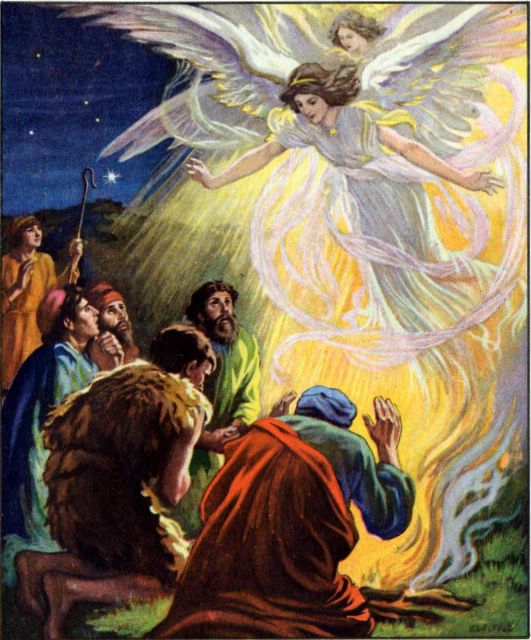
In that region there were shepherds living in the fields, keeping watch over their flock by night. Then an angel of the Lord stood before them, and the glory of the Lord shone around them, and they were terrified.
 
But the angel said to them, ‘Do not be afraid; for see—I am bringing you good news of great joy for all the people: to you is born this day in the city of David a Saviour, who is the Messiah, the Lord.
This will be a sign for you: you will find a child wrapped in bands of cloth and lying in a manger.’ And suddenly there was with the angel a multitude of the heavenly host, praising God and saying,
‘Glory to God in the highest heaven,
and on earth peace among those whom he favours!’

When the angels had left them and gone into heaven, the shepherds said to one another, ‘Let us go now to Bethlehem and see this thing that has taken place, which the Lord has made known to us.’So they went with haste and found Mary and Joseph, and the child lying in the manger.When they saw this, they made known what had been told them about this child;and all who heard it were amazed at what the shepherds told them.But Mary treasured all these words and pondered them in her heart.The shepherds returned, glorifying and praising God for all they had heard and seen, as it had been told them."  - (Luke 2: 1-20)


1 Corinthians 13 – a Christmas Version 
If I decorate my house perfectly with plaid bows, strands of twinkling lights and shiny balls, but do not show love to my family, I’m just another decorator.

If I slave away in the kitchen, baking dozens of Christmas cookies, preparing gourmet meals and arranging a beautifully adorned table at mealtime, but do not show love to my family, I’m just another cook.

If I work at the soup kitchen, carol in the nursing home and give all that I have to charity, but do not show love to my family, it profits me nothing.

 If I trim the spruce with shimmering angels and crocheted snowflakes, attend a myriad of holiday parties and sing in the choir’s cantata but do not focus on Christ, I have missed the point.

Love stops the cooking to hug the child. Love sets aside the decorating to kiss the husband. Love is kind, though harried and tired. Love doesn’t envy another’s home that has coordinated Christmas china and table linens.

Love doesn’t yell at the kids to get out of the way, but is thankful they are there to be in the way. Love doesn’t give only to those who are able to give in return but rejoices in giving to those who can’t.

Love bears all things, believes all things, hopes all things, endures all things. Love never fails. Video games will break, pearl necklaces will be lost, golf clubs will rust, but giving the gift of love will endure.