Showing posts with label Pilgrim Progress. Show all posts

15 Apr 2019

Grace freely given-the Anointing at Bethany

Cross post from Pilgrims Progress:
Grace, Mercy, Compassion, and Forgiveness freely and willingly offered to those who repent.

GRACE=
God’s
Riches
At
Christ’s
Expense

Strangely so, all the excitement of the procession into Jersualem, the crowds chanting, the road strewn with coats and branches – it all leads up to, well, nothing. Mark Chapter 11, 11 tells us that Jesus entered Jerusalem and went into the temple courts, he looked around he then turns around and returns to Bethany. And Bethany is where a very significant event takes place, one that often is glossed over on our Holy Week journey.

Today, Monday of Holy Week, we are given a Gospel text which often passed over, the Anointing at Bethany. The anointing of Jesus at Bethany is an event which is narrated in the accounts of the four evangelists, something which is relatively rare. The details differ slightly from evangelist to evangelist.
As Jesus dines with his beloved friends, Mary does something which only love can do. She took the most precious thing she had and spent it all on Jesus. Her love was not calculated but extravagant. Not some cheap romance or TV soap love but one of complete and oblivious donation! Mary's action was motivated by one thing, and one thing only, namely, her love for Jesus and her gratitude for God’s mercy.  Mary anoints Jesus with a costly ointment called nard or spikenard, a fragrant oil from the root and spike of the nard plant of northern India. It would have been extremely expensive, costing up to a year’s pay for an average labourer. 
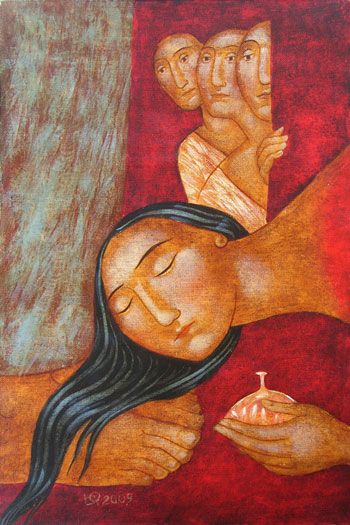
Anointing of Christ- Julia Stankova
We can imagine how that precious perfume may have run down His clothes and onto His feet. Mary got on the ground, on her knees, with her hair, and she washed His feet. She did something; however, a Jewish woman would never do in public. She loosed her hair and anointed Jesus with her tears. Matthew and Mark have the woman who carries out the anointing anoint Jesus on the head, Luke and John have her anoint his feet. It was customary for a woman on her wedding day to bind her hair and for a married woman to loosen her hair in public was a sign of grave immodesty. Mary was oblivious to all around her, except for Jesus. She took no thought for what others would think. In humility she stooped to anoint Jesus' feet and to dry them with her hair.

In this holy week, we can ask ourselves, how do we anoint the Lord’s feet and show him our love and gratitude? Her deed of love shows the extravagance of love, a love that we cannot outmatch. The Lord Jesus showed us the extravagance of his love in giving the best he had by pouring out his own blood for our sake and by anointing us with his Holy Spirit. Judas viewed her act as extravagant wastefulness because of greed. It is here that we see that Judas was an embittered man and had a warped sense of what was precious and valuable, especially to God.
The anointing of the Jesus brings out an important contrast, a contrast of the insight and devotion of Mary, and the indifference and deadened responses of the disciples. Remember, just a few days later, in the upper room, Jesus is going to wash their feet as an example of servanthood. She is washing the feet of the Son of God in the most extravagant way. She’s serving, but with a spirit of devotion. She’s doing the foot-washing, but in a way that cost her entire inheritance. She threw her whole future into this.

From start to finish, then, life as a child of God is marked by excess and extravagance, both given and received. We see that God never holds back on the extravagance, but it is not nard that is poured but the blood of his Beloved Son from the Cross which anoints us. Extravagance moves both ways. It's reciprocal, both given and received, by both God and his people. Sometimes God is the giver; at other times we are. At the wedding party in Cana, God provided a surplus of wine. At this dinner party in Bethany, Mary gave a gift of expensive perfume. Whether divine or human, given or received, these acts of reckless abundance are signs of what life is like with the living God. All of us want to feel that we are ‘worth’ something, to somebody, to the world. We like to feel our worth reflected back to us through affirmation, compliments, success and much more. But often we forget that we don’t have to do anything to earn the love of the Father. It is grace, pure grace.
The question is, are we ready to do the same? To be this self-emptying gift of prayer and joyful love, unafraid of stares or conflict from an often uncomprehending society? Are you willing to be balm for the brokenness and hurt of today’s humanity?” For those around her, the gesture by the woman in the Gospel was a ‘waste’!  We may not have the huge supply of nard but we can offer our time and prayer and our presence. We can ‘waste’ time with Jesus and just bask in his presence and feel that balm being applied to our weary lives, restoring our health and welcoming us as beloved children.


Pope Francis’ favourite image of the priest is of one who is anointed so as to anoint others with the oil, that is, the oil of gladness. He said a good priest anoints his people “with the oil of gladness,” by preaching the Gospel “with unction.” He continues saying “We need to ‘go out,’ then, in order to experience our own anointing, its power and its redemptive efficacy: to the ‘outskirts’ where there is suffering, bloodshed, blindness that longs for sight, and prisoners in thrall to many evil masters. The power of grace “comes alive and flourishes to the extent that we, in faith, go out and give ourselves and the Gospel to others, giving what little ointment we have to those who have nothing, nothing at all.”

The anointing which a priest receives at his ordination is not meant just for himself: it is to flow through him to those he serves. So at the heart of the priesthood is joy, a humbling joy received from God and a joy to be shared with others. God anointed his servants so they would be there for others, serving “the poor, prisoners, the sick, for those who are in sorrow and alone. The precious sacramental oil “is not intended just to make us fragrant, much less to be kept in a jar, for then it would become rancid and the heart bitter.”

During Holy Week, the bishop, joined by the priests of the diocese, gather at the Cathedral to celebrate the Chrism Mass. This Mass manifests the unity of the priests with their bishop and there the bishop blesses three oils, the Oil of Catechumens, the Oil of the Infirm and Holy Chrism which will be used in the administration of the sacraments throughout the diocese for the year.
The oils are kept in sacred vessels and here we can reflect on how often we too are vessels of the graces of the Father. However, St. Paul reminds us that we are very human and we must rely on his grace, “But we have this treasure in clay jars, so that it may be made clear that this extraordinary power belongs to God and does not come from us.” (2 Cor 4:7). The alabaster jar which held the perfume was broken to release the nard in order for Mary to carry out the anointing. Clay jars can break easily too. There is a very interesting quote from the late Bishop Fulton Sheen.
"Broken things are precious. We eat broken bread because we share in the depth of our Lord and His broken life. Broken flowers give perfume. Broken incense is used in adoration. A broken ship saved Paul and many other passengers on their way to Rome. Sometimes the only way the good Lord can get into some hearts is to break them."  -Fulton Sheen
Yes we all have cracks but that doesn’t mean we are broken. Those cracks are the hairline fractures of life which remind us that we are fragile and that we can break. The cracks make us who we are. It’s when we are crushed and broken and disappointed, our dreams shattered, that we begin to rely on the Lord. In China, when a precious vase breaks, the cracks are painted over in gold paint, indicating that the cracks are precious and are now part of the vase. So in some sense we are and will be always cracked pots (or crackpots!), until we reach that perfection in Heaven.
Without a deep sense of being held in this extravagant love, it would be hard to trust, face various decisions or let go of any safety nets which we have woven in order to keep God’s plans out and ours in! I am sure that, like the woman in the Gospel, that only when we stop measuring our relationship and respond to God’s call without measuring or counting, that we receive the immensity of grace which He wants to pour onto our vulnerable love.

The journey from 'Hosanna' to 'Crucify Him' - April 14, 2019

Crosspost from Pilgrims Progress:

“Lord, we know that every journey begins with a first step. Be with us as we take another step in our Lenten journey and a step towards the Triduum. We began this journey with the sign of ashes on our forehead, reminding us that this is no ordinary walk. We move one step forward in the promise of your light. We seek new meaning in the Easter that awaits us all. But first, we must walk with you to Jerusalem, to Calvary, to the Tomb and beyond. We ask for the courage and the grace that we need to be committed pilgrims along the Calvary Way. We make this prayer through Christ our Lord. AMEN.”
As we draw near to the end of Lent, it’s fitting to think about the journey we make during this Holy Week. Holy Week is holy, first and foremost, because of all Jesus Christ did during this week, from the triumphal entry into his city on Palm Sunday, to his teaching in the Temple, to the Last Supper, to his prayer in Gethsemane, to his arrest, torture, crucifixion and death on Good Friday, to his rest in the tomb, and his glorious resurrection on the third day. But Holy Week is holy because it’s also supposed to make us holy. Holy Week ought to be our most faith-filled week of the year. 

Every religious experience begins with a sense of emptiness, of life being bigger than us. We began the Lenten journey in the desert and we continue to walk, making the journey from 'Ashes' to 'Alleluia'. On Ash Wednesday we came forward to have ashes placed on our forehead and to hear the words “Remember you are dust and to dust you will return”. There is continuity in the liturgy where the burnt palms, symbol of the joy and majesty which accompanied Jesus during his entrance into Jerusalem, become the dust and ashes placed on our forehead.

On Palm Sunday the liturgy offers a panoramic view of the mysteries which we will contemplate during this Holy Week or Paschal Triduum: the institution of the Eucharist, the Passion and death of the Lord, and the prediction of His Resurrection.Our emotions this week swing between the great joy of those outside the southern city walls on the way to Bethany which we marked on Palm Sunday, and the great sadness of those outside the northwestern wall on the hill of Calvary on Good Friday and Holy Saturday.

We can see that the Palm Sunday Liturgy is framed by two expressions. The first is “Hosanna,” which was shouted out by the crowd, as we hear in the Gospel which proceeds the procession with the Palms at the beginning of Mass. Imagine, the crowd was chanting at the top of their lungs, “Hosanna to the Son of David, Hosanna to the King.” And slowly, and gradually, the Hosannas became quieter and quieter and quieter. Then nothing.  Later on, another chant had begun, almost in a whisper, “crucify him,” softly, softly, louder, louder and finally bursting with power, “Crucify him. Crucify him. Crucify him. Crucify that man. Yes, one minute, we are singing Hosanna and then in almost the next breath, we are saying ‘Crucify him’.

When we listen to the Passion of the Lord, we may feel shocked or even outrage against the many betrayals of Jesus. We can be so fickle- one moment we are lifting palms in our hands and laying cloaks on the ground for Jesus and not long after we have stripped him of his clothes. Yet the Passion account becomes the mirror for us to look at our own lives and see how our following Him can oscillate between fidelity and betrayal.

Upon the Calvary way the Crowd is composed of ‘Everyone’, the Crowd is each one of us because we all struggle with being faithful to the end. Pope Emeritus Benedict XVI wrote in the encyclical ‘Deus Caritas Est’, that God's passionate love for his people, for humanity, is at the same time a forgiving love. God didn't just say he loved us, he showed it. The Scriptures tell us: God showed his great love for us by sending Christ to die for us while we were still sinners!

It is important as we travel the Calvary Way, not to stop just at figures like Judas, Peter, Pilate or Herod, who each in their own ways show us the darker side of humanity. We must also celebrate our fidelity along the Christian way. Our Founder Blessed Alberione had a phrase, ‘just as we sing the Miserere we must also sing the Magnificat.’ We encounter others like Mary Magdalene, Mary our Mother, Simon of Cyrene, the Roman Centurion, St. John.  These people are icons in which we can read the love of God and the compassion of humanity. We are Mary Magdalene, reconciled sinners who are called to be faithful to the Lord to the end. We are called to be Simon of Cyrene, helping the Lord, albeit perhaps reluctantly at first, to carry the Cross. We are called to be St. John, receiving Mary as our inheritance. We are beckoned to follow the example of the Centurion by proclaiming Jesus to be the Son of God. During these days we are called to contemplate their faces as well and see in them the reflection of our own.

Whatever the disciples expected to happen, and whatever the crowds expected, just didn’t happen. Their expectations and Jesus’ agenda are worlds apart. We can be like the disciples, easily disillusioned when Jesus our King chooses another path. Perhaps we forget that inside every one of us resides aspects of each disciple: fear, confusion, betrayal;  mistrust;  denial;  doubt; intellect;  ego and so many more. However, “Hosanna”, and “Crucify him” shouted from the deepest core of our being, and often shouted with absolutely no real understanding of what we are asking for, become the miraculous vocabulary with which God teaches us the meaning of unconditional love, mercy and salvation.
These are crucial challenges for those of us who cling to the Christian faith and may ask ‘why’ about so many things. Why is there so suffering, pain, violence? Why is our world in such much turmoil? It is enough to turn on the TV or open a newspaper or look online. The answer is embedded in the mystery of this coming week.  An answer which is the closest thing to an answer that we Christians may have.  The answer is in the Cross. The answer is on the Cross. On that Cross, God makes a promise that in His Son, He will be with us to the end of time. God is not asking us to make a promise we cannot keep. God is asking us to believe a promise that only He can keep.

God steps out of grandeur to stand with us in awkward places at awful times to experience life and death, mercy and forgiveness.  Jesus entered Jerusalem in humility but was welcomed as a king. God answers our cries of "Hosanna" in ways so utterly unexpected that we look again to see if they can possibly be true. Is there any better way to commence Holy Week than with palms in our hands and "Hosannas" on our lips?  Is there any more faithful way to embark on this sacred journey than to ask God, out of the deep, honest places inside of us, to be our strength, our Everything?
Pope Francis in his apostolic exhortation ‘Joy of the Gospel’ writes: “We are not called to accomplish epic feats or to proclaim high-sounding words, but to give witness to the joy that arises from the certainty of knowing we are loved, from the confidence that we are saved.”

The ‘epic feat’ which we are called to live each day is simple, it is fidelity to the gift received. Going back to that phrase I quoted at the beginning from Blessed James Alberione, we are reminded that we sing the ‘Misere’ asking God for his pardon and then we intone the great ‘Magnficat’, as we praise Him for his goodness to us. The life of each one is an ongoing story of grace upon grace. So we begin to walk to Calvary....and beyond!

25 Mar 2019

25th March 2019 - One 'yes' does not last a lifetime!

Crosspost from Pilgrims Progress:

For the solemnity today, the liturgy of the day offers us Luke's narrative of the Annunciation for our reflection. We all know how the story goes. I wish I could always muster a classy yes like Mary’s. “Let it be done with me according to your word” is a far cry from my usual “OK Lord, if you say so.” We do the best we can. We notice the very human details of the Annunciation. It happened in a specific place, to a specific person and so I look at my story and how I give my 'yes' for the small and the big moments of life. 

Mary’s fiat, as it is called (Latin for “let it be done”), was a yes to the Unknown. These are the only yeses that really count. A yes to the Unknown—this was the fiat of Mary as she accepted the impossible message of the angel. This was the yes of those Wise Men following the star to only God knows where. This was the yes of Jesus as he accepted baptism by his cousin John. This is my yes to the Lord as He continues to lead me to different places, to different communities and to meet different people along the pilgrimage of life.

I am reminded of a homily given by one of our Pauline priests Fr. Michael Goonan, ssp, when the Gospel came up during Advent. He spoke of three elements of Mary's 'yes':


1) One 'yes' does not last a lifetime: the 'yes' she pronounces at the Annunciation is renewed at the birth of Jesus, at the Presentation, in the daily ups and downs of life, it is purified during the Passion and death of her Son, it is rewarded on that Easter Sunday when He rose from the dead. I often joke and say that my daily 'fiat' is when the alarm clock goes off in the morning. It costs me a lot to get up at 5.30 am and make my way to the chapel but I know I need to begin the day with a sure foundation and in the presence of the One who loves me so as to face whatever might spring up throughout the course of the day.


2) Our 'yes' is more than often given in the ordinariness, amidst the pots and pans than in the extraordinariness. It is saying 'yes' to go a different way which is not necessarily my way but to trust that it is the best way. This takes guts but more so it takes complete abandonment to the One who leads the way. To go a different way to often tread a new path and prepare the way for others. 


3) Our 'yes' is a free and freeing 'yes': it frees us and it frees others. A response that is given out of coercion or fear is not free. Nothing is impossible for God.

One of my favourite readings from the Divine Office is the one which we read in the week before Christmas, taken from St. Bernard of Clairvaux which tells the same Annunciation event with an air of expectation which is tangible:


"You have heard, O Virgin, that you will conceive and bear a son; you have heard that it will not be by man but by the Holy Spirit. The angel awaits an answer; it is time for him to return to God who sent him. We too are waiting, O Lady, for your word of compassion; the sentence of condemnation weighs heavily upon us...Answer quickly, O Virgin. Reply in haste to the angel, or rather through the angel to the Lord. Answer with a word, receive the Word of God. Speak your own word, conceive the divine Word. Breathe a passing word, embrace the eternal Word. Why do you delay, why are you afraid? Believe, give praise, and receive. Let humility be bold, let modesty be confident. Though modest silence is pleasing, dutiful speech is now more necessary. Open your heart to faith, O blessed Virgin, your lips to praise, your womb to the Creator. See, the desired of all nations is at your door, knocking to enter. If he should pass by because of your delay, in sorrow you would begin to seek him afresh, the One whom your soul loves. Arise, hasten, open. Arise in faith, hasten in devotion, open in praise and thanksgiving. Behold the handmaid of the Lord, she says, be it done to me according to your word."

As we continue our Lenten journey God continues to draw us to Him. His Holy Spirit has “overshadowed” our lives in some way. And we are beginning to believe that, like Mary, we too are being asked to “carry Christ into the world,” to bring him to birth…in our own lives and in the lives of others and to give a soulful and trusting 'Yes' to whatever He may ask of us today. Happy journeying!

15 Oct 2018

Saint Oscar Romero- Love must win out!

Cross post from Pilgrims Progress - Sr Louise O'Rourke:

Photo credit:Vatican website

I have to confess that I was like a little child waiting for Christmas this morning as I waited for the Mass of Canonisation on Vatican Television. A series of circumstances meant that last night we still  had no EWTN or other holy channels and no Internet (thanks to a national outage with EIR!) and it seemed that we wouldn’t be able to follow the great event either on TV or Internet. Lo and behold the Internet returned and we were able to watch the Mass live from Vatican City presided over by Pope Francis.

Today our Pope declared as saints in the Church six new models for us to follow. All very diverse, young and old, men and women, priests, religious, laity- each one of them followed Jesus totally. They are: Pope Paul VI, Oscar Romero, Francesco Spinelli, Vincenzo Romano, Maria Catherine Kasper, Nazaria Ignazia of Saint Teresa of Jesus, and Nuncio Sulprizio.

For nearly 20 years one of them in particular has been a strong presence in my life- Oscar Arnulfo Romero, Saint Oscar, as of today. I know I have blogged about this before so apologies if some of this is repetition. I also had the opportunity to do an interview with Sacred Space 102 FM in Limerick in occasion of the canonisation of Oscar Romero....thanks guys for the invite! It was a privilege! If you’re interested you can find the link here.

Fr. Romero was assassinated on the 24th of March 1980 and I claim this date as being special to my life story because it was the month and the year that I was to grace the world. However God had another plan and myself being a little precocious, I arrived a little earlier on January 24th. However that little connection was a discovery I made only a few years ago!

My personal admiration for Romero goes back to a discernment weekend which was held in our community in Dublin back in 1997. I remember it vividly because that weekend we watched the movie ‘Romero’. The story of this heroic pastor was life changing for me. At a certain point of his journey, Romero is shown literally at a crossroads. We see him fall to his knees and he utters a simple prayer: “I can’t, You must, I’m Yours, lead me!” It was the prayer from a heart that didn’t know what to do in the face of such injustice, death and despair. He was the pastor and the sheep continued to be slaughtered and torn from his grasp. I found myself in tears because I realised that that simple prayer echoed the sentiments of my own heart. I had been rebelling against the Lord for such a long time in responding to the call to religious life and I was tired. Romero’s prayer had become my prayer. If I was to embark upon the journey of trying consecrated life, it had to be upon fully surrendering to the guidance of the Shepherd. This simple prayer has been my lifeline on many occasions, a call back to reality and to see that I need to be guided and that I can’t do this on my own. It is a prayer which I whisper often each day when words fail me in prayer or don’t seem to carry me as they usually do. There is a short song: “Trust, surrender, believe, receive”  that in the same way says those precious words which came from the lips of Archbishop Romero.

However to follow Jesus is not easy. Let's not fool ourselves. The Pope reminded us today of this in the homily: 
"Jesus is radical. He gives all and he asks all: he gives a love that is total and asks for an undivided heart. Even today he gives himself to us as the living bread; can we give him crumbs in exchange? We cannot respond to him, who made himself our servant even going to the cross for us, only by observing some of the commandments. We cannot give him, who offers us eternal life, some odd moment of time. Jesus is not content with a “percentage of love”: we cannot love him twenty or fifty or sixty percent. It is either all or nothing."

Indeed for Romero it was 'all or nothing'!  On the 24th of March 1980, evil men in El Salvador tried to silence the voice of a prophet. Archbishop Romero gave his life, in the words of Pope John Paul II, “for the church and the people of his beloved country” of El Salvador. His death from an assassin’s bullet crowned a life of service as priest and bishop.  His great motto was ‘Love must win out’. Today, by canonising him, the Church once more declares that witness for Christ cannot be silenced by evil. During his three years as Archbishop of San Salvador, he became known across the world as a fearless defender of the poor and suffering. Oscar Romero’s humility is the fruitful ground of his confidence. He was a man with trust, an unlimited trust in Jesus Christ. We see in him a man who had fixed his eyes on Jesus and thus can walk safely amidst the pain and suffering of his people. This was the life of Oscar Romero. Throughout history, the voice of the prophet is one of the vehicles through which God speaks to the community and to the world and the Lord spoke powerfully through Romero, too powerfully for the government and the military who didn't like the message he was preaching to stop the oppression of the poor, the country people, the marginalized. And for this Romero paid with his life.


In the Mass today, Pope Francis used the chalice of Pope Paul VI as well as his crozier, symbol of him being a Shepherd. The Pope also carried out a very poignant gesture by wearing the bloodstained cincture of Archbishop Romero around his waist, the one he was wearing when he was shot while celebrating Mass on the 24th of March 1980. II can only imagine how the Pope felt thinking that his brother priest, a fellow Latin American had paid the ultimate price, love to the end. The Church and our society live in challenging times where every value we stand for is undermined. We may not be called to martyrdom like Romero was, but there is a witness to which we are called every single day, as Christians, as Catholics, as committed priests, religious and laity. As Pope Paul VI who was canonised today said: “Holiness is within everyone’s reach”. We can take heart from this quote from Romero:

 “A church that does not provoke any crisis, preach a gospel that does not unsettle, proclaim a word of God that does not get under anyone's skin or a word of God that does not touch the real sin of the society in which it is being proclaimed: what kind of gospel is that?”

 And another:
 “Beautiful is the moment in which we understand that we are no more than an instrument of God; we live only as long as God wants us to live; we can only do as much as God makes us able to do; we are only as intelligent as God would have us be. ”
And lastly…“Let us not forget: we are a pilgrim church, subject to misunderstanding, to persecution, but a church that walks serene, because it bears the force of love.” 

May we too 'bear the force of love' and walk serenely, wherever the Lord calls us to walk!

And now I'm off to watch the movie 'Romero' again...for the 18th time (I think!).

8 Jun 2018

Heart speaks to heart

Crosspost from Pilgrims Progress


Heart speaks to Heart- Cor ad cor loquitur!

This motto of Blessed Cardinal John Newman is what comes to my mind and heart for the feast day today.


Today and tomorrow we will celebrate the hearts of Jesus and of Mary. Today, the Solemnity of the Sacred Heart -one of my favourites and tomorrow the Immaculate Heart of Mary. Nowadays it seems that the devotion to the Sacred Heart of Jesus has been archived back to the time of our grandparents or our parents. I remember in school learning to sing 'Sweet heart of Jesus' with great fervour as taught to us by the Sisters of Mercy. Even now when I hear it, I am still somewhat nostalgic. I doubt somehow that these are the songs which my nieces learnt for their school choir for Mass. also remembered how often we prayed the short prayers to the Sacred Heart in class, in assembly, when we were in trouble or anxious: "Sacred Heart of Jesus, I place all my trust in you" or "Sweet heart of Jesus, make me love you more and more". In primary school, some of us used to deliver the Sacred Heart Magazine (also known as the Messenger, a Jesuit Publication) to elderly people in our town. My Nana was subscribed to it and part of my childhood summer holidays was spent reading the collection of magazines from the year. Is it any wonder I ended up in the convent!


Pioneer Pin
Later on, after taking the Pledge, a promise not to drink alcohol until eighteen, we were given a pin of the Sacred Heart of Jesus after becoming a 'pioneer'. Roman Catholic children in Ireland who make their Confirmation (typically at age eleven or twelve) are encouraged to promise, or "take the pledge", not to drink alcohol until they are at least 18 (the legal drinking age in Ireland).The Pioneer Total Abstinence Association of the Sacred Heart (or PTAA) is an Irish organisation for Roman Catholic teetotallers who also choose not to drink alcohol for their entire lives. While the PTAA does not advocate prohibition, it does require complete abstinence from alcoholic drink from its members. It also encourages devotion to the Sacred Heart of Jesus as an aid to resisting the temptation of alcohol. Pioneers wear a lapel pin called a Pioneer pin with an image of the Sacred Heart, both to advertise the organisation and to alert others not to offer them alcohol. It is a little sacrifice which we can offer to the Lord by not drinking alcohol or making some other sacrifice, big or small.

Fr. William Byrne reminds us that the "devotion to the Sacred Heart of Jesus, a human heart that is inflamed with divine love, is a powerful meditation and an important theological bridge that helps us understand who Jesus is and how much he loves us." 

I am reposting his five reasons to adore the Sacred Heart as I think they are very insightful: 


1. A Sacred Sonogram - Imagine if sonograms had existed at the time of Jesus. Just a little more than a week after the Annunciation when Mary says yes to being the mother of God, we would have seen something amazing on that screen, a little beating heart. That tiny pulse, undetectable to the human ear but resounding in heaven, meant that our God has a heart.


2. What John didn't hear, but the angels did. - At the Last Supper, John the beloved laid his head on Jesus' chest. Jesus knew that Judas, one of his chosen Apostles, was going to betray him. What John did not hear but what echoed in heaven was the sound of a breaking heart. The Sacred Heart is as human as yours and mine, it is a sign of the true humanity of Jesus. Its beat quickened when Jesus laughed with a loved one, and it ached with sorrow when he experienced betrayal. Think how truly his heart feels your joys and sorrows.


3. Blessing not bitterness. - "But when they came to Jesus and saw that he was already dead, they did not break his legs, but one soldier thrust his lance into his side, and immediately blood and water flowed out." (John 19: 33-34) The Sacred Heart of Jesus was wounded and from that wound came blood and water. From his suffering, blessings flowed - the water of Baptism and the blood of the Eucharist. From our pains and hurts, what flows? Grudges, blame and anger or mercy, compassion and forgiveness? Don't wait for suffering to come to turn to Christ on the cross, but begin to pray now that when we are put to the test, blessings and not bitterness will flow from our wounded side.


4. Certain wounds never heal. - When the soldier thrust the lance into Jesus' side, he was already dead. As Thomas learned, those wounds never healed. He was able to feel the marks of the crucifixion and put his hand into Jesus' side. The water and blood, Baptism and Eucharist, have never ceased to flow from the Heart of Christ. His mercy is without end. After you receive Communion at Mass, stay after a few minutes and recall his overwhelming, never-ending generosity. Pray that just as his love flows from the cross into you and me that they may flow from you and me into the world.


5. Like unto Thine. - The Sacred Heart of Jesus, a human heart, opened the gates of heaven for each of us. In Jesus, humanity entered into union with God that could only happen when God became a man. As he took a human heart, he invites us into his divinity.


"To Jesus through Mary" has been an often repeated phrase of devotional writers and preachers. St Louis Marie De Montfort has formulated perhaps the most clear devotion and adoration of Jesus Christ, that is, to love him and gift ourselves to him through Mary, with her spirit, with her Immaculate Heart. In his book, True Devotion to Mary, he shows that proper devotion to the Mother of God only makes one more Christ centred. She always leads us to her Son so we can discover the immensity of His love. St. Augustine also reminds us that to “fall in love with God is the greatest of all romances; to seek Him, the greatest adventure; to find Him, the greatest human achievement.”

When I am feeling miserable or having a bad day, there is nothing like having a heart-to-heart conversation with someone who just listens, understands and is able to be with you in that moment. Words don't necessarily have to follow. It is simply a feeling of presence. This is the promise of Jesus to us, He is always waiting to welcome us, to listen, to let us rest our head on His heart. A heart is like a mirror, it reflects who you are, it's to be handled with care! The one person you can give your heart to without the fear of being broken is God. May you keep seeking the greatest romance ever written!

27 Feb 2018

Star gazing - Sr Louise O'Rourke

Cross post from Sr Louise O'Rourke at pilgrimsprogress:  


Already at the second week of Lent, the liturgy presents us with varying images for the journey. Sunday is the day in my week where I  stop and take stock of how the journey is going. We are on a Lenten pilgrimage but from where and towards where? 

Pope John Paul II writes in Incarnationis Mysterium 7: “A pilgrimage evokes the believer's personal journey in the footsteps of the Redeemer: it is an exercise of practical asceticism, of repentance for human weaknesses, of constant vigilance over one's own frailty, of interior preparation for a change of heart. Through vigils, fasting and prayer, the pilgrim progresses along the path of Christian perfection, striving to attain, with the support of God's grace, “the state of the perfect man, to the measure of the full maturity of Christ” (Eph 4:13).”

A pilgrim needs to be able to read the signs of the times around them, of the people with whom they live and journey with and of nature itself. A few years ago, a friend of mine gave me a basic introduction to astronomy and I still smile to myself when I can identify 'Orion's Belt' or 'The Big Dipper.' In today’s First Reading, God took Abraham outside for an astronomy lesson of another kind and said, “Now look toward the heavens, and count the stars, if you are able to count them. And He said to him, ‘So shall your descendants be.’ God had just promised Abraham a son. Why would looking at billions of stars help Abraham believe he would father a son? Look again at what happened. “Now look toward the heavens, and count the stars, if you are able to count them” … Then Abraham believed in the Lord.  When Abraham began to count the stars he was overcome by the glory of God. Who was this speaking to him? Nothing could be impossible to the creator of all this beauty. His heart believed in God, and God counted his faith as righteousness.

Gazing at stars has a somewhat romantic connotation attached to it. Whilst it is a beautiful experience it does makes you realize just how small you are and how big the universe is. Paradoxically, if it isn’t dark, we can’t see the stars. A few years ago, two of our sisters, Sr. M. Regina Cesarato (our previous Mother General) and Sr. M. Fiorella Schiermedori composed a hymn in occasion of the beatification of our Founder, Blessed James Alberione. The refrain goes like this: “ Guarda le stelle del cielo, Alberione uomo di Dio,conta i granelli di sabbia: così sarĂ , così sarĂ  la tua Famiglia!Amen! Amen! Amen!.” 

Translated, it reads: Look at the stars of heaven, Alberione, man of God. Count the grains of sand, your family will be like this”. As numbers in religious life decrease in many parts, we are invited to trust that the Lord does not go back on his promises. We have to keep ‘stargazing’ and remembering that we are not the Creator, but the work of the Creator and He will keep creating. 

If we look at today’s Gospel, that of the Transfiguration, the disciples don’t want the experience to end, to an extent they want to keep looking at the stars. ‘Let us build three tents’ is their way of saying ‘let us stay here’. Often this happens when we have a wonderful experience that we just don’t want to end. When we reach the top of the mountain and all we want to do is bask in the view, drink in the scenery, feel our lungs pumping and the adrenaline rush. It is sitting with friends and feeling the presence of Christ in our midst. It is seeing the crystalline formation of snowflakes and marveling at how perfect they are. There is a deep desire within the human soul for beauty. However, the disciples desire to ‘remain’ on the mountain is also an attempt to escape the reality which awaits Jesus. He has already announced that his journey to Jerusalem will result in his death. Beauty and suffering are always hand in hand. 

At the top of the mountain is also the painful reality that we must descend. The beauty of truth also embraces offence, pain, and even the dark mystery of death, and that this can only be found in accepting suffering, not in ignoring it. The One who is the Beauty itself let himself be slapped in the face, spat upon, crowned with thorns; the Shroud of Turin can help us imagine this in a realistic way. However, in his Face that is so disfigured, there appears the genuine, extreme beauty: the beauty of love that goes "to the very end"; for this reason it is revealed as greater than falsehood and violence. This is Love Transfigured, it is the ‘beauty that saves the world’. 

Similarly our Transfiguration experience is in realising the transience of life and that our destination is Heaven, even though we resist in some many ways. It is in walking the journey with those who suffer, of being accompanied in attaining our personal transformation, that point where ‘I no longer live but Christ lives in me’. This is our goal, this is our destination. Often though we need to get away from the daily habits we have so as to find a different place to stand and observe ourselves in the world. Prayer times, retreats and other privileged moments of grace give us this opportunity. May you have time in your day to find some. 


15 Jan 2018

Ordinary in an extraordinary way!

Cross post from Pilgrim Progress:


Christmas has officially finished! Until next year that is.  With the second Vespers of the Baptism of the Lord, tomorrow we return to Ordinary Time. We get back into the ordinary course of events. Through the period of Ordinary Time following Christmas, we become increasingly aware that this marvel of birth and growth will mature into something challenging.  However we need time to focus on this and we are gifted with the time of Lent which culminates in the great event of the Resurrection, the battle of life over death, light over darkness. Lent greets us somewhat earlier this year and believe it or not, but Ash Wednesday is on the 14th of February, Valentine's Day! Just 5 weeks away.

With the way the calendar fell this year, it seemed that the time after New Year's and normal time just flew. Jokingly, I said that the shops will already have the Easter eggs in soon. I wasn't too far wrong, in fact, they are already in the shops since New Year's Eve (not impressed  Tesco!). What is it with the commercial world continually projecting us into the future. Have we lost the capacity to live the present moment? Are we afraid to live the present? Are we afraid that the present is too 'ordinary.'


However, ordinary time can be misleading. It seems to suggest that life and faith carry on as usual and they do to an extent. The truth however is quite the contrary when the readings of the season are taken into account. In the Gospel which accompanies us into Ordinary Time, Jesus issues the invitation: " Follow me".  Follow him a world which is both ordinarily extraordinary and extraordinarily ordinary.

A quote reads: “The difference between ordinary and extraordinary is that little extra.” What is the little ‘extra’ which makes the difference in your life? For me, beauty continues to speak a language of its own which does not necessarily need words or vocabulary, precisely because it belongs to the sphere of the simple. My quest for ‘extra’ continues, or translated into biblical terms, the journey towards embracing Jesus’ invitation in John 10:10 ‘I have come that you may life in abundance.'


That said, extraordinary things happen in Ordinary time too. People are born and people die. Wars begin and wars end, and wars go on and on. Tornados and earthquakes happen and end. Miracles come in silently, softly, transforming the lives of unsuspecting people. People shed the extraordinary because they have been wearied by life and settle for the ordinary. Ironically, when travel and the media have blown all horizons wide open, our own inner horizons seem to have become narrower and our vision contracted. How can we find again the seeing eye and the feeling touch? The reality of “time and eternity” is one that few people these days choose to contemplate, because we are so distracted. Technology and entertainment have become the things people chase when they are not fulfilling their obligations and taking up their responsibilities.


To follow Jesus, means to take up the Cross. Life is not easy as we all know. Taking up the cross means living at least in part in an alternative reality, one in which the freedom of love, forgiveness and grace  prevails in place of the normal arrangements of domination, retribution and exchange. With the commercial hype of Christmas having passed, it is easy to get dragged into a sense of a mundane life, void of fairy lights, candy canes and gifts under the tree. January can be somewhat of an anti-climatic month. Yes, we are all human; we don't have absolute power over everything; there will be difficult times, there will depressing times; and nothing good comes easy. We may get tossed around by the storms of life like ordinary people except for the fact that we serve God, who is able to speak to our storms and say ‘Peace, be still!’ We think of Celtic spirituality where "Celtic spirituality was a practice in which ordinary people in their daily lives took the tasks that lay to hand but treated them sacramentally, as pointing to a greater reality which lay beyond them." (Esther de Waal).  The Good News that God’s extraordinary life comes to us in seemingly ordinary ways is the ongoing lesson of Ordinary Time.

This said, no-one wants to be ‘ordinary’, we all want to feel special. We want to live exciting lives which give us interesting photos and bizarre statuses to post on Facebook or Twitter. We want people to think our lives are extraordinary.  Easily we forget that every single person on earth is completely unique and not exactly like anyone else. Every single life is special and extraordinary. We don’t have to prove ourselves to God or to anyone for that matter. It can seem that even in church circles, we have to do ‘big’ things. There is so much importance placed on having a big ministry or having that “special calling” to bigger things yet we often fail to recognize that God can do extraordinary things when we’re doing the ordinary.

Holly Gerth writes: “Ordinary is the lie we tell ourselves when we look in the mirror and say the girl looking back is no one special. It’s the false feeling that tries to overwhelm us when we’re standing in the corner at a conference and everyone else seems cooler. It’s the whisper of the enemy of our hearts when we get ready to offer what we’ve tucked away inside for so long. You are not ordinary. You are extraordinary. The God who spoke the stars into being knit together your soul. Chose the color of your eyes. Numbered the hairs on your head. Placed gifts within you like presents for the world to open with joy.”

Yes, God does call some people to go out and do new and extraordinary things but that doesn’t mean that what we do is insignificant. For the vast majority of us, He’s called us to live an ordinary life but He desires that we live it in an extraordinary way.  He wants us to give unconditionally without expecting return, to love in a way which the world doesn’t acknowledge, loving the poor, the weak, those whom the world deems ‘unlovable’. He wants us to be faithful in the little things, making the little sacrifices which no-one might even see. By giving time to someone in need of a kind word or gesture when you feel just like having your personal space. We don’t need a big “calling” to have an impact in this world.  Maybe that is why I love the lives of the saints so much, they teach us that God does miracles in the lives of ordinary people. He changes sinners into saints. All we need to do is live our ordinary lives in an extraordinary way. So don’t be afraid to be ordinary!

3 Dec 2017

Waiting in Joyful Hope! Advent begins - Pilgrim Progress

Cross post from Sr Louise at Pilgrims Progress:


Advent begins not with a cute baby scene but one which might even disturb us. We do not begin our Advent journey with the baby Jesus snuggled in the arms of his parents all aglow in a tranquil postpartum nativity scene.  Instead we begin right in the middle of the birth pains that accompany a difficult delivery. The prophet Isaiah lets out a gut wrenching cry: “O God that you would tear open the heavens and come down.”  The world around us is in turmoil, God.  We need your presence.  Come and occupy our world now! The world cries out for the Lord.

Nowadays people don’t like waiting. In the past I’ve thought of waiting as wasted time, such as when I wait for a bus or in a doctor’s surgery. This kind of waiting requires little action on our part; it’s mostly a matter of biding our time. Everything is so instantaneous that we no longer know how to wait. Yet, these are opportunities to pray. The Second Reading from St. Paul reminds us that as we wait, we do so with a grateful heart. We have received so many gifts which help us as we wait, gifts which keep us faithful. The Lord also asks us to pray as we wait. If we are too busy to pray then we really are too busy. The same amount of time will pass whether I am squandering it in impatience or using it to serve the Lord and His children. Choosing to “wait upon the Lord” or viewed another way, to serve Him, yields far more satisfying results.

A reflection I read on this Sunday’s Gospel invites us to give thanks to all those who keep watch and wait for us. Who are the doorkeepers in our lives who wait anxiously for us to welcome us, even when we have strayed from them, blocked them out? There are doorkeepers who encourage us and offer hospitality and words of advice to keep going along the pilgrim way. 

It is like during the Lough Derg pilgrimage when have to stay awake all night as part of the penitential element. You try to sneak a few secret minutes of zzzz’s before you get caught. You keep moving position to stop your legs hopping with restlessness. It requires effort to stay awake. How can we keep our soul awake for when the Lord comes?

I love Night vigils. There is something very special about keeping watch in the dark by the glow of candles or the moonlight. There is a stillness that the day cannot encapture. But it is so easy to fall asleep, especially when you want to stay awake! 

For this, the Church gives us Advent. It is four weeks of being alert, of preparation. Advent always begins with a word about wakefulness. The wakefulness that Jesus describes is a state of mind and body, a practice, a way of being. It does not bear resemblance to the ways we usually try to keep ourselves (or unwittingly find ourselves) awake, methods that usually leave us jangly-nerved and less than fully functional, usually caffeine-induced! Sometimes we exist more than live, or even worse we ‘survive’ and not live at all. Our Father wants us to thrive, not just survive. The prophet Isaiah wrote to the believers of his day: “those who wait on the Lord will renew their strength. They will soar on wings like eagles; they will run and not grow weary, they walk and not be faint” (Isaiah 40:31). Those who wait on the Lord shall renew their strength. Isn’t it amazing how exhausted we can get doing God’s work?

Too often, rather than waiting patiently, quietly, expectantly, and in his word, we are fretting and anxious and non-trusting and our strength is drained. Those who wait on the Lord will soar on wings as eagles! It is an interesting thing about eagles. They soar, they don’t fly. They wait for the correct wind, and then they ride that wind, soaring to the heights. Isn’t that a great picture for us as we wait on the Lord? When the wind of the Spirit moves and blows, we ride with wings as eagles to where he wants us to go.

Expectantly wait on Him. And when the Holy Spirit moves, when the wind blows, then soar on wings like an eagle, run and not grow weary, walk and not be faint. In the meantime, wait for Him. And while you are waiting – renew your strength.