Showing posts with label Assumption of the Blessed Virgin Mary. Show all posts

14 Aug 2018

15th August 2018 - Assumption of the Blessed Virgin Mary


It is truly right and just, our duty and our salvation,
always and everywhere to give You thanks,
Lord, holy Father, almighty and eternal God,
through Christ our Lord.
For today the Virgin Mother of God
was assumed into heaven
as the beginning and image
of Your Church’s coming to perfection
and a sign of sure hope and comfort to Your pilgrim people;
rightly You would not allow her
to see the corruption of the tomb
since from her own body she marvellously brought forth
Your incarnate Son, the Author of all life. 
(The 1973 version of the Preface for the Mass of the Solemnity)

The 15th August in the Latin/western tradition is the celebration of the Solemnity of the Assumption of the Blessed Virgin Mary. While having different theological foci on the celebration, it is a common liturgical date of celebration for both Catholics and Orthodox Christians.

The dogma was officially declared by Pope Pius XII in 1950 in the apostolic constitution  Munificentissimus Deus. The apostolic constitution traces out the ancient understanding of the dogma going back through the centuries and emphasises that its official declaration by Pope Pius XII was seen as only the official confirmation of a belief long held in the Tradition of the church rather than as something new. Rather than something imposed by Pius XII, consultation was made with the bishops and on May 1, 1946, a letter "Deiparae Virginis Mariae," was issued which asked, "Do you, venerable brethren, in your outstanding wisdom and prudence, judge that the bodily Assumption of the Blessed Virgin can be proposed and defined as a dogma of faith? Do you, with your clergy and people, desire it?" with a response very much in the affirmative.


So, Pius XII declared that:


"Hence the revered Mother of God, from all eternity joined in a hidden way with Jesus Christ in one and the same decree of predestination,(47) immaculate in her conception, a most perfect virgin in her divine motherhood, the noble associate of the divine Redeemer who has won a complete triumph over sin and its consequences, finally obtained, as the supreme culmination of her privileges, that she should be preserved free from the corruption of the tomb and that, like her own Son, having overcome death, she might be taken up body and soul to the glory of heaven where, as Queen, she sits in splendour at the right hand of her Son, the immortal King of the Ages.......after we have poured forth prayers of supplication again and again to God, and have invoked the light of the Spirit of Truth, for the glory of Almighty God who has lavished his special affection upon the Virgin Mary, for the honour of her Son, the immortal King of the Ages and the Victor over sin and death, for the increase of the glory of that same august Mother, and for the joy and exultation of the entire Church; by the authority of our Lord Jesus Christ, of the Blessed Apostles Peter and Paul, and by our own authority, we pronounce, declare, and define it to be a divinely revealed dogma: that the Immaculate Mother of God, the ever Virgin Mary, having completed the course of her earthly life, was assumed body and soul into heavenly glory......
 The following reading on the Assumption (known by eastern Christians as the Dormition) of Mary is taken from the first homily of St. John Damascene on the Assumption of the Blessed Virgin Mary.
“But even though, according to nature, your most holy and happy soul is separated from your most blessed and stainless body and the body as usual is delivered to the tomb, it will not remain in the power of death and is not subject to decay. For just as her virginity remained inviolate while giving birth, when she departed her body was preserved from destruction and only taken to a better and more divine tabernacle, which is not subject to any death . . . Hence I will call her holy passing not death, but falling asleep or departure, or better still, arrival. . . .

"Your stainless and wholly immaculate body has not been left on earth; the Queen, the Mistress, the Mother of God who has truly given birth to God has been translated to the royal palaces of heaven. .

 "Angels and archangels have borne you upwards, the impure spirits of the air have trembled at your ascension. The air is purified, the ether sanctified by your passing through them. . . the powers meet you with sacred hymns and much solemnity, saying something like this: Who is she that comes forth as the morning rising, fair as the moon, elect like the sun? [cf. Cant 6:9] How you have blossomed forth, how sweet you have become! You are the flower of the field, a lily among the thorns [Cant 2.1] . . . Not like Elijah have you entered heaven, not like Paul have you been rapt to the third heaven; no, you have penetrated even to the royal throne of your Son himself . . . a blessing for the world, a sanctification of the universe, refreshment for those who are tired, comfort for the sorrowing, healing for the sick, a port for those in danger, pardon for sinners, soothing balm for the oppressed, quick help for all who pray to you. . .

“Good Mistress, graciously look down on us; direct and guide our destinies wheresoever you will. Pacify the storm of our wicked passions, guide us into the quiet port of the divine will and grant us the blessedness to come.”


  • While no longer being updated, one blog which we often recommend for reflections is Blue Eyed Ennis; check out these posts here, here and here (the last one is an interesting reflection on Struggling with the Assumption).

15th August 2018 - The Dormition of the Birthgiver of God


In the Orthodox Churches, the feast of the Dormition or Falling-asleep of the Theotokos is celebrated on the fifteenth of August, preceded by a two-week fast. This feast commemorates the death, resurrection and glorification of Christ’s mother. It proclaims that Mary has been “assumed” by God into the heavenly kingdom of Christ in the fullness of her spiritual and bodily existence.

As with the nativity of the Virgin and the feast of her entrance to the temple, there are no biblical or historical sources for this feast. The Tradition of the Church is that Mary died as all people die, not “voluntarily” as her Son, but by the necessity of her mortal human nature which is indivisibly bound up with the corruption of this world.

The Orthodox Church teaches that Mary is without personal sins. In the Gospel of the feast, however, in the liturgical services and in the Dormition icon, the Church proclaims as well that Mary truly needed to be saved by Christ as all human persons are saved from the trials, sufferings and death of this world; and that having truly died, she was raised up by her Son as the Mother of Life and participates already in the eternal life of paradise which is prepared and promised to all who “hear the word of God and keep it” (Lk11.27–28).

In giving birth, you preserved your virginity. In falling asleep you did not forsake the world, O Theotokos. You were translated to life, O Mother of Life, and by your prayers, you deliver our souls from death (Troparion).

Neither the tomb, nor death, could hold the Theotokos, who is constant in prayer and our firm hope in her intercessions. For being the Mother of Life, she was translated to life, by the One who dwelt in her virginal womb (Kontakion).

The services of the feast repeat the main theme, that the Mother of Life has “passed over into the heavenly joy, into the divine gladness and unending delight” of the Kingdom of her Son (Vesperal hymn). The Old Testament readings, as well as the gospel readings for the Vigil and the Divine Liturgy, are exactly the same as those for the feast of the Virgin’s nativity and her entrance into the Temple. Thus, at the Vigil we again hear Mary say: “My soul magnifies the Lord and my Spirit rejoices in God my Saviour” (Lk 1.47). At the Divine Liturgy we hear the letter to the Philippians where Saint Paul speaks of the self-emptying of Christ who condescends to human servitude and ignoble death in order to be “highly exalted by God his Father” (Phil 2.5–11). And once again we hear in the Gospel that Mary’s blessedness belongs to all who “hear the word of God and keep it” (Lk 11.27–28).


Thus, the feast of the Dormition of the Theotokos is the celebration of the fact that all humans are “highly exalted” in the blessedness of the victorious Christ, and that this high exaltation has already been accomplished in Mary the Theotokos. The feast of the Dormition is the sign, the guarantee, and the celebration that Mary’s fate is, the destiny of all those of “low estate” whose souls magnify the Lord, whose spirits rejoice in God the Saviour, whose lives are totally dedicated to hearing and keeping the Word of God which is given to men in Mary’s child, the Saviour and Redeemer of the world.

Finally it must be stressed that, in all of the feasts of the Virgin Mother of God in the Church, the Orthodox Christians celebrate facts of their own lives in Christ and the Holy Spirit. What happens to Mary happens to all who imitate her holy life of humility, obedience, and love. With her all people will be “blessed” to be “more honorable than the cherubim and beyond compare more glorious than the seraphim” if they follow her example. All will have Christ born in them by the Holy Spirit. All will become temples of the living God. All will share in the eternal life of His Kingdom who live the life that Mary lived.

In this sense everything that is praised and glorified in Mary is a sign of what is offered to all persons in the life of the Church. It is for this reason that Mary, with the divine child Jesus within her, is called in the Orthodox Tradition the Image of the Church. For the assembly of the saved is those in whom Christ dwells.

- From the Orthodox Church in America


15 Aug 2017

15th August 2017 - Solemnity of the Assumption of the Blessed Virgin Mary - Dormition of the Birthgiver of God


The 15th August is the celebration of the Solemnity of the Assumption of the Blessed Virgin Mary. While having different theological foci on the celebration, it is a common liturgical date of celebration for both Catholics and Orthodox Christians.

The dogma was officially declared by Pope Pius XII in 1950 in the apostolic constitution  Munificentissimus Deus. The apostolic constitution traces out the ancient understanding of the dogma going back through the centuries and emphasises that its official declaration by Pope Pius XII was seen as only the official confirmation of a belief long held in the Tradition of the church rather than as something new. Rather than something imposed by Pius XII, consultation was made with the bishops and on May 1, 1946, a letter "Deiparae Virginis Mariae," was issued which asked, "Do you, venerable brethren, in your outstanding wisdom and prudence, judge that the bodily Assumption of the Blessed Virgin can be proposed and defined as a dogma of faith? Do you, with your clergy and people, desire it?" with a response very much in the affirmative.


So, Pius XII declared that:

"Hence the revered Mother of God, from all eternity joined in a hidden way with Jesus Christ in one and the same decree of predestination,(47) immaculate in her conception, a most perfect virgin in her divine motherhood, the noble associate of the divine Redeemer who has won a complete triumph over sin and its consequences, finally obtained, as the supreme culmination of her privileges, that she should be preserved free from the corruption of the tomb and that, like her own Son, having overcome death, she might be taken up body and soul to the glory of heaven where, as Queen, she sits in splendour at the right hand of her Son, the immortal King of the Ages.......after we have poured forth prayers of supplication again and again to God, and have invoked the light of the Spirit of Truth, for the glory of Almighty God who has lavished his special affection upon the Virgin Mary, for the honour of her Son, the immortal King of the Ages and the Victor over sin and death, for the increase of the glory of that same august Mother, and for the joy and exultation of the entire Church; by the authority of our Lord Jesus Christ, of the Blessed Apostles Peter and Paul, and by our own authority, we pronounce, declare, and define it to be a divinely revealed dogma: that the Immaculate Mother of God, the ever Virgin Mary, having completed the course of her earthly life, was assumed body and soul into heavenly glory......

Previous posts from SS102fm including reflections on the readings of the day are HERE.
  • While no longer being updated, one blog which we often recommend for reflections is Blue Eyed Ennis; check out these posts here, here and here (the last one is an interesting reflection on Struggling with the Assumption).


12 Aug 2017

13th August 2017 - Mary; Our Mother - a reflection in advance of the feast of the Assumption

On this weeks programme, Geraldine Creaton joins John and Shane in advance of the celebration of the Assumption of the Blessed Virgin to reflect on the role of Mary in the story of salvation. We have a rather abbreviated reflection on this weeks Sunday gospel as well as our regular discussion on the saints of the week and other liturgical odds and ends.

You can listen to the podcast of this weeks full programme HERE.

15th August - Solemnity of the Assumption of the Blessed Virgin Mary - Dormition of the Birth-giver of God

Never be afraid of loving the Blessed Virgin too much. You can never love her more than Jesus did. 
If anyone does not wish to have Mary Immaculate for his Mother, he will not have Christ for his Brother 

- St Maximilian Kolbe


Source
On this weeks programme Geraldine Creaton from the Emmanuel Community returns to join John and Shane to reflect on the role of Mary - the simple Jewish woman who became the linchpin to the story of salvation.

You can  listen to the discussion and reflection excerpted from the main programme podcast HERE

August 15th is the solemnity of the Assumption of the Blessed Virgin Mary, commemorated by the Orthodox churches as the Dormition (or Falling asleep) of the Virgin Mary.

The dogma was officially declared by Pope Pius XII in 1950 in the apostolic constitution  Munificentissimus Deus. The apostolic constitution traces out the ancient understanding of the dogma going back through the centuries and emphasises that its official declaration by Pope Pius XII was seen as only the official confirmation of a belief long held in the Tradition of the church rather than as something new. 

Rather than something imposed by Pius XII, consultation was made with the bishops and on May 1, 1946, a letter "Deiparae Virginis Mariae," was issued which asked "Do you, venerable brethren, in your outstanding wisdom and prudence, judge that the bodily Assumption of the Blessed Virgin can be proposed and defined as a dogma of faith? Do you, with your clergy and people, desire it?" with a response very much in the affirmative.

So, Pius XII declared that:
"Hence the revered Mother of God, from all eternity joined in a hidden way with Jesus Christ in one and the same decree of predestination,(47) immaculate in her conception, a most perfect virgin in her divine motherhood, the noble associate of the divine Redeemer who has won a complete triumph over sin and its consequences, finally obtained, as the supreme culmination of her privileges, that she should be preserved free from the corruption of the tomb and that, like her own Son, having overcome death, she might be taken up body and soul to the glory of heaven where, as Queen, she sits in splendor at the right hand of her Son, the immortal King of the Ages.......after we have poured forth prayers of supplication again and again to God, and have invoked the light of the Spirit of Truth, for the glory of Almighty God who has lavished his special affection upon the Virgin Mary, for the honor of her Son, the immortal King of the Ages and the Victor over sin and death, for the increase of the glory of that same august Mother, and for the joy and exultation of the entire Church; by the authority of our Lord Jesus Christ, of the Blessed Apostles Peter and Paul, and by our own authority, we pronounce, declare, and define it to be a divinely revealed dogma: that the Immaculate Mother of God, the ever Virgin Mary, having completed the course of her earthly life, was assumed body and soul into heavenly glory......
Dormition of the Theotokas
According to Orthodox tradition, the apostles were miraculously gathered from the various countries in which they were preaching the gospel to be at the bedside of the BVM as she passed from earth to heaven
Shout, O David, and declare: * What is this present feast? * And he says: Today has Christ * unto the mansions above * translated her from whom He was born without seed * and whom I have extolled * in the Book of the Psalms * as daughter, child of God, * and as a virgin as well. * And for this reason do mothers and daughters * and brides of Christ now rejoice and say: * Rejoice, O Lady who were translated * unto the royal courts on high. (Source)


Gospel - Matthew 14:22-33


After he had fed the people, Jesus made the disciples get into a boatand precede him to the other side,while he dismissed the crowds. After doing so, he went up on the mountain by himself to pray. When it was evening he was there alone. Meanwhile the boat, already a few miles offshore,was being tossed about by the waves, for the wind was against it. During the fourth watch of the night,he came toward them walking on the sea. When the disciples saw him walking on the sea they were terrified. "It is a ghost," they said, and they cried out in fear. At once Jesus spoke to them, "Take courage, it is I; do not be afraid." Peter said to him in reply,"Lord, if it is you, command me to come to you on the water." He said, "Come." Peter got out of the boat and began to walk on the water toward Jesus. But when he saw how strong the wind was he became frightened;and, beginning to sink, he cried out, "Lord, save me!" Immediately Jesus stretched out his hand and caught Peter,and said to him, "O you of little faith, why did you doubt?" After they got into the boat, the wind died down. Those who were in the boat did him homage, saying,"Truly, you are the Son of God."
Reflections on this week's Sunday gospel:

Liturgical odds & ends

Liturgy of the Hours: Psalter week 3, 19th week in Ordinary time 

Saints of the Week

August 14th - St Maximilian Kolbe
August 15th - Solemnity of the Assumption of the Blessed Virgin Mary
August 17th - Our Lady of Knock
August 18th - St Helena
August 19th - St John Eudes


15 Aug 2016

15th August 2016 - Solemnity of the Assumption of the Blessed Virgin Mary - Dormition of the Birthgiver of God


 It is truly right and just, our duty and our salvation,
always and everywhere to give You thanks,
Lord, holy Father, almighty and eternal God,
through Christ our Lord.
For today the Virgin Mother of God
was assumed into heaven
as the beginning and image
of Your Church’s coming to perfection
and a sign of sure hope and comfort to Your pilgrim people;
rightly You would not allow her
to see the corruption of the tomb
since from her own body she marvellously brought forth
Your incarnate Son, the Author of all life.
 
(The 1973 version of the Preface for the Mass of the Solemnity)
 
August 15th is the solemnity of the Assumption of the Blessed Virgin Mary, commemorated by the Orthodox churches as the Dormition (or Falling asleep) of the Virgin Mary.
 

Dormition of the Theotokas
According to Orthodox tradition, the apostles were miraculously gathered from the various countries in which they were preaching the gospel to be at the bedside of the BVM as she passed from earth to heaven
Shout, O David, and declare: * What is this present feast? * And he says: Today has Christ * unto the mansions above * translated her from whom He was born without seed * and whom I have extolled * in the Book of the Psalms * as daughter, child of God, * and as a virgin as well. * And for this reason do mothers and daughters * and brides of Christ now rejoice and say: * Rejoice, O Lady who were translated * unto the royal courts on high. (Source)


 The dogma was officially declared by Pope Pius XII in 1950 in the apostolic constitution  Munificentissimus Deus. The apostolic constitution traces out the ancient understanding of the dogma going back through the centuries and emphasises that its official declaration by Pope Pius XII was seen as only the official confirmation of a belief long held in the Tradition of the church rather than as something new.
 
Rather than something imposed by Pius XII, consultation was made with the bishops and on May 1, 1946, a letter "Deiparae Virginis Mariae," was issued which asked "Do you, venerable brethren, in your outstanding wisdom and prudence, judge that the bodily Assumption of the Blessed Virgin can be proposed and defined as a dogma of faith? Do you, with your clergy and people, desire it?" with a response very much in the affirmative.
 
So, Pius XII declared that:
"Hence the revered Mother of God, from all eternity joined in a hidden way with Jesus Christ in one and the same decree of predestination,(47) immaculate in her conception, a most perfect virgin in her divine motherhood, the noble associate of the divine Redeemer who has won a complete triumph over sin and its consequences, finally obtained, as the supreme culmination of her privileges, that she should be preserved free from the corruption of the tomb and that, like her own Son, having overcome death, she might be taken up body and soul to the glory of heaven where, as Queen, she sits in splendor at the right hand of her Son, the immortal King of the Ages.......after we have poured forth prayers of supplication again and again to God, and have invoked the light of the Spirit of Truth, for the glory of Almighty God who has lavished his special affection upon the Virgin Mary, for the honor of her Son, the immortal King of the Ages and the Victor over sin and death, for the increase of the glory of that same august Mother, and for the joy and exultation of the entire Church; by the authority of our Lord Jesus Christ, of the Blessed Apostles Peter and Paul, and by our own authority, we pronounce, declare, and define it to be a divinely revealed dogma: that the Immaculate Mother of God, the ever Virgin Mary, having completed the course of her earthly life, was assumed body and soul into heavenly glory......


The following reading on the Assumption (known by eastern Christians as the Dormition) of Mary is taken from the first homily of St. John Damascene on the Assumption of the Blessed Virgin Mary. 
“But even though, according to nature, your most holy and happy soul is separated from your most blessed and stainless body and the body as usual is delivered to the tomb, it will not remain in the power of death and is not subject to decay. For just as her virginity remained inviolate while giving birth, when she departed her body was preserved from destruction and only taken to a better and more divine tabernacle, which is not subject to any death . . . Hence I will call her holy passing not death, but falling asleep or departure, or better still, arrival. . . .

"Your stainless and wholly immaculate body has not been left on earth; the Queen, the Mistress, the Mother of God who has truly given birth to God has been translated to the royal palaces of heaven. .

 "Angels and archangels have borne you upwards, the impure spirits of the air have trembled at your ascension. The air is purified, the ether sanctified by your passing through them. . . the powers meet you with sacred hymns and much solemnity, saying something like this: Who is she that comes forth as the morning rising, fair as the moon, elect like the sun? [cf. Cant 6:9] How you have blossomed forth, how sweet you have become! You are the flower of the field, a lily among the thorns [Cant 2.1] . . . Not like Elijah have you entered heaven, not like Paul have you been rapt to the third heaven; no, you have penetrated even to the royal throne of your Son himself . . . a blessing for the world, a sanctification of the universe, refreshment for those who are tired, comfort for the sorrowing, healing for the sick, a port for those in danger, pardon for sinners, soothing balm for the oppressed, quick help for all who pray to you. . .

“Good Mistress, graciously look down on us; direct and guide our destinies wheresoever you will. Pacify the storm of our wicked passions, guide us into the quiet port of the divine will and grant us the blessedness to come.”


The gospel reading for the Mass of the day is taken from Luke 1:39-56
Mary set out at that time and went as quickly as she could to a town in the hill country of Judah. She went into Zechariah’s house and greeted Elizabeth. Now as soon as Elizabeth heard Mary’s greeting, the child leapt in her womb and Elizabeth was filled with the Holy Spirit. She gave a loud cry and said, ‘Of all women you are the most blessed, and blessed is the fruit of your womb. Why should I be honoured with a visit from the mother of my Lord? For the moment your greeting reached my ears, the child in my womb leapt for joy. Yes, blessed is she who believed that the promise made her by the Lord would be fulfilled.’ 
And Mary said: 
‘My soul proclaims the greatness of the Lord
and my spirit exults in God my saviour;
because he has looked upon his lowly handmaid.
Yes, from this day forward all generations will call me blessed,
for the Almighty has done great things for me.
Holy is his name,
and his mercy reaches from age to age for those who fear him.
He has shown the power of his arm,
he has routed the proud of heart.
He has pulled down princes from their thrones and exalted the lowly.
The hungry he has filled with good things, the rich sent empty away.
He has come to the help of Israel his servant, mindful of his mercy
– according to the promise he made to our ancestors –
of his mercy to Abraham and to his descendants for ever.’
Mary stayed with Elizabeth about three months and then went back home.


14 Aug 2015

15th August 2015 - Solemnity of the Assumption of the Blessed Virgin Mary


 It is truly right and just, our duty and our salvation,
always and everywhere to give You thanks,
Lord, holy Father, almighty and eternal God,
through Christ our Lord.
For today the Virgin Mother of God
was assumed into heaven
as the beginning and image
of Your Church’s coming to perfection
and a sign of sure hope and comfort to Your pilgrim people;
rightly You would not allow her
to see the corruption of the tomb
since from her own body she marvellously brought forth
Your incarnate Son, the Author of all life.
 
(The 1973 version of the Preface for the Mass of the Solemnity)
 
August 15th is the solemnity of the Assumption of the Blessed Virgin Mary, commemorated by the Orthodox churches as the Dormition (of Falling asleep) of the Virgin Mary.


 The dogma was officially declared by Pope Pius XII in 1950 in the apostolic constitution  Munificentissimus Deus. The apostolic constitution traces out the ancient understanding of the dogma going back through the centuries and emphasises that its official declaration by Pope Pius XII was seen as only the official confirmation of a belief long held in the Tradition of the church rather than as something new. Rather than something imposed by Pius XII, consultation was made with the bishops and on May 1, 1946, a letter "Deiparae Virginis Mariae," was issued which asked "Do you, venerable brethren, in your outstanding wisdom and prudence, judge that the bodily Assumption of the Blessed Virgin can be proposed and defined as a dogma of faith? Do you, with your clergy and people, desire it?" with a response very much in the affirmative.
 
So, Pius XII declared that:
"Hence the revered Mother of God, from all eternity joined in a hidden way with Jesus Christ in one and the same decree of predestination,(47) immaculate in her conception, a most perfect virgin in her divine motherhood, the noble associate of the divine Redeemer who has won a complete triumph over sin and its consequences, finally obtained, as the supreme culmination of her privileges, that she should be preserved free from the corruption of the tomb and that, like her own Son, having overcome death, she might be taken up body and soul to the glory of heaven where, as Queen, she sits in splendor at the right hand of her Son, the immortal King of the Ages.......after we have poured forth prayers of supplication again and again to God, and have invoked the light of the Spirit of Truth, for the glory of Almighty God who has lavished his special affection upon the Virgin Mary, for the honor of her Son, the immortal King of the Ages and the Victor over sin and death, for the increase of the glory of that same august Mother, and for the joy and exultation of the entire Church; by the authority of our Lord Jesus Christ, of the Blessed Apostles Peter and Paul, and by our own authority, we pronounce, declare, and define it to be a divinely revealed dogma: that the Immaculate Mother of God, the ever Virgin Mary, having completed the course of her earthly life, was assumed body and soul into heavenly glory......


The following reading on the Assumption (known by eastern Christians as the Dormition) of Mary is taken from the first homily of St. John Damascene on the Assumption of the Blessed Virgin Mary. 
“But even though, according to nature, your most holy and happy soul is separated from your most blessed and stainless body and the body as usual is delivered to the tomb, it will not remain in the power of death and is not subject to decay. For just as her virginity remained inviolate while giving birth, when she departed her body was preserved from destruction and only taken to a better and more divine tabernacle, which is not subject to any death . . . Hence I will call her holy passing not death, but falling asleep or departure, or better still, arrival. . . .

"Your stainless and wholly immaculate body has not been left on earth; the Queen, the Mistress, the Mother of God who has truly given birth to God has been translated to the royal palaces of heaven. .

 "Angels and archangels have borne you upwards, the impure spirits of the air have trembled at your ascension. The air is purified, the ether sanctified by your passing through them. . . the powers meet you with sacred hymns and much solemnity, saying something like this: Who is she that comes forth as the morning rising, fair as the moon, elect like the sun? [cf. Cant 6:9] How you have blossomed forth, how sweet you have become! You are the flower of the field, a lily among the thorns [Cant 2.1] . . . Not like Elijah have you entered heaven, not like Paul have you been rapt to the third heaven; no, you have penetrated even to the royal throne of your Son himself . . . a blessing for the world, a sanctification of the universe, refreshment for those who are tired, comfort for the sorrowing, healing for the sick, a port for those in danger, pardon for sinners, soothing balm for the oppressed, quick help for all who pray to you. . .

“Good Mistress, graciously look down on us; direct and guide our destinies wheresoever you will. Pacify the storm of our wicked passions, guide us into the quiet port of the divine will and grant us the blessedness to come.”


The gospel reading for the Mass of the day is taken from Luke 1:39-56
Mary set out at that time and went as quickly as she could to a town in the hill country of Judah. She went into Zechariah’s house and greeted Elizabeth. Now as soon as Elizabeth heard Mary’s greeting, the child leapt in her womb and Elizabeth was filled with the Holy Spirit. She gave a loud cry and said, ‘Of all women you are the most blessed, and blessed is the fruit of your womb. Why should I be honoured with a visit from the mother of my Lord? For the moment your greeting reached my ears, the child in my womb leapt for joy. Yes, blessed is she who believed that the promise made her by the Lord would be fulfilled.’ 
And Mary said: 
‘My soul proclaims the greatness of the Lord
and my spirit exults in God my saviour;
because he has looked upon his lowly handmaid.
Yes, from this day forward all generations will call me blessed,
for the Almighty has done great things for me.
Holy is his name,
and his mercy reaches from age to age for those who fear him.
He has shown the power of his arm,
he has routed the proud of heart.
He has pulled down princes from their thrones and exalted the lowly.
The hungry he has filled with good things, the rich sent empty away.
He has come to the help of Israel his servant, mindful of his mercy
– according to the promise he made to our ancestors –
of his mercy to Abraham and to his descendants for ever.’
Mary stayed with Elizabeth about three months and then went back home.


14 Aug 2013

Year of Faith: Pope to consecrate world to Immaculate Heart of Mary

Tomorrow August 15th the Irish bishops will gather at Knock for the solemnity of the Assumption and will consecrate Ireland to the Immaculate heart of Mary (click on links to see previous blogs posts).

At the same time, the Holy See has announced that Pope Francis will consecrate the world to the Immaculate Heart of Mary this Oct. 13 as part of the Marian Day celebration and that the consecration will be done in the presence of the statue of Our Lady of the Rosary of Fatima.

“The Holy Father strongly desires that the Marian Day may have present, as a special sign, one of the most significant Marian icons for Christians throughout the world and, for that reason, we thought of the beloved original Statue of Our Lady of Fatima,” wrote Cardinal Rino Fisichella.

You can read more from CNS here


13 Aug 2013

August 15th - Solemnity of the Assumption (Dormition) of the Blessed Virgin Mary into heaven

 
It is truly right and just, our duty and our salvation,
always and everywhere to give You thanks,
Lord, holy Father, almighty and eternal God,
through Christ our Lord.
For today the Virgin Mother of God
was assumed into heaven
as the beginning and image
of Your Church’s coming to perfection
and a sign of sure hope and comfort to Your pilgrim people;
rightly You would not allow her
to see the corruption of the tomb
since from her own body she marvelously brought forth
Your incarnate Son, the Author of all life.
 
(The 1973 version of the Preface for the Mass of the Solemnity)
 
August 15th is the solemnity of the Assumption of the Blessed Virgin Mary, commemorated by the Orthodox churches as the Dormition (of Falling asleep) of the Virgin Mary. The dogma was officially declared by Pope Pius XII in 1950 in the apostolic constitution  Munificentissimus Deus. The apostolic constitution traces out the ancient understanding of the dogma going back through the centuries and emphasises that its official declaration by Pope Pius XII was seen as only the official confirmation of a belief long held in the Tradition of the church rather than as something new. Rather than something imposed by Pius XII, consultation was made with the bishops and on May 1, 1946, a letter "Deiparae Virginis Mariae," was issued which asked "Do you, venerable brethren, in your outstanding wisdom and prudence, judge that the bodily Assumption of the Blessed Virgin can be proposed and defined as a dogma of faith? Do you, with your clergy and people, desire it?" with a response very much in the affirmative.
 
So, Pius XII declared that:
 
"Hence the revered Mother of God, from all eternity joined in a hidden way with Jesus Christ in one and the same decree of predestination,(47) immaculate in her conception, a most perfect virgin in her divine motherhood, the noble associate of the divine Redeemer who has won a complete triumph over sin and its consequences, finally obtained, as the supreme culmination of her privileges, that she should be preserved free from the corruption of the tomb and that, like her own Son, having overcome death, she might be taken up body and soul to the glory of heaven where, as Queen, she sits in splendor at the right hand of her Son, the immortal King of the Ages.......after we have poured forth prayers of supplication again and again to God, and have invoked the light of the Spirit of Truth, for the glory of Almighty God who has lavished his special affection upon the Virgin Mary, for the honor of her Son, the immortal King of the Ages and the Victor over sin and death, for the increase of the glory of that same august Mother, and for the joy and exultation of the entire Church; by the authority of our Lord Jesus Christ, of the Blessed Apostles Peter and Paul, and by our own authority, we pronounce, declare, and define it to be a divinely revealed dogma: that the Immaculate Mother of God, the ever Virgin Mary, having completed the course of her earthly life, was assumed body and soul into heavenly glory......


The following reading on the Assumption (known by eastern Christians as the Dormition) of Mary is taken from the first homily of St. John Damascene on the Assumption of the Blessed Virgin Mary.

“But even though, according to nature, your most holy and happy soul is separated from your most blessed and stainless body and the body as usual is delivered to the tomb, it will not remain in the power of death and is not subject to decay. For just as her virginity remained inviolate while giving birth, when she departed her body was preserved from destruction and only taken to a better and more divine tabernacle, which is not subject to any death . . . Hence I will call her holy passing not death, but falling asleep or departure, or better still, arrival. . . . 

 "Your stainless and wholly immaculate body has not been left on earth; the Queen, the Mistress, the Mother of God who has truly given birth to God has been translated to the royal palaces of heaven. .

 "Angels and archangels have borne you upwards, the impure spirits of the air have trembled at your ascension. The air is purified, the ether sanctified by your passing through them. . . the powers meet you with sacred hymns and much solemnity, saying something like this: Who is she that comes forth as the morning rising, fair as the moon, elect like the sun? [cf. Cant 6:9] How you have blossomed forth, how sweet you have become! You are the flower of the field, a lily among the thorns [Cant 2.1] . . . Not like Elijah have you entered heaven, not like Paul have you been rapt to the third heaven; no, you have penetrated even to the royal throne of your Son himself . . . a blessing for the world, a sanctification of the universe, refreshment for those who are tired, comfort for the sorrowing, healing for the sick, a port for those in danger, pardon for sinners, soothing balm for the oppressed, quick help for all who pray to you. . .
 
“Good Mistress, graciously look down on us; direct and guide our destinies wheresoever you will. Pacify the storm of our wicked passions, guide us into the quiet port of the divine will and grant us the blessedness to come.”


The gospel reading for the Mass of the day is taken from Luke 1:39-56
Mary set out at that time and went as quickly as she could to a town in the hill country of Judah. She went into Zechariah’s house and greeted Elizabeth. Now as soon as Elizabeth heard Mary’s greeting, the child leapt in her womb and Elizabeth was filled with the Holy Spirit. She gave a loud cry and said, ‘Of all women you are the most blessed, and blessed is the fruit of your womb. Why should I be honoured with a visit from the mother of my Lord? For the moment your greeting reached my ears, the child in my womb leapt for joy. Yes, blessed is she who believed that the promise made her by the Lord would be fulfilled.’ 
And Mary said: 
‘My soul proclaims the greatness of the Lord
and my spirit exults in God my saviour;
because he has looked upon his lowly handmaid.
Yes, from this day forward all generations will call me blessed,
for the Almighty has done great things for me.
Holy is his name,
and his mercy reaches from age to age for those who fear him.
He has shown the power of his arm,
he has routed the proud of heart.
He has pulled down princes from their thrones and exalted the lowly.
The hungry he has filled with good things, the rich sent empty away.
He has come to the help of Israel his servant, mindful of his mercy
– according to the promise he made to our ancestors –
of his mercy to Abraham and to his descendants for ever.’
Mary stayed with Elizabeth about three months and then went back home
 
Reflections on the readings of the feast

Sunday Reflections
Word on Fire


From Fisheaters:

According to the Catholic Encyclopedia, the date of Mary's Assumption is placed from anywhere between 3 and 15 years after Our Lord's Ascension, and the place from which she was assumed is listed as Jerusalem, where her tomb has been placed since around the 6th century, though some claim Ephesus as the proper place. At any rate, St. John Damascene (John of Damascus, A.D. 676 - 754/787) writes:

St. Juvenal, Bishop of Jerusalem, at the Council of Chalcedon (A.D. 451), made known to the Emperor Marcian and Pulcheria, who wished to possess the body of the Mother of God, that Mary died in the presence of all the Apostles, but that her tomb, when opened, upon the request of St. Thomas, was found empty; wherefrom the Apostles concluded that the body was taken up to heaven.
According to tradition, however, Our Lady's tomb was not exactly found empty; lilies and roses were found where her body "should" have been. This Feast is associated with herbs and fruits, and the Roman Ritual includes a blessing for such. In some parishes and chapels, congregants will bring fresh flowers to adorn the church in Mary's honor, and will bring the same along with fruit and herbs -- especially healing herbs -- to be blessed and take home.
 
*******
 
The location of the "tomb of the virgin" is open to discussion!

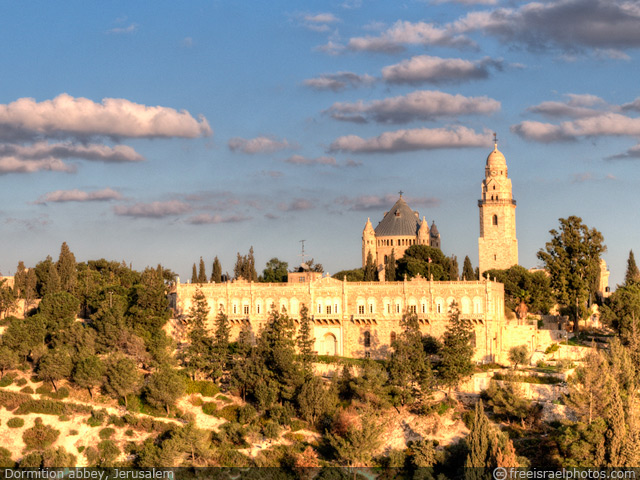
Today of course is the patronal feast day of the Abbey of the Dormition of Our Lady on Mount Zion in Jerusalem which is in the custody of the Benedictines. According to local tradition, it was on this spot, near the site of the Last Supper, that the Blessed Virgin Mary died. In Orthodoxy and Catholicism, as in the language of scripture, death is often called a "sleeping" or "falling asleep", and this gave the original monastery its name, the church itself is called Basilica of the Assumption (or Dormition).


The Russian Orthodox Church have the care of a church in the Kedron Valley at the foot of the Mount of Olives (just around the corner from the Garden of Gethsemene) which they believe holds the empty tomb of the Virgin. While Catholic teaching is silent as to whether Mary actually died and was buried, Orthodox teaching is the Virgin Mary died a natural death (the Dormition of the Theotokos, the falling asleep), like any human being; that her soul was received by Christ upon death; and that her body was resurrected on the third day after her repose, at which time she was taken up, soul and body, into heaven in anticipation of the general resurrection. Her tomb, according to this teaching, was found empty on the third day.