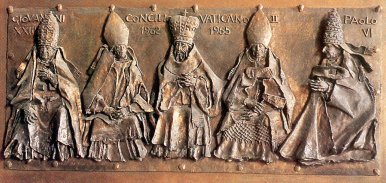
Showing posts with label Dei Verbum. Show all posts

7 Sept 2013

8th September 2013 - 23rd Sunday in Ordinary time (Year C) - Year of Faith: Exploring Our Church's understanding of Divine Revelation (Part 4 of 4)


On this week's programme we have the final episode in our Year of Faith reflection on the Second Vatican Council's Dogmatic Constitution on Divine Revelation Dei Verbum. We have our usual reflection on the Gospel and outlining our celestial guides for the week ahead.  This week's full programme is available HERE.

The book we used as the basis for our programmes on Dei Verbum is a wonderfully accessible and insightful book by Canon John Redford called Treasures of Dei Verbum.  It has the text of Dei Verbum on the left hand side of the page and an explanation of the text on the right hand side of the page.  It is available from Alive Publishing (
www.alivepublishing.co.uk)

On our first programme we outlined what Dei Verbum was all about i.e. the bishops of the Second Vatican Council saw the need to place more emphasis on the goal of divine revelation.  The whole point of divine revelation is to give us all a share in the divine life, fellowship, communion with God the Father through Jesus the Son in the Holy Spirit.  This is the good news we have to give to the world.

In our second programme we looked at how Divine Revelation was handed on by the bishops as successors of the Apostles. The teaching office of the Church (Magisterium) is the authentic interpreter of the Word of God in Scripture and Tradition. The Holy Spirit gives special assistance to the Bishops of the Church united with the Pope to serve, teach, listen to, guard and explain the Word of God. We also looked at Sacred Scripture, its inspiration and divine interpretation.

 
In our third programme we saw that the OT and the NT are the inspired word of God and how we cannot dismiss the OT because it is divinely inspired. “God, the inspirer and author of both Testaments, wisely arranged that the New Testament be hidden in the Old and the Old be made manifest in the New” (DV 16). We saw how the Old and New Testaments were not merely collections of sacred books, but witnessed to two Covenant events. The covenant event of the OT is the covenant given to Moses on the holy mountain with its laws and directions to guide the people to the promised land. The covenant event of the NT is the coming of our Lord Jesus Christ to be born of a virgin, preach the kingdom of God, perform miracles, manifest himself as God become Man, die on the cross for our salvation, rise again from the dead bodily and pour out his Spirit on those who believe. We also looked at how the books of the NT, the Gospels, the letters and the Book of revelation, are of course very important, the inspired word of God, but their value, as Dei Verbum tells us, is as the prime witness to the wonderful realities of the coming of Jesus our Saviour.
 
This week we will look at the final Chapter of Dei Verbum, Chapter 6, Sacred Scripture in the Life of the Church.

You can listen to the Dei Verbum section of the programme HERE.

Resources which may be of use to you on reading and understanding Dei Verbum:

 
Gospel - Luke 14: 25 - 33


This week's Gospel contains one of the greatest challenges Jesus ever offered to his disciples: "If anyone comes to me without hating his father and mother, wife and children, brothers and sisters, and even his own life, he cannot be my disciple." Here Christ is emphasizing the great spiritual principle of detachment. In order to live healthy spiritual lives we must love Christ most of all, with everything else finding its meaning in relation to God.

Dietrich Bonhoeffer was a German Lutheran pastor, theologian, dissident anti-Nazi and founding member of the Confessing Church. His writings on Christianity's role in the secular world have become widely influential. Apart from his theological writings, Bonhoeffer became known for his staunch resistance to the Nazi dictatorship. He strongly opposed Hitler's euthanasia program and genocidal persecution of the Jews. He was also involved in plans by members of the Abwehr (the German Military Intelligence Office) to assassinate Adolf Hitler. He was arrested in April 1943 by the Gestapo and executed by hanging in April 1945 while imprisoned at a Nazi concentration camp, just 23 days before the German surrender.

One of his most famous books is called the "Cost of Discipleship" and has a number of challenging and thought provoking quotes in line with this weeks gospel:

 
“Cheap grace is the grace we bestow on ourselves. Cheap grace is the preaching of forgiveness without requiring repentance, baptism without church discipline, Communion without confession.... Cheap grace is grace without discipleship, grace without the cross, grace without Jesus Christ, living and incarnate.” 

“Costly grace is the gospel which must be sought again and again and again, the gift which must be asked for, the door at which a man must knock. Such grace is costly because it calls us to follow, and it is grace because it calls us to follow Jesus Christ. It is costly because it costs a man his life, and it is grace because it gives a man the only true life. It is costly because it condemns sin, and grace because it justifies the sinner. Above all, it is costly because it cost God the life of his Son: 'Ye were bought at a price', and what has cost God much cannot be cheap for us. Above all, it is grace because God did not reckon his Son too dear a price to pay for our life, but delivered him up for us. Costly grace is the Incarnation of God.” 

Reflections on this weeks gospel:
Word on Fire
English Dominicans
Sunday Reflections
Centre for Liturgy
Dear Working Preacher - The cost of disipleship

Liturgical odds and ends

Liturgy of Hours - Psalter Week 3, 23rd week in ordinary time

Saints of the Week

September 9th - St Kieran of Clonmacnoise
September 10th - 205 Martyrs of Japan
September 11th - Bl Dominic Dillon (Martyr)
September 12th - Holy Name of Mary also Bl Victoria Strata
September 13th - St John Chrysostom also Bl Margaret of Cashel
September 14th - The Feast of the Exaltation of the Cross

31 Aug 2013

1st September 2013 - 22nd Sunday in Ordinary time (Year C) - Year of Faith: Exploring Our Church's understanding of Divine Revelation (Part 3 of 4)


On this week's programme we continue our Year of Faith reflection on the Second Vatican Council's Dogmatic Constitution on Divine Revelation Dei Verbum, as well as our usual reflection on the Gospel and outlining our celestial guides for the week ahead.  This week's full programme is available HERE.

The book we are using as the basis for our programmes on Dei Verbum is a wonderfully accessible and insightful book by Canon John Redford called Treasures of Dei Verbum.  It has the text of Dei Verbum on the left hand side of the page and an explanation of the text on the right hand side of the page.  It is available from Alive Publishing (
www.alivepublishing.co.uk)
On our first programme we outlined what Dei Verbum was all about i.e. the bishops of the Second Vatican Council saw the need to place more emphasis on the goal of divine revelation.  The whole point of divine revelation is to give us all a share in the divine life, fellowship, communion with God the Father through Jesus the Son in the Holy Spirit.  This is the good news we have to give to the world.

In our second programme we looked at how Divine Revelation was handed on by the bishops as successors of the Apostles.  The teaching office of the Church (Magisterium) is the authentic interpreter of the Word of God in Scripture and Tradition.  The Holy Spirit gives special assistance to the Bishops of the Church united with the Pope to serve, teach, listen to, guard and explain the Word of God.  We also looked at Sacred Scripture, its inspiration and divine interpretation.  This week we continue looking at Dei Verbum’s treatment of Scripture in Chapter 4 and Chapter 5 on the Old and New Testaments.


You can listen to the Dei Verbum section of the programme HERE.

Resources which may be of use to you on reading and understanding Dei Verbum:

Gospel - Luke 14:1, 7-14


Reflections on this weeks gospel:
HumblepietyWord on Fire
English Dominicans
Sunday Reflections
Centre for Liturgy

Liturgical odds and ends

Liturgy of Hours - Psalter Week 2, 22nd week in ordinary time

Saints of the Week

2nd September - The Martyrs of September (aka the Martyrs of Paris)

3rd September - St Gregory the Great (Pope)
4th September - St Mac Nissi (Bishop)
5th September - Bl Mother Teresa of Calcutta
6th September - Bl Thomas Tsuji SJ (Martyr) (First Friday)
7th September - St Regina

Popes Intentions for month of September

General – Silence: That the men and women of our time, often overwhelmed by noise, may rediscover the value of silence and learn to listen to the voice of God and their brothers and sisters.

Mission – Persecuted Christians: That Christians who suffer persecution in many parts of the world may be prophets of the love of Christ by their testimony


25 Aug 2013

25th August 2013 - 21st Sunday in Ordinary time (Year C) - Year of Faith: Exploring Our Church's understanding of Divine Revelation (Part 2 of 4)


On this week's programme we continue our Year of Faith reflection on the Second Vatican Council's Dogmatic Constitution on Divine Revelation Dei Verbum, as well as our usual reflection on the Gospel and outlining our celestial guides for the week ahead.  This week's full programme is available HERE.

The book we are using as the basis for our programmes on Dei Verbum is a wonderfully accessible and insightful book by Canon John Redford called Treasures of Dei Verbum.  It has the text of Dei Verbum on the left hand side of the page and an explanation of the text on the right hand side of the page.  It is available from Alive Publishing (www.alivepublishing.co.uk)


On our first programme we outlined what Dei Verbum was all about i.e. the bishops of the Second Vatican Council saw the need to place more emphasis on the goal of divine revelation.  The whole point of divine revelation is to give us all a share in the divine life, fellowship, communion with God the Father through Jesus the Son in the Holy Spirit.  This is the good news we have to give to the world.

In this week's programme, our attention turns to chapter 2 and chapter 3 of Dei Verbum.

Chapter 2 looks at 'Handing on Divine Revelation'.  Dei Verbum refers us to the teaching of the Council of Trent (1546) because it wants to reiterate Trent's teaching that Jesus Christ himself is the fullness of revelation and that Jesus gave his revelation, not in the form of a book, but to twelve men who were to preach the Gospel.  The word 'Gospel' is not restricted to those preaching from the bible alone, but means the whole package of revelation.  The apostles transmitted faithfully this whole teaching of Christ before any of it was written down. 

The Church is an apostolic church in that the bishops continue to represent the apostles as the guardians of living Tradition and of Scripture.  Dei Verbum makes it clear that the Magisterium (Teaching Office of the Church) "is not above the word of God, but serves it, teaching only what has been handed on, listening to it devoutly, guarding it scrupulously and explaining it faithfully in accord with a divine commission and with the help of the Holy Spirit" (DV 10)

Chapter 3 examines 'Sacred Scripture, its inspiration and divine interpretation'.  The Second Vatican Council in clear in stating that Scripture "must be acknowledged as teaching solidly, faithfully and without error that truth which God wanted put into sacred writings for the sake of salvation" (DV 11).  In other words, the Scriptures contain no error in that they say exactly and no more what God wanted to say for our salvation.

The bible is not so much a book as a library of books, and, as such, contain many different types of 'literary forms' e.g. poetry, historical narratives, epistles (letters), farewell discourses, statements of belief etc.  The interpreter of Scripture must look at Scripture in the light of the contemporary literary forms of the writers of Scripture in accordance with the situations of their own time and cultures, way of speaking, styles of writing etc.  However, the Church's understanding of what God is saying to us is not limited to the historical method.  There is also a spiritual sense of Scripture, that meaning which God wants to convey to us through the Holy Spirit. 

The last paragraph of chapter 3 speaks of God's marvellous 'condescension'.  Sometimes when we think of the word condescending, we think of it is an insult, but in this context it shows God's fatherly love for us in sending his Son to us to reveal his great love for us.

You can listen to the Dei Verbum section of this programme HERE.

 
Resources which may be of use to you on reading and understanding Dei Verbum:
Gospel - Luke 13:22-30

It has often been said that the Gospel comforts the disturbed and disturbs the comfortable.  This Gospel is certainly one that should disturb us if we have grown complacent in our relationship with God!  Some of us may have a tendency to skip over the harder readings from scripture, to find something that sits better with us, but it is better for us to sit with these scriptures.

All of the readings for the 21st Sunday in Ordinary Time tell us that salvation is for everyone.  God desires to give every single human being a share in divine life, however, the Gospel warns us against taking God for granted and becoming complacent in our relationship with him.

We know from our human relationships, that they take time and effort.  How easy it is to grow apart from friends when we don't make the effort to keep in touch.

Yes, today's Gospel is not an easy one, but the Second Reading reminds us that God is treating us like his children and sometimes children need a little reminder when they are going astray (cf. Heb 12:5-7).  Let us take this opportunity to reflect on our relationship with God.  Do we take God for granted?  Do we work on our relationship with God, or do we sometimes think that just because I'm a Catholic, I'm automatically going to heaven?  Do we seek to deepen our love for God and our charity towards others, or have we become complacent, letting other worries and cares distract us?  As Jesus said, let us strive to enter through the narrow door.  If we have become distant from God, treating him almost like a penpal or someone we only run to when we are in trouble, let us get in contact with him again today.  He cannot wait to hear from us.

Reflections on this week's Gospel:
Word on Fire
Sunday Reflections
Centre for Liturgy
Blue Eyed Ennis
English Dominicans

Liturgical Odds and Ends

Liturgy of the Hours - Psalter Week 1  - 21st Sunday in Ordinary Time

Saints of the Week
August 27th - St. Monica
August 28th - St. Augustine of Hippo (Bishop and Doctor of the Church)
August 29th - The Passion of St. John the Baptist
August 30th - St. Fiacre (Monk)
August 31st -  St. Aidan of Lindisfarne (Bishop and Missionary)

17 Aug 2013

18th August 2013 - 20th Sunday in Ordinary time (Year C) - Year of Faith: Exploring Our Church's understanding of Divine Revelation (Part 1 of 4)

On this weeks programme as part of its coverage of the Year of Faith, SS102fm begins a short series on exploring the Catholic Church's understanding of Divine Revelation as set out during the second Vatican Council in 1965.
 
We have our regular reflection on the gospel and liturgical odds and ends including our celestial guides of the week.
 
This weeks programme can be heard in full on podcast HERE.
 
You can listen to the Dei Verbum element of the programme excerpted from the programme HERE and it will also be linked on our Year of Faith page which we encourage you to visit which you can click to here or use the links at the top of the page.
 
 
The Church's understanding of Divine Revelation (Dei Verbum, Part 1)
 
Pope Benedict XVI announced that the universal Church would celebrate a Year of Faith beginning on October 11th 2012 and ending on the Solemnity of Our Lord Jesus Christ, Universal King on November 24th 2013. This is a special year in which we are asked as to reflect on the gift of faith as the universal Church, diocesan level, parish, community and individually. The Year of Faith has a three-fold focus: knowing our Catholic faith, living it out sacramentally within the church and in the world, and sharing the faith through evangelization and catechesis.
October 11th 2012 marked the fiftieth anniversary of the opening of the Second Vatican Council (Vatican II) and the 20th anniversary of the publication of the Catechism of the Catholic Church. Both of these occassions mark important moments in the history of the church in the last fifty years; moments of history to which we are only now beginning to see bear fruit.
 
As part of SS102fm's contribution to the Year of Faith and given our focus on scripture and lectio divina on the programme we decided to do a short introductory series on the Church's understanding of Divine Revelation with a particular focus on a document called "Dei Verbum".

The book that we are using as the basis for our programmes on Dei Verbum is a wonderfully accessible and insightful book by Canon John Redford called Treasures of Dei Verbum. It has the text of Dei Verbum on the left hand side of the page and an explanation of the text on the right hand side of the page. It is available from Alive Publishing (
www.alivepublishing.co.uk).


Dei Verbum (the Word of God) is the short name used for the Dogmatic Constitution on Divine Revelation. A dogmatic constitution is a “document of the highest authority, issued by the Pope, or by a Church Council with the Pope's approval… When used to proclaim a Church dogma, [it is] called a Dogmatic Constitution”. The constitution went through 5 drafts before finally being approved unanimously by the whole Council in 1965.

This was a controversial document. Pope John XXIII disbanded the preparatory commission because it was not working satisfactorily and formed another which turned out more successful. Pope Paul VI promulgated the document on November 18th 1965, but it was a document issued by the whole body of bishops of the Catholic Church. As Church documents go, it is a very short document – only 26 paragraphs – but it deals with a very important topic, Divine Revelation.
 
 
The structure of the document:
 
Preface (Paragraph 1)
Chapter 1 – Revelation Itself (Paragraphs 2 – 6)
Chapter 2 – Handing on Divine Revelation (Paragraphs 7 – 10)
Chapter 3 – Sacred Scripture, Its Inspiration and Divine Interpretation (Paragraphs 11 – 13
Chapter 4 – The Old Testament (Paragraphs 14 – 16)
Chapter 5 – The New Testament (Paragraphs 17 – 20)
Chapter 6 – Sacred Scripture in the Life of the Church (Paragraphs 21 – 26)

This programme will look at the Preface and Chapter 1. Programme 2 in the series will look at Chapter 2 and 3; Programme 3: Chapter 4 and 5 and Programme 4: Chapter 6
 
In accordance with a long tradition of the Church, Popes and Councils name an important document from the first two or three words of the document. These words indicate what the document was about. Dei Verbum (the Word of God) names the subject of this document, the word which God addressed to us through four thousand years (2,000 years before the coming of Christ – the Old Testament) and 2,000 years since.
 
It is important for us Catholics to realise that the Word of God does not refer to the Bible alone, but also to the living Tradition of the Church. In the Preface, the document refers to the Council of Trent which was convoked in 1545 and the First Vatican Council which met in 1870. These were two defining Councils in the Church’s history – the Council of Trent defined that the revelation of God is contained in the Sacred Scripture and also in the living Tradition of the Church (e.g. the Sacraments). Trent declared that the Word of God is “contained in written books (i.e. the Bible) and in unwritten traditions”.
 
Revelation means ‘to uncover’, ‘to remove a veil’. The First Vatican Council affirmed that that some truths about God can be known by human reason (e.g. that God exists), but some truths about God can only be known if God reveals that truth explicitly. For example, we could never have known by reason alone that God was Trinity unless He revealed that to us.
 
So this document, Dei Verbum, builds on the teachings of previous Church Councils and teachings. It is important to remember that the Church’s knowledge about God through scripture and tradition is not static, but grows and develops throughout the centuries. The bishops of the Second Vatican Council saw the need to place more emphasis on the goal of divine revelation. The whole point of divine revelation is to give us all a share in the divine life, fellowship, communion with God the Father through Jesus the Son and in the Holy Spirit. That is the good news we have to give the world.
 
You can listen to the Dei Verbum section of this programme HERE.
 
Resources which may be of use to you on reading and understanding Dei Verbum:
 
Gospel - Luke 12:49-53


We are presented with a tough little passage from Luke this weekend. People think Luke is all nice and cuddly, highlighting the mercy of God, but He can really pack a punch too!

From Sean Goan's "Let the Reader understand":

The idea that the kingdom of God is both a gift and a challenge is very present in the extract from the gospel that is put before us today. The encouraging opening words inspire confidence in the hearers as Jesus reminds his ‘little flock’ that there is no need for fear because the kingdom has been given. So if the disciples are not to fear, what should they do? Jesus answers this question in a most challenging way by telling them to think differently about the world and their place in it. They should not be concerned about wealth or the exercise of power; rather they should busy themselves doing what the Lord asks of them as any good servant would do. Jesus puts it to his disciples very sternly — much has been given you, so much will be expected from you. This is not to inspire fear but to inspire reflection on how gifted we truly are.

Reflections on this weeks gospel:

Word on Fire
Sunday Reflections
Centre for Liturgy
Blue Eyed Ennis
English Dominicans

Liturgical Odds and Ends

Liturgy of the Hours - Psalter Week 4 - 20th Week in Ordinary time

Saints of the Week

August 19th - St John Eudes (priest)
August 20th - St Bernard of Clairvaux (Abbot and Doctor of the Church)
August 21st - St Pius X (pope)
August 22nd - The Queenship of the Blessed Virgin Mary
August 23rd - St Rose of Lima
August 24th - St Bartholomew (Apostle)

9 Sept 2010

Lectio Divina II - A New Spiritual Springtime

Excerpts from the address of Benedict XVI delivered in the courtyard of the papal summer residence of Castel Gandolfo, on Sept. 16, 2005 to 400 participants in the international congress on "Sacred Scripture in the Life of the Church." The Sept. 14-18 congress, in Rome, attracted 400 experts, including about 100 bishops. The initiative commemorated the 40th anniversary of the Second Vatican Council's dogmatic constitution on divine Revelation, "Dei Verbum."

"We are grateful to God that in recent times, and thanks to the impact made by the Dogmatic Constitution "Dei Verbum" the fundamental importance of the Word of God has been deeply re-evaluated. From this has derived a renewal of the Church's life, especially in her preaching, catechesis, theology and spirituality, and even in the ecumenical process. The Church must be constantly renewed and rejuvenated and the Word of God, which never ages and is never depleted, is a privileged means to achieve this goal. Indeed, it is the Word of God, through the Holy Spirit, which always guides us to the whole truth (cf. John 16:13).
In this context, I would like in particular to recall and recommend the ancient tradition of "Lectio divina": "the diligent reading of Sacred Scripture accompanied by prayer brings about that intimate dialogue in which the person reading hears God who is speaking, and in praying, responds to him with trusting openness of heart" (cf. "Dei Verbum," n. 25). If it is effectively promoted, this practice will bring to the Church -- I am convinced of it -- a new spiritual springtime.
As a strong point of biblical ministry, "Lectio divina" should therefore be increasingly encouraged, also through the use of new methods, carefully thought through and in step with the times. It should never be forgotten that the Word of God is a lamp for our feet and a light for our path (cf. Psalm 119[118]:105).