Showing posts with label Reek Sunday. Show all posts

11 Aug 2018

Homily of Archbishop Michael Neary for Reek Sunday


Questions enable us to clarify our priorities, what is taking place in our lives and how we are coping in the world we share with others.  God’s first question to humankind in the early pages of the Bible: “Where are you?” (Genesis 3:9) is a question each one of us is called to answer and a question which we are called to answer together.  It is a question which is of huge importance and the answer to which is very informative and revealing in our culture today. 

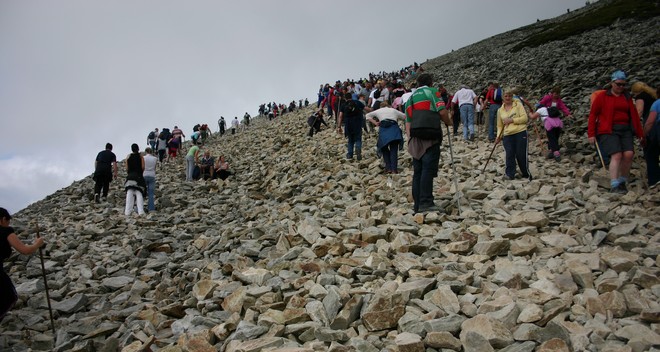
The rugged, jagged edges of the slopes of Croagh Patrick challenge and question us.  We are very conscious of the slow, silent decline of faith in Ireland.  Many feel they are “strangers in a strange land”.  Pilgrimages provide an opportunity to take stock but also a time to discover new heart.

Croagh Patrick, long seen as one of the acid tests of continuing practice throughout the country, was always far more than that.  It was never simply a communal celebration of the status quo. Its uncompromising and inhospitable terrain,  cut through all groupthink and sentimentality and roughly summoned the individual believer back to the absolute rock bottom, the “ground zero” of his or her experience.  Back to the desert, so to speak,  where any believer in Jesus Christ can share prophecy with Moses, and God is encountered face to face.  

We are familiar with the way in which we have questioned our faith but we also need to be questioned by our faith.  We need that encounter as never before, as individuals and as Church. As in the Roman Empire, the Church, again small, peripheral, suspect and despised, faces a brilliant, glittering and self-assured civilisation. Short and medium-term goals animate terrific and sustained concentration and effort.  In politics, business, entertainment and sport careers are made, unmade or simply just die unnoticed, all at a tremendous pace.  Our educational system makes fewer and fewer bones about the socio-economic goals of learning and there is less and less value placed on knowledge for its own sake and wisdom as an end in education.  The questions are also of the short and medium-term:  Where? When? How? There is little patience for the questions of “Why?”.

But God is not in the hurricane or the earthquake or the fire (1 Kg 19: 11-13).  He is not the bewildering competition of sounds and voices saying variations of nothing. He is in the “still, small voice” (1 Kg 19: 12). To hear Him, we must, like Elijah, forsake familiarity, comfort and safety and go out to the entrance of the cave (1 Kg 19: 13).  We must perfect a key skill of our trade as disciples, a hard skill: we must learn to listen. And to listen we must learn to be quiet, to stop our incessant chatter, to look away from the social mirror which allegedly tells us who we are.

It would be easy, as Church,  to avoid the long, hard personal journey.  To spend all of our remaining energy on desperately vying for the attention of this culture.  Grabbing any chance to speak to society as a whole.  To address the nation from any pulpit at which it will now briefly gather.  The truth is that we must ensure before talking that we have something to say.  No prophet goes to the people without having first listened to God.  The process cannot be reversed.  The one must always precede the other.

Today the Church in Ireland is called to return, for the umpteenth time in the repeated ebb and flow of its long history, to penance and prayer.  To begin yet again that historical process of Christian discernment which has at its heart the attitude of listening “to what the Spirit is saying to the churches”.   Could it be that we yet have our best work to do?  And that this work will be done by a small, socially and politically peripheral and poorer Church?  A Church which has rediscovered through adversity the honesty and authenticity of the suffering servant, the prophet, the abandoned Messiah?  A Church which has rediscovered its own ancient wisdom and which places God first, confident that all will then be well?

Just as once we were consulted and heard in the most powerful circles, now we must get used to preaching on street corners and making the Gospel heard over the incessant hubbub of the public square.  What will we have to say?  Are we to become enmeshed in an endless pattern of reaction, forever back-footed by events or do we take the opportunity now to come in from the desert, from places like this and the necessary retreat and recollection they symbolise, and give the Good News of God’s love and grace?  Unbidden and even unwanted?  An outright free gift at God’s initiative? 

If we have one mission it is surely to subvert the closed shop that is the modern, western world view and to startle that careful, calculating world with the unaccounting largesse, the generosity, the hospitality of God. 

We are indeed strangers here.  The truth is that we always were. For all its grandeur, and there is no shortage of grandeur in the view from this mountain, this world is too small for us.  We will not be strangers forever.  The call of Croagh Patrick is not to unthinking and endless renunciation.  It is simply a call to powerful things beyond the frail and undependable present.  It is a call to holiness: to meaning, belonging and home.

31 Jul 2016

Reek Sunday 2016


Homily Notes of Archbishop Charles J Brown for the Annual Croagh Patrick Pilgrimage

The path of Christian faith is still alive in Ireland in 2016. Perhaps at ...times we are tempted to be downcast, to keep our eyes down and our heads down. Even physically, many of us, and I include myself in this, have our heads literally down as we read our smart phones and type and text. But Jesus Christ is saying to each of us today: “sursum corda” – hearts up! – Archbishop Brown

Homily Notes:

“I lift up my eyes to the mountains, from where shall come my help? My help comes from the Lord who made heaven and earth” (Psalm 121:1).

Brothers and sisters in Christ, from the dawn of history, human beings have been fascinated by mountains. There is something intangibly mystical, attractive and enchanting about the high places, something profoundly renewing about just being in the mountains. The American naturalist, John Muir, the father of the American National Park system, famously gave advice to his contemporaries about finding peace: “Climb the mountains” he wrote, “and get their good tidings. Nature’s peace will flow into you as sunshine flows into trees. The winds will blow their freshness into you, and the storms their energy, while cares will drop off like autumn leaves.”

For Catholic Christians, the mountains are something more than a place of beauty and refreshment and renewal. The mountains are places where we come in contact with the mystery of God: in the Old Testament, it is on the Mountain of Sinai that Moses encounters the unspeakable majesty of God and receives the Ten Commandments. In the New Testament, on the new Mountain, the Mountain of the Beatitudes, the disciples of Jesus receive from him the new law of love.

28 Jul 2012

Reek Sunday 2012

Source: Irish Catholic Bishops Conference

Psalm 121: God the Help of Those Who Seek Him

A Song of Ascents.

I will lift up my eyes to the hills—
From whence comes my help?
2 My help comes from the Lord,
Who made heaven and earth.
3 He will not allow your foot to be moved;
He who keeps you will not slumber.
4 Behold, He who keeps Israel
Shall neither slumber nor sleep.
5 The Lord is your keeper;
The Lord is your shade at your right hand.
6 The sun shall not strike you by day,
Nor the moon by night.
7 The Lord shall preserve you from all evil;
He shall preserve your soul.
8 The Lord shall preserve your going out and your coming in
From this time forth, and even forevermore.


Tomorrow, being the last Sunday in the month of July is "Reek Sunday", the day traditionally associated with the climbing of one of Ireland's holy mountains, Croagh Patrick in Co Mayo.

The tradition of pilgrimage to this holy mountain stretches back over 5,000 years from the Stone Age to the present day without interruption. Its religious significance dates back to the time of the pagans, when people are thought to have gathered here to celebrate the beginning of harvest season.

Croagh Patrick is renowned for its Patrician Pilgrimage in honour of Saint Patrick, Ireland's patron saint. It was on the summit of the mountain that Saint Patrick fasted for forty days in 441 AD and the custom has been faithfully handed down from generation to generation.

From CatholicIreland.net:

Close to 30,000 pilgrims are expected to take part in the annual Reek Sunday pilgrimage this weekend on Ireland's holy mountain, Croagh Patrick, which is in the Archdiocese of Tuam.
 
The pilgrimage has been carried out uninterrupted on Reek Sunday, the last Sunday in July for over 1,500 years.
 
The Croagh Patrick pilgrimage is associated with St Patrick who, in 441, spent 40 days and nights fasting on the summit, following the example of Christ and Moses. The name 'Reek Sunday' comes from Patrick's ability to Christianise many pagan customs including the festival of Lughnasa, which previously had heralded the start of the harvest festival honouring the ancient pagan god Lugh, whose name is encompassed in the Irish word for August - Lughnasa.
 
The festival's tradition became absorbed into the new Christian beliefs and locally became known as Domhnach na Cruaiche (Reek Sunday).
 
As in previous years, the climb of Croagh Patrick will be led by the Archbishop of Tuam Most Rev Michael Neary. This year he will be accompanied by the newly appointed Papal Nuncio to Ireland Cardinal Charles Browne. Cardinal Browne (52) stated when he was appointed in January of this year that he, “wished to get to know more about Ireland,” and it is believed that his decision to make the climb is in keeping with that promise.
 
According to the diocese of Tuam, Mass will be celebrated at the summit at 8:00am and every half-hour thereafter until the last Mass at 2:00pm.
 
The Papal Nuncio will celebrate the 9:30pm at Saint Patrick's Oratory at the summit of the mountain while the 10:00am Mass will be celebrated in Irish by Fr Jim Walsh.
 
Archbishop Neary will celebrate Mass at 10:30am.
 
Pilgrims may avail of the Sacrament of Reconciliation on the summit from 7:30am to 2:30pm.  
 
 
Mayo Mountain rescue service are asking all those who intend to climb to come prepared for the current weather conditions, to bring suitable warm and waterproof clothing, good footwear, a walking stick or staff, and water, and to be mindful of the safety of themselves and other pilgrims.
 
Meanwhile ahead of the climb, the parish priest of Westport Fr Charlie McDonnell has revealed that a Conservation Plan on the future use of Croagh Patrick has started.
 
“We are the custodians of Croagh Patrick for future generations and I must say that there is an element of recklessness in its present use. But this is not about apportioning blame. The various partners need to sit down, and this has already started, and make a future plan for its conservation and sustainability.”
 
He added, “I think everyone who uses the mountain needs to respect its Christian and pre-Christian heritage. If you look back at old photographs to the 1950's there is one clear path going up the mountain. Now it looks like a hodgepodge of many different paths.”
 
 
Further information about climbing Croagh Patrick and Reek Sunday: