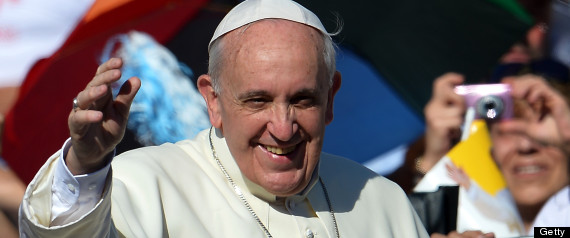
Pope Francis has given an interview to the Jesuit family of journals and publications which as been published simultaneously around the world which is a very frank, open and for all catholics of different views challenging. Pope Francis reaffirms the church's pastoral focus on its dealings with gays and lesbians, underscores understanding of the equivalence of doctrines and teachings and is very open and frank about his own personal failings. While calling for a greater awareness and listening to women's voices, Pope Francis reaffirms the church's understanding that even if it wanted to, it does not have the authority to ordain women priests. He reflects on the second Vatican council and what it means to be a faithful catholic "thinking with the church".
It is an article worth reading slowly, even somewhat prayerfully as it will provoke and challenge and given the way it will be distorted into sound bites by secular media, it is well worth spending the time and reading the original which we have set out below. At the bottom of the article we have put some links to initial reaction and analysis for you to review and read.
UPDATE I: You can download a Kindle version of the interview HERE
UPDATE IV: - yes oddly we are putting this link before all the rest as it would be a great idea to read The Parable of the Papal interview before hand to give ourselves some perspective with the strong recommendation you read the reactions and commentary AFTER reading the interview below
UPDATE II: Reactions and commentary
John Allen - NCR
Analysis and coverage from America magazine HERE (at the bottom of the page)
Time magazine
First Things
Poking the Pope - Fr Dwight Longenecker raises some questions on interpretation of the Popes comments and actions
Catholic Online
NPR in the USA interview with Fr James Martin SJ
Cardinal Timothy Dolan of New Yorks response
Archbishop Diarmuid Martins response HERE and HERE
Fr Thomas Reese SJ in NCR
Whispers in the Loggia
Jimmy Akin at National Catholic Register
The Confession of a Pope who came from afar - Sandro Magister
John Thavis
Elizabeth Scalia asks the question - "Is the world making an idol of Pope Francis?"
UPDATE III:
Reactions from the Jesuit Post (which are being updated regularily)
David Quinn - Irish Independent
Jeffrey Tucker - New Liturgical Movement
*************
Jesuit Editors Note: This interview with Pope Francis took place over the course of three meetings during August 2013 in Rome. The interview was conducted in person by Antonio Spadaro, S.J., editor in chief of La Civiltà Cattolica, the Italian Jesuit journal. Father Spadaro conducted the interview on behalf of La Civiltà Cattolica, Thinking Faith, America and several other major Jesuit journals around the world. The editorial teams at each of the journals prepared questions and sent them to Father Spadaro, who then consolidated and organised them. The interview was conducted in Italian. After the Italian text was officially approved, a team of five independent experts were commissioned to produce the English translation, which is also published by America.
Father Spadaro met the pope at the Vatican in the pope’s apartments in the Casa Santa Marta, where he has chosen to live since his election. Father Spadaro begins his account of the interview with a description of the pope’s living quarters.
The setting is simple, austere. The workspace occupied by the desk is small.
I am impressed not only by the simplicity of the furniture, but also by the
objects in the room. There are only a few. These include an icon of St. Francis,
a statue of Our Lady of Luján, patron saint of Argentina, a crucifix and a
statue of St. Joseph sleeping. The spirituality of Jorge Mario Bergoglio is not
made of “harmonised energies,” as he would call them, but of human faces:
Christ, St. Francis, St. Joseph and Mary.
The pope speaks of his trip to Brazil. He considers it a true grace, that
World Youth Day was for him a “mystery.” He says that he is not used to talking
to so many people: “I can look at individual persons, one at a time, to come
into contact in a personal way with the person I have before me. I am not used
to the masses,” the pope remarks. He also speaks about the moment during the
conclave when he began to realise that he might be elected pope. At lunch on
Wednesday, March 13, he felt a deep and inexplicable inner peace and comfort
come over him, he said, along with a great darkness. And those feelings
accompanied him until his election later that day.
The pope had spoken earlier about his great difficulty in giving interviews.
He said that he prefers to think rather than provide answers on the spot in
interviews. In this interview the pope interrupted what he was saying in
response to a question several times, in order to add something to an earlier
response. Talking with Pope Francis is a kind of volcanic flow of ideas that are
bound up with each other. Even taking notes gives me an uncomfortable feeling,
as if I were trying to suppress a surging spring of dialogue.
Who Is Jorge Mario Bergoglio?
I ask Pope Francis point-blank: “Who is Jorge Mario Bergoglio?” He stares at
me in silence. I ask him if I may ask him this question. He nods and replies: “I
do not know what might be the most fitting description.... I am a sinner. This
is the most accurate definition. It is not a figure of speech, a literary genre.
I am a sinner.”
The pope continues to reflect and concentrate, as if he did not expect this
question, as if he were forced to reflect further. “Yes, perhaps I can say that
I am a bit astute, that I can adapt to circumstances, but it is also true that I
am a bit naïve. Yes, but the best summary, the one that comes more from the
inside and I feel most true is this: I am a sinner whom the Lord has looked
upon.” And he repeats: “I am one who is looked upon by the Lord. I always felt
my motto, Miserando atque Eligendo [By Having Mercy and by Choosing Him],
was very true for me.”
The motto is taken from the Homilies of Bede the Venerable, who writes
in his comments on the Gospel story of the calling of Matthew: “Jesus saw a
publican, and since he looked at him with feelings of love and chose him, he
said to him, ‘Follow me.’” The pope adds: “I think the Latin gerund
miserando is impossible to translate in both Italian and Spanish. I like
to translate it with another gerund that does not exist: misericordiando
[“mercy-ing”].
Pope Francis continues his reflection and says, jumping to another topic: “I
do not know Rome well. I know a few things. These include the Basilica of St.
Mary Major; I always used to go there. I know St. Mary Major, St. Peter’s...but
when I had to come to Rome, I always stayed in [the neighbourhood of] Via della
Scrofa. From there I often visited the Church of St. Louis of France, and I went
there to contemplate the painting of ‘The Calling of St. Matthew,’ by
Caravaggio.
“That finger of Jesus, pointing at Matthew. That’s me. I feel like him. Like
Matthew.” Here the pope becomes determined, as if he had finally found the image
he was looking for: “It is the gesture of Matthew that strikes me: he holds on
to his money as if to say, ‘No, not me! No, this money is mine.’ Here, this is
me, a sinner on whom the Lord has turned his gaze. And this is what I said when
they asked me if I would accept my election as pontiff.” Then the pope whispers
in Latin: “I am a sinner, but I trust in the infinite mercy and patience of our
Lord Jesus Christ, and I accept in a spirit of penance.”

 Pedro Arrupe SJ died on this day in 1991. He was the first Basque since St Ignatius to be superior General of the Jesuits. He trained as a doctor before entering the Society and became a member of the Japanese Province. When the atomic bomb was dropped in August 1945 he was novice master at the community on the edge of Hiroshima and he organised for the care of many of the victims in the city. He became Provincial in Japan, and was elected General of the Jesuits in 1965. He was a inspirational leader and was widely respected as a ‘re-founder’ of the Society of Jesus in the light of Vatican II. He became a vocal advocate of peace and justice being an integral part of the preaching of the Good News in the modern world. Just before he was incapacitated by a stroke in 1981, he established the Jesuit Refugee Service, now at work today in more than 50 countries worldwide.