Showing posts with label Holy Thursday. Show all posts

1 Apr 2018

Holy Thursday Homily of Fr Abbot Brendan Coffey OSB - Glenstal


Glenstal Abbey
Homily for Holy Thursday
Fr Abbot Brendan Coffey OSB  
30 Mar 2018

When the Jewish Passover meal is celebrated the youngest in the family asks “what makes this night different from all other nights?” This gives rise to the telling of the story of the Exodus. We could well ask this same question this evening; what makes this night different from all other nights? This evening the scene is set for us in the upper room. According to tradition this is the place where Jesus shares the Last Supper with his disciples; where he will appear among them after his resurrection and where the Holy Spirit will descend upon them. Here, in this room the Church is born and from this place she goes forth into the world. What happens in this room forms the Church, you and me, and the memory of all that takes place here tells us who we are. What happens in this room reminds us of service, sacrifice and communion. What happens in this upper room, however, also reminds us of other things, betrayal, pettiness and jealousy. The entire spectrum of human life is found within the walls of this one room and out of this mixed bag of experiences the Church is born. It embraces all of life and by so doing makes all things new in Christ.

          At the Last Supper their little community was falling to pieces; things were not going well. Just when it all seemed hopeless Jesus does something completely unexpected. He took bread into his hands “this is my body which will be given up for you”. In that upper room on this holy night the Lord Jesus gave his body and blood for us. He leaves us the covenant that he will seal with his blood on the cross. Every time we celebrate the Sacraments the Lord Jesus kneels down again before our feet and washes us. The new commandment consists in loving together with him who loved us first. I have given you an example. The foot washing has been traditionally referred to as the Mandatum, the Command. It is a command from the Lord himself to become a man or woman poured out for others.

Jesus’ action speaks of loving kindness, mercy, tenderness and compassion. These are things that heal. This is to be our way of being in the world. It speaks of a God whose heart was capable of being deeply moved when confronted by human suffering and need; it speaks of a body that is given for us; it speaks of someone who is true and faithful, someone who understands and is always present. This is what our world today longs for; authenticity, honesty, kindness and integrity.

We are presented on this night with a scene unlike any other. Jesus removes the garments of his glory and clothes himself with the towel of humility. Never before and never since have we witnessed an action which speaks such love and such respect for everything human. It becomes for Jesus a profound offering of intimacy and communion. This is re-enacted not just when we celebrate our Eucharist, but also when we do even small things that speak of human dignity and hope.

Each one of us can identify with the uncertainty and confusion of the disciples in the Upper Room at the Last Supper. When Jesus commands his disciples to repeat this action he is not merely talking about the washing of feet. He is insisting that we forgive one another as he has forgiven us; that we love one another as he has loved us. Do this in memory of me. The Lord puts the jug and towel into our hands this night so that we can become truly Christian. No mere spectators in this Act of Love we are empowered to become participants.

Who needs my forgiveness and love this night? From whom do I need forgiveness? How important this is, is brought home to us forcefully when we look upon the face of human tragedy; victims of mass shootings, victims of natural disasters, famines, wars, violence and hatred, the homeless and refugees, those who die of the cold on our streets. It is here that the foot washing comes to life and it is here that we understand the meaning of this sacrament we celebrate. It comes with a cost, but this is what it means to be a Christian. What makes this night different to all other nights? Tonight we say ‘yes’ to his Mandatum, his command to love as we begin the journey of these three days. And as we say yes we show ourselves to be a people of the Lamb.

29 Mar 2018

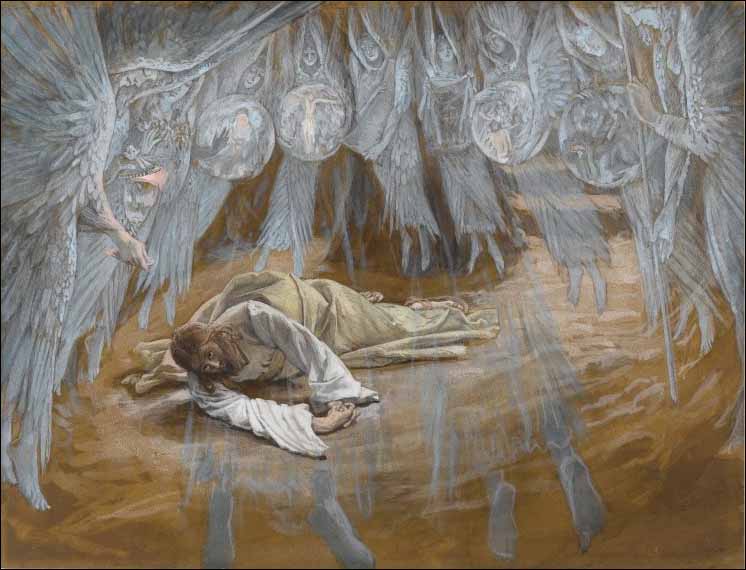
Let us keep watch with the Lord in his agony


Tissot, Jesus in Agony in the Garden


His companions asleep in the shade;
His Father - in heaven, yet rejecting him,
A frightening void where love succumbs;
No bird in the quivering tree......


Is it only Jesus who keeps vigil,
imprisoned by unending night?
Is only he abandoned? Only his ear waiting in
vain for the voice of the morning?

In her house, the window open
onto the hill, once so green,
which she beheld, in happier times,

the Mother also suffers in agony
for the absent son, forgotten by his Father,
but she must shed her tears alone.

Miroir de peine ('Mirror of Pain') by the Belgian poet Henri Gheon (the pen name of Henri Vangeon) is a set of five poems which describe Christ's sufferings from the point of view of his mother Mary. Hendrick Andriessen composed his setting in 1923.

"Could you not keep watch for one hour" by James Tissot

Could YOU not keep watch with me one hour?


Garden of Gethsemene - October 2011

And so it begins.....................

O Holy Tridiuum!


As the sun sets this evening Christians enter into the sacred and blessed Triddum - the three days where Christians remember the Passion, Death and suffering of our Saviour Jesus Christ before the good news, the great news, the glorious news of Easter morning.
‘The Easter mystery is a game changer. It is definitely a game changer for us. But don’t forget it was also a game changer for Jesus and his companions. The first point, I am sure many of you will preached on, the resurrected Jesus still bears the wounds of the crucifixion. The resurrected Jesus is deeply connected to his death and the manner of his death. The resurrection does not undo the death, but it does cast it in an entirely new light. The second point is that whilst there is continuity (as evidenced by the wounds) everything changes. The resurrection was literally unimaginable. And the what Jesus does post resurrection changes. There are no post resurrection stories of Jesus feeding the multitude, of Jesus preaching, of Jesus healing the sick. Jesus’ way of being in the world changes.
As Christians we celebrated the Paschal mystery every year. As a Roman Catholic, the liturgy of the Easter Triduum is quite extraordinary. We have a single liturgical service held over three days. On Maundy [Holy] Thursday we commemorate the Last Supper, the celebration pauses with a time of contemplation as we consider Jesus in Garden of Gethsemane. The second phase of the liturgy begins on Friday afternoon – the reading of the Passion and the veneration of the Cross. It is the only day in the entire year where there is no consecration of the Eucharist. The third phase begins on Saturday evening. It is the telling of Salvation history, the singing of the beautiful Exsultet, the affirmation of our baptismal promises and the declaration that he is indeed risen.
It is only as I prepare this talk, that I recognize the powerful subliminal messaging that is inherent in the annual cycle of Lent, Easter and the Easter season. We need a perennial reminder that death is not the end, but it is also not trivial. It is this foundational paradox – death does change everything, but not necessarily in the way that we expect. Death is an end but it is not necessarily the end.’
It is this reminder that gives us the faith to hold our nerve through the countless deaths both literal and metaphorical which life serves us.
Maggie Blackie - Reflections, thoughts and conversations on the essence of life 
At his general audience on Wednesday 28th March, Pope Francis reflected on the Paschal Triduum, calling it the center “of our faith and vocation in the world”. The Triduum, or “three days”, begins with the Mass of the Lord’s Supper on Thursday evening and ends on Easter Sunday. The Holy Father said Christians are called to live the mystery of Jesus’ death and resurrection as “the matrix of their personal and communitarian lives”.

Pope Francis said the climax of the Church’s liturgical year is proclaimed at Mass on Easter Sunday in the Sequence: “Christ, my hope, is arisen; into Galilee he will go before his own.” He called this both “a proclamation of joy and hope” and “an appeal to responsibility and mission. The Triduum, he said, prepares us to receive this proclamation. “It is the center of our faith and our hope. It is the kerygma, which continuously evangelizes the Church, which in turn is sent out to evangelize.”

Pope Francis said the Paschal Triduum renews baptized Christians in “the meaning of their new condition”. “In Baptism,” he said, “we are raised with Jesus and we die to the things and logic of this world.” He said this new condition must be lived out concretely day-by-day. “A Christian – if they truly let themselves be washed by Christ and stripped by him of ‘the old man’ to walk in newness of life – even though they remain a sinner, cannot be corrupted. [The Christian] can live no more with death in their soul, nor can they be a cause of death.”

Pope Francis said the world becomes “the space to live our newly resurrected lives.” We are called to do this, he said, “on our feet, with our head held high. Thus can we share the humiliation of those who today, like Jesus, still suffer nakedness, need, loneliness, and death”.

The Holy Father said that it is thanks to Jesus and with Him that we become “instruments of redemption and hope, as well as signs of life and resurrection.”


For Latin Christians/Roman Catholics Holy Thursday night marks the celebration of the Mass of the Lords Supper when we commemorate the institution of the Eucharist, the priesthood and remember the Mandatum - the great commandment

At the Last Supper, Jesus took a basin and a towel, got down on his hands and knees and washed the feet of all of his apostles. After this action, he commanded the apostles, “I have given you a model to follow, so that as I have done for you, you should also do” (John 13:15). This is Jesus’ commandment: Just as Jesus has been a servant to his apostles, so the apostles must go out into the world and be servants to everyone around them.


We are called to do the same in our daily lives. Well, we are not called literally to wash each other’s feet (though sometimes that may be the case). The action of washing one another’s feet reminds us of the call to humble servitude. Foot washing is not a re-enactment or re-creation of a past event, but rather, it is a commemorative action that reminds us that God calls us first and foremost to be servants to others in our daily lives.


At the very first Last Supper, Jesus also instituted the Eucharist for the Church. At this Holy Thursday celebration, we are reminded of who we are in Jesus Christ and that, through the sacrament of the Eucharist, we are and we become even more the Body of Christ together.


At the conclusion of the Holy Thursday celebration, there is no concluding prayer. Once the celebration of the Eucharist is completed, there is a Eucharistic Procession (where the Eucharist that is left from Communion is processed to a Chapel of Reservation). This procession to the Chapel of Reservation reminds us of Jesus’ time in the garden of Gethsemane when he prayed so fervently through the night. The entire community is invited to join in this procession and then join in the silent prayer and adoration until night prayer is prayed and the Eucharist is put in the Tabernacle. The gathered community leaves in silence only to return in prayer the next day for the Good Friday celebration.


Holy Thursday in Rome with Pope Francis


Pope Francis at Chrism Mass: 'God is close to his people'

In his Chrism Mass homily, Pope Francis says that God’s closeness, which is expressed in Jesus’ and Mary’s interactions with others, is key for priestly ministry.


Pope Francis at Mass of the Lord’s Supper: 'Jesus risks himself in service'

Pope Francis tells the inmates at Regina Coeli prison present for the Mass of the Lord’s Supper that Jesus risks himself by serving others because he loves so much.

Pope washes feet of inmates at Regina Coeli prison

At the Mass of Our Lord’s Supper on Holy Thursday afternoon, Pope Francis washed the feet of Christians, Muslims and a Buddhist prisoner, recalling the way Jesus washed the feet of his 12 disciples before sharing the Last Supper with them.

13 Apr 2017

Holy Thursday Night

As the sun sets this evening we enter into the sacred and blessed Triddum - the three days where Christians remember the Passion, Death and suffering of our Saviour Jesus Christ before the good news of Easter morning. And this year, all Christians celebrate at the same time as the liturgical calendars coincide.

For Latin Christians/Roman Catholics Holy Thursday night marks the celebration of the Mass of the Lords Supper when we commemorate the institution of the Eucharist, the priesthood and remember the Mandatum - the great commandment

At the Last Supper, Jesus took a basin and a towel, got down on his hands and knees and washed the feet of all of his apostles. After this action, he commanded the apostles, “I have given you a model to follow, so that as I have done for you, you should also do” (John 13:15). This is Jesus’ commandment: Just as Jesus has been a servant to his apostles, so the apostles must go out into the world and be servants to everyone around them.

We are called to do the same in our daily lives. Well, we are not called literally to wash each other’s feet (though sometimes that may be the case). The action of washing one another’s feet reminds us of the call to humble servitude. Foot washing is not a re-enactment or re-creation of a past event, but rather, it is a commemorative action that reminds us that God calls us first and foremost to be servants to others in our daily lives.


At the very first Last Supper, Jesus also instituted the Eucharist for the Church. At this Holy Thursday celebration, we are reminded of who we are in Jesus Christ and that, through the sacrament of the Eucharist, we are and we become even more the Body of Christ together.

At the conclusion of the Holy Thursday celebration, there is no concluding prayer. Once the celebration of the Eucharist is completed, there is a Eucharistic Procession (where the Eucharist that is left from Communion is processed to a Chapel of Reservation). This procession to the Chapel of Reservation reminds us of Jesus’ time in the garden of Gethsemane when he prayed so fervently through the night. The entire community is invited to join in this procession and then join in the silent prayer and adoration until night prayer is prayed and the Eucharist is put in the Tabernacle. The gathered community leaves in silence only to return in prayer the next day for the Good Friday celebration.


Pope Francis urges faithful to help and serve each other

(Vatican Radio) Pope Francis on Holy Thursday washed the feet of inmates at Paliano prison, south of Rome, during the Mass of Our Lord’s Supper.

The Pope traveled to the penitentiary for a private visit and the celebration of Mass marking Jesus’ Last Supper with his disciples on the day before his Crucifixion.

Listen to the report from Vatican Radio HERE.

***********

Crux - At mafia prison, Francis says Holy Thursday is not ‘folklore’  
In a maximum security prison for mafia informers on Holy Thursday, Pope Francis washed the feet of a dozen inmates, telling them that it is a gesture meant to be a reminder of God's love for humanity: "Until the end, giving his life for each one of us." He insisted the ceremony is not "folklore," but a remembrance of what Jesus himself did.

**************

CNA - You can show God's love even behind bars, Pope Francis tells inmates

24 Mar 2016

Stay here with me


Reflection from Ignation Spirituality - Stay here with me

Mass of the Lord's Supper - Rome 2016


Vatican Radio - Pope Francis on Thursday evening celebrated the Missa in coena Domini – the Mass of the Lord’s Supper – leading the Church of Rome into the great three-day liturgical action that culminates in the great Easter Vigil. The Holy Father celebrated the first liturgy of the Triduum at the C.A.R.A. Welcome and Hospitality Centre operated by the Auxilium cooperative.

Located a short distance outside the Rome city limits, in Castelnuovo di Porto, the Centre currently provides temporary lodging and services to 892 asylum seekers from 25 different countries.

In his homily, Pope Francis renewed his condemnation of those who – like Judas Iscariot – sow discord for gain and trade in arms, selling the tools of bloodshed for profit. “Each of us has a story, each of you has a story you carry with you. Many crosses, many sorrows: but also an open heart that wants brotherhood.

The Holy Father also spoke of the communicative power of concrete actions, saying that gestures of fraternity, concord and peace among people of different religion and cultural tradition who truly desire peace and resolve to live as brothers and sisters is a powerful witness to a world sorely in need of such signs. “Let each, in his religious language,” concluded Pope Francis, “pray the Lord that this brotherhood be contagious in the world, that there be no 30 pieces of silver to purchase a brother’s murder, that there be always brotherhood and goodness.”

Pope Francis: gestures of fraternity defeat hatred and greed (text of Pope Francis homily)

Missa in coena Domini: Pope calls for acts of fraternity

Pope's gesture to refugees seen as vital sign of welcome

3 Apr 2015

Holy Thursday with Pope Francis in Rome 2015

Chrism Mass in Rome - Pope Francis to priests: Christ is our strength in ministry


From Vatican Radio - Pope Francis celebrated the Chrism Mass on Thursday morning in St. Peter’s Basilica. The Chrism Mass is the liturgy in which the oils – of the infirm, of the catechumens, and the sacred chrism – are blessed for use in the Sacraments of Baptism, Confirmation, Holy Orders, and Anointing of the Sick, throughout the year. It is also an occasion on which bishops traditionally reflect on the nature of priestly ministry, with the priests of their diocese.


ANDREAS SOLARO/AFP/Getty
Pope Francis blows in an amphora containing holy oil
during a Chrism mass for Holy Thursday
on April 2, 2015 at St Peter's basilica
In his homily, Pope Francis focused on three particular forms of weariness that can affect priests, especially, in their lives: the weariness of the crowd, which the Holy Father described as, “[A] good and healthy tiredness,” which is “the exhaustion of the priest who wears the smell of the sheep… but also smiles the smile of a father rejoicing in his children or grandchildren.” ; the weariness of enemies – a particular danger, since, “The evil one is far more astute than we are, and he is able to demolish in a moment what it took us years of patience to build up, so that priests must take heart in the words of the Lord, “Have courage!  I have overcome the world! (Jn. 16:33)”; and, weariness of oneself, which arises when the priest loses sight of the truth that his work is – first and last – a labour of love, for which Pope Francis counsels, “Only love gives true rest,” adding, “what is not loved becomes tiresome, and in time, brings about a harmful weariness.”

The Holy Father concluded his reflection with a reminder that priests, too, are disciples of Christ with a special vocation within the Church, saying that, when priests remember that Christ loved all of us first, and loved us to the end, “Our discipleship itself is cleansed by Jesus, so that we can rightly feel ‘joyful’, ‘fulfilled’, ‘free of fear and guilt’, and impelled to go out ‘even to the ends of the earth, to every periphery.’  In this way we can bring the good news to the most abandoned, knowing that ‘he is with us always, even to the end of the world.’”

You can read the full homily HERE.

Pope Francis celebrates In Coena Domini Mass at Rebibbia prison


(Vatican Radio) Pope Francis on Thursday evening celebrated the Mass of the Lord's Supper at Rome's Rebibbia prison.  The Mass was also attended by inmates at a nearby women's detention centre.  During the Mass Pope Francis washed the feet of 6 men and 6 women, including one mother holding her small child in her lap.

During his off-the-cuff homily, Pope Francis focused on the passage of the Gospel reading which said "He loved His own in the world, and He loved them until the end."

"He loves us without limits, until the end," Pope Francis said.  "He never tires of loving....He loves all of us, so that he would even give his own life for us." Pope Francis pointed at individual inmates and said, Jesus gave his life "for you, for you, for you, for me...for everyone, first name and last name. His love is like this...so personal."

The Holy Father told them God "never tires of loving, as he never tires of embracing us." Quoting Isaiah, Pope Francis said: "God's love has no limits – 'Even if a mom forgets her child, I won't forget you.' That's God's love for us."

During the Rite of the Washing of the Feet, several of the inmates cried as the Pope washed their feet.  One woman detainee from Africa was holding her young child, and the Pope washed his feet, too.

Earlier in his homily, the Pope has said in the time of Jesus, washing feet was the work of a slave. "Jesus is so loving, that he became a slave to serve us, to heal us, to cleanse us," said Pope Francis. "I also need to be cleansed by the Lord," he said. "And for this, pray during this Mass, so that the Lord also washes my sins and stains, too, so that I become more slave-like in the service of people as Jesus did."

Pope Francis homily from Zenit.

18 Apr 2014

Holy Thursday - Mass of the Lord's Supper

Holy Thursday night; the Church recalls the Last Supper and the institution of the priesthood and the Eucharist. It is the first night of the Sacred Triduum as we enter into the hourly recollection of the Passion, Death and Resurrection of Jesus Christ.


Vatican Radio:
In a gesture of humility and service, and in imitation of Christ, Pope Francis put on an apron and knelt down to wash the feet of 12 patients at a long-term care facility, during the Missa In Coena Domini, or the Mass of the Lord’s Supper, on Thursday evening.

Visibly fatigued and requiring assistance to kneel and stand up again as he came close to the end of the rite, Pope Francis conveyed tenderness and concern for each person, pouring water on each person’s foot, then drying it and kissing it, before offering a loving gaze, sometimes reciprocated, depending on each person’s state of health. The patients ranged in age from 16 to 86, and all suffer from a variety disabilities. All of them are Italian (though three were of a different ethnic origin), including one Muslim man.  
The Mass was celebrated in Italian in the chapel of the Santa Maria della Provvidenza Centre, one of more than two dozen healthcare facilities, run by the Don Carlo Gnocchi Foundation. It reflected the character of the healthcare centre and of the local Christian community, with the centre’s usual Sunday choir, consisting of patients, volunteers and staff, singing popular Italian hymns. Many of the centre’s patients sat in their wheelchairs in the front rows of the assembly.

The Mass, which recalls Christ’s last Passover meal with this Apostles, his washing of their feet in a gesture of service, and the institution of the Eucharist, begins the Easter Triduum.

The Pope’s selection of the location and his gesture of washing the feet of 12 people with disability was intended to underline the forms of fragility, in which the Christian community is called to recognize the suffering Christ and to which it must devote attention, solidarity and charity.

In his brief homily, the Pope recalled that God made himself a servant in Christ and that this is the inheritance of all believers. Christ came to love and his followers, in turn, “need to be servants in love”.

Speaking extemporaneously, he said to wash the feet of another was, in Jesus’ time, the task of the slave or the servant of the house. In executing this gesture, Jesus tells his followers that they are called to be servants to each other.

“Everyone here must think of others… and how we can serve others better,” he said.

At the end of the Mass, the Pope carried the Blessed Sacrament to an Altar of Repose. He remained there in prayer until the end of the Pange Lingue hymn, after which he processed out of the chapel in the usual silence with which the Holy Thursday evening liturgy concludes.

This is the second year the Pope celebrates the Mass of the Lord’s Last Supper among a group of people usually marginalized by society. Last year, the Pope celebrated the Mass of the Lord’s Last Supper at a youth detention centre.
Rome Reports:


Vatican Radio

Pope Francis preached an extemporaneous homily during the celebration of the Mass of the Lord’s Supper, which was held at S. Maria della Provvidenza, a rehabilitation and long-term care facility in the suburbs of Rome. The following is an English translation of Pope Francis’ reflections on the Lord’s loving act of service, an act which the Pope himself imitated later in the Mass, kneeling down to wash the feet of twelve patients of the centre.
We have heard what Jesus did at the Last Supper: It is a gesture of farewell. He is God and He makes Himself a servant, our servant. It is like an inheritance. You also must be servants of one another. He crossed this path by love. Also you must love each other and be servants in Love. This is the inheritance that Jesus leaves us. And He makes this gesture of washing feet, which is a symbolic act. The slaves performed this, the servants at the meals for the people who came to dine because at that time the streets were made of dirt, and when they entered in a house it was necessary to wash one’s feet. And Jesus made performed this action, a work, a service of a slave, of a servant. And this He leaves like an inheritance amongst us. We must be servants of each other.  
And for this reason, the Church, today, commemorates the Last Supper when Jesus instituted the Eucharist, also—in the ceremony—performs the action of the washing of the feet, which reminds us that we must be servants of one another. Now I will perform this act, but all of us, in our hearts, let us think of others and think in the love that Jesus tells us that we have to have for the others and let us consider also how we can serve better, other people. Because Jesus wanted it this way amongst us

17 Apr 2014

Holy Thursday - Chrism Mass - UPDATED


Vatican Radio

In a series of reflections, the Secretary of the Vatican Congregation for Divine Worship and Discipline of the Sacraments, Archbishop Arthur Roche, walks Vatican Radio through the Holy Week liturgies, explaining their significance, symbolism and place within the history of Christ’s Passion, Death and Resurrection.

He begins with the Chrism Mass, the first of the liturgies Holy Thursday morning, that leads us towards Easter.


You can listen to the report from Vatican Radio HERE.

**************

Limerick's diocesan Chrism Mass was held on Wednesday night in St Joseph's Church in Limerick which was + Brendan's first Chrism Mass as bishop of the diocese.

The Chrism Mass for the diocese of Rome presided over by Pope Francis is being held in St Peter's Basilica this morning and you can watch a live stream HERE.


You can learn more about the Chrism Mass here, here and here

*****************


On Holy Thursday, Pope Francis celebrated the Chrism Mass, where he blessed the Holy Oils used in the several Sacraments, including the ordination of priests. This particular moment was the theme of his homily. The Pope said that, upon their ordination, all priests are anointed with the "oil of joy.”

"Priestly joy is a priceless treasure, not only for the priest himself but for the entire people of God: those faithful for which the priest is called to be anointed, and which he, in turn, is sent to anoint.”


In defining what priestly joy is, the Pope listed three main points. The first is that it comes from deep within, from the moment priests are ordained and anointed with holy oil. The second is that joy is never-ending, and can also be renewed. The third point, he said, is that priestly joy is missionary at heart.

"Our anointing is done to anoint God’s holy and faithful people: for baptizing and confirming them, healing and sanctifying them, blessing, comforting and evangelizing them.”

Pope Francis said this connection between a priest and his flock is essential. And that in times of boredom or sadness, a priest can find joy within his congregation. He referred to it as a "protected joy,” guarded by the congregation, and by its "sisters”: poverty, loyalty and obedience.

A priest is materially poor, the Pope explained, so instead he seeks joy in God, and his people. But in order to do so, he asked them to "go out” from themselves, and among the people of God, who gives the priests purpose and identity.

"If you don't go out from yourself, the holy oil grows rancid and the anointing cannot be fruitful. Going out from ourselves presupposes self-denial; it means poverty.”


The Pope added that priests must also be loyal to the "living Church,” made up of his "spiritual children,” which include the children he's baptized, the sick he's tended to, and the people he helps.

He also stressed the obedience all priests must have to the Church, but especially the Church's mission to be there, with arms open, for all.

"Wherever God’s people have desires or needs, there is the priest, who knows how to listen and feels a loving mandate from Christ, who sends him to relieve that need with mercy or to encourage those good desires with resourceful charity.”


To conclude his homily, Pope Francis called on Christ to preserve the joy of newly ordained priest, to confirm the joy of experienced priests, and make better known the joy of elderly priests.

You can read the full text of Pope Francis homily HERE.

5 Apr 2012

The Agony in the Garden


Agonie au jardin
The Agony in the Garden

from "Miroir de peine" - Heindrik Andriessen
Poems by Henri Gheon (1875 - 1944)


Tissot, Jesus in Agony in the Garden


His companions asleep in the shade;
His Father - in heaven, yet rejecting him,
A frightening void where love succumbs;
No bird in the quivering tree......
Is it only Jesus who keeps vigil,
imprisoned by unending night?
Is only he abandoned? Only his ear waiting in
vain for the voice of the morning?

In her house, the window open
onto the hill, once so green,
which she beheld, in happier times,

the Mother also suffers in agony
for the absent son, forgotten by his Father,
but she must shed her tears alone.

Miroir de peine ('Mirror of Pain') by the Belgian poet Henri Gheon (the pen name of Henri Vangeon) is a set of five poems which describe Christ's sufferings from the point of view of his mother Mary. Hendrick Andriessen composed his setting in 1923.

"Could you not keep watch for one hour" by James Tissot

Could YOU not keep watch with me one hour?


Garden of Gethsemene - October 2011

Pange lingua


Translation from Wikipedia


Latin text
An English translationA more literal rendering
Pange, lingua, gloriosi
Corporis mysterium,
Sanguinisque pretiosi,
quem in mundi pretium
fructus ventris generosi
Rex effudit Gentium.

Nobis datus, nobis natus
ex intacta Virgine,
et in mundo conversatus,
sparso verbi semine,
sui moras incolatus
miro clausit ordine.

In supremae nocte coenae
recumbens cum fratribus
observata lege plene
cibis in legalibus,
cibum turbae duodenae
se dat suis manibus.

Verbum caro, panem verum
verbo carnem efficit:
fitque sanguis Christi merum,
et si sensus deficit,
ad firmandum cor sincerum
sola fides sufficit.

Tantum ergo Sacramentum
veneremur cernui:
et antiquum documentum
novo cedat ritui:
praestet fides supplementum
sensuum defectui.

Genitori, Genitoque
laus et jubilatio,
salus, honor, virtus quoque
sit et benedictio:
Procedenti ab utroque
compar sit laudatio.
Amen. Alleluja.
Sing, my tongue, the Saviour's glory,
of His Flesh, the mystery sing;
of the Blood, all price exceeding,
shed by our Immortal King,
destined, for the world's redemption,
from a noble Womb to spring.

Of a pure and spotless Virgin
born for us on earth below,
He, as Man, with man conversing,
stayed, the seeds of truth to sow;
then He closed in solemn order
wond'rously His Life of woe.

On the night of that Last Supper,
seated with His chosen band,
He, the Paschal Victim eating,
first fulfils the Law's command;
then as Food to His Apostles
gives Himself with His own Hand.

Word-made-Flesh, the bread of nature
by His Word to Flesh He turns;
wine into His Blood He changes;
what though sense no change discerns?
Only be the heart in earnest,
faith her lesson quickly learns.

Down in adoration falling,
This great Sacrament we hail,
O'er ancient forms of worship
Newer rites of grace prevail;
Faith will tell us Christ is present,
When our human senses fail.

To the Everlasting Father,
And the Son who made us free
And the Spirit, God proceeding
From them Each eternally,
Be salvation, honour, blessing,
Might and endless majesty.
Amen. Alleluia.
Strike, tongue, the mystery
of the Glorious Body:
and of the Precious Blood,
the price which the King,
the noble Fruit of the Womb,
poured out for the nations.

Given to us, born for us
from an untouched Virgin,
and engaged in the world;
he broadcast the seed of the Word,
and His long-awaited coming
marvelously closed the Law.

In the night of that final Supper,
reclining with His brothers,
He carries out the full Law
with the food of the Law.
He gives himself as Food to the Twelve
with His own Hands.

The Incarnate Word
makes true bread Flesh by a Word,
and makes wine the Blood of Christ.
And if the senses are not enough
to strengthen the sincere heart,
faith alone shall suffice.

So, then, we venerate
the seen Sacrament,
and the old dispensation
gives way to a new rite.
Faith, being superior,
strengthens the inadequate senses.

To the Begetter and the Begotten,
praise and rejoicing;
health, to Them, honour, strength too,
and blessing.
And, to the Proceeder from the Others,
be like praise.
Amen, Alleluia.

Obedience and freedom on the Mount of Olives

Source: Photo by Franco Origlia/Getty Images Europe

Mass of the Lord's Supper
Homily of His Holiness Benedict XVI
Basilica of St John Lateran
Holy Thursday, 5 April 2012

Dear Brothers and Sisters!

Holy Thursday is not only the day of the institution of the Most Holy Eucharist, whose splendour bathes all else and in some ways draws it to itself. To Holy Thursday also belongs the dark night of the Mount of Olives, to which Jesus goes with his disciples; the solitude and abandonment of Jesus, who in prayer goes forth to encounter the darkness of death; the betrayal of Judas, Jesus’ arrest and his denial by Peter; his indictment before the Sanhedrin and his being handed over to the Gentiles, to Pilate. Let us try at this hour to understand more deeply something of these events, for in them the mystery of our redemption takes place.

Jesus goes forth into the night. Night signifies lack of communication, a situation where people do not see one another. It is a symbol of incomprehension, of the obscuring of truth. It is the place where evil, which has to hide before the light, can grow. Jesus himself is light and truth, communication, purity and goodness. He enters into the night. Night is ultimately a symbol of death, the definitive loss of fellowship and life. Jesus enters into the night in order to overcome it and to inaugurate the new Day of God in the history of humanity.

On the way, he sang with his disciples Israel’s psalms of liberation and redemption, which evoked the first Passover in Egypt, the night of liberation. Now he goes, as was his custom, to pray in solitude and, as Son, to speak with the Father. But, unusually, he wants to have close to him three disciples: Peter, James and John. These are the three who had experienced his Transfiguration – when the light of God’s glory shone through his human figure – and had seen him standing between the Law and the Prophets, between Moses and Elijah. They had heard him speaking to both of them about his “exodus” to Jerusalem. Jesus’ exodus to Jerusalem – how mysterious are these words! Israel’s exodus from Egypt had been the event of escape and liberation for God’s People. What would be the form taken by the exodus of Jesus, in whom the meaning of that historic drama was to be definitively fulfilled? The disciples were now witnessing the first stage of that exodus – the utter abasement which was nonetheless the essential step of the going forth to the freedom and new life which was the goal of the exodus. The disciples, whom Jesus wanted to have close to him as an element of human support in that hour of extreme distress, quickly fell asleep. Yet they heard some fragments of the words of Jesus’ prayer and they witnessed his way of acting. Both were deeply impressed on their hearts and they transmitted them to Christians for all time. Jesus called God “Abba”. The word means – as they add – “Father”. Yet it is not the usual form of the word “father”, but rather a children’s word – an affectionate name which one would not have dared to use in speaking to God. It is the language of the one who is truly a “child”, the Son of the Father, the one who is conscious of being in communion with God, in deepest union with him.

If we ask ourselves what is most characteristic of the figure of Jesus in the Gospels, we have to say that it is his relationship with God. He is constantly in communion with God. Being with the Father is the core of his personality. Through Christ we know God truly. “No one has ever seen God”, says Saint John. The one “who is close to the Father’s heart … has made him known” (1:18). Now we know God as he truly is. He is Father, and this in an absolute goodness to which we can entrust ourselves. The evangelist Mark, who has preserved the memories of Saint Peter, relates that Jesus, after calling God “Abba”, went on to say: “Everything is possible for you. You can do all things” (cf. 14:36). The one who is Goodness is at the same time Power; he is all-powerful. Power is goodness and goodness is power. We can learn this trust from Jesus’ prayer on the Mount of Olives.

Before reflecting on the content of Jesus’ petition, we must still consider what the evangelists tell us about Jesus’ posture during his prayer. Matthew and Mark tell us that he “threw himself on the ground” (Mt 26:39; cf. Mk 14:35), thus assuming a posture of complete submission, as is preserved in the Roman liturgy of Good Friday. Luke, on the other hand, tells us that Jesus prayed on his knees. In the Acts of the Apostles, he speaks of the saints praying on their knees: Stephen during his stoning, Peter at the raising of someone who had died, Paul on his way to martyrdom. In this way Luke has sketched a brief history of prayer on one’s knees in the early Church. Christians, in kneeling, enter into Jesus’ prayer on the Mount of Olives. When menaced by the power of evil, as they kneel, they are upright before the world, while as sons and daughters, they kneel before the Father. Before God’s glory we Christians kneel and acknowledge his divinity; by that posture we also express our confidence that he will prevail.

Jesus struggles with the Father. He struggles with himself. And he struggles for us. He experiences anguish before the power of death. First and foremost this is simply the dread natural to every living creature in the face of death. In Jesus, however, something more is at work. His gaze peers deeper, into the nights of evil. He sees the filthy flood of all the lies and all the disgrace which he will encounter in that chalice from which he must drink. His is the dread of one who is completely pure and holy as he sees the entire flood of this world’s evil bursting upon him. He also sees me, and he prays for me. This moment of Jesus’ mortal anguish is thus an essential part of the process of redemption. Consequently, the Letter to the Hebrews describes the struggle of Jesus on the Mount of Olives as a priestly event. In this prayer of Jesus, pervaded by mortal anguish, the Lord performs the office of a priest: he takes upon himself the sins of humanity, of us all, and he brings us before the Father.

Lastly, we must also pay attention to the content of Jesus’ prayer on the Mount of Olives. Jesus says: “Father, for you all things are possible; remove this cup from me; yet not what I want, but what you want” (Mk 14:36). The natural will of the man Jesus recoils in fear before the enormity of the matter. He asks to be spared. Yet as the Son, he places this human will into the Father’s will: not I, but you. In this way he transformed the stance of Adam, the primordial human sin, and thus heals humanity. The stance of Adam was: not what you, O God, have desired; rather, I myself want to be a god. This pride is the real essence of sin. We think we are free and truly ourselves only if we follow our own will. God appears as the opposite of our freedom. We need to be free of him – so we think – and only then will we be free. This is the fundamental rebellion present throughout history and the fundamental lie which perverts life. When human beings set themselves against God, they set themselves against the truth of their own being and consequently do not become free, but alienated from themselves. We are free only if we stand in the truth of our being, if we are united to God. Then we become truly “like God” – not by resisting God, eliminating him, or denying him. In his anguished prayer on the Mount of Olives, Jesus resolved the false opposition between obedience and freedom, and opened the path to freedom. Let us ask the Lord to draw us into this “yes” to God’s will, and in this way to make us truly free. Amen.

"A Priest never belongs to himself"

HOMILY OF POPE BENEDICT XVI
HOLY THURSDAY MASS OF THE CHRISM
ST PETER'S BASILICA
5 APRIL 2012

Dear Brothers and Sisters,
At this Holy Mass our thoughts go back to that moment when, through prayer and the laying on of hands, the bishop made us sharers in the priesthood of Jesus Christ, so that we might be "consecrated in truth" (Jn 17:19), as Jesus besought the Father for us in his high-priestly prayer. He himself is the truth. He has consecrated us, that is to say, handed us over to God for ever, so that we can offer men and women a service that comes from God and leads to him. But does our consecration extend to the daily reality of our lives – do we operate as men of God in fellowship with Jesus Christ? This question places the Lord before us and us before him. "Are you resolved to be more united with the Lord Jesus and more closely conformed to him, denying yourselves and confirming those promises about sacred duties towards Christ’s Church which, prompted by love of him, you willingly and joyfully pledged on the day of your priestly ordination?" After this homily, I shall be addressing that question to each of you here and to myself as well. Two things, above all, are asked of us: there is a need for an interior bond, a configuration to Christ, and at the same time there has to be a transcending of ourselves, a renunciation of what is simply our own, of the much-vaunted self-fulfilment. We need, I need, not to claim my life as my own, but to place it at the disposal of another – of Christ. I should be asking not what I stand to gain, but what I can give for him and so for others. Or to put it more specifically, this configuration to Christ, who came not to be served but to serve, who does not take, but rather gives – what form does it take in the often dramatic situation of the Church today? Recently a group of priests from a European country [Ed.: Austria] issued a summons to disobedience, and at the same time gave concrete examples of the forms this disobedience might take, even to the point of disregarding definitive decisions of the Church’s Magisterium, such as the question of women’s ordination, for which Blessed Pope John Paul II stated irrevocably that the Church has received no authority from the Lord. Is disobedience a path of renewal for the Church? We would like to believe that the authors of this summons are motivated by concern for the Church, that they are convinced that the slow pace of institutions has to be overcome by drastic measures, in order to open up new paths and to bring the Church up to date. But is disobedience really a way to do this? Do we sense here anything of that configuration to Christ which is the precondition for all true renewal, or do we merely sense a desperate push to do something to change the Church in accordance with one’s own preferences and ideas?

But let us not oversimplify matters. Surely Christ himself corrected human traditions which threatened to stifle the word and the will of God? Indeed he did, so as to rekindle obedience to the true will of God, to his ever enduring word. His concern was for true obedience, as opposed to human caprice. Nor must we forget: he was the Son, possessed of singular authority and responsibility to reveal the authentic will of God, so as to open up the path for God’s word to the world of the nations. And finally: he lived out his task with obedience and humility all the way to the Cross, and so gave credibility to his mission. Not my will, but thine be done: these words reveal to us the Son, in his humility and his divinity, and they show us the true path.

Let us ask again: do not such reflections serve simply to defend inertia, the fossilization of traditions? No. Anyone who considers the history of the post-conciliar era can recognize the process of true renewal, which often took unexpected forms in living movements and made almost tangible the inexhaustible vitality of holy Church, the presence and effectiveness of the Holy Spirit. And if we look at the people from whom these fresh currents of life burst forth and continue to burst forth, then we see that this new fruitfulness requires being filled with the joy of faith, the radicalism of obedience, the dynamic of hope and the power of love.

Dear friends, it is clear that configuration to Christ is the precondition and the basis for all renewal. But perhaps at times the figure of Jesus Christ seems too lofty and too great for us to dare to measure ourselves by him. The Lord knows this. So he has provided "translations" on a scale that is more accessible and closer to us. For this same reason, Saint Paul did not hesitate to say to his communities: Be imitators of me, as I am of Christ. For his disciples, he was a "translation" of Christ’s manner of life that they could see and identify with. Ever since Paul’s time, history has furnished a constant flow of other such "translations" of Jesus’ way into historical figures. We priests can call to mind a great throng of holy priests who have gone before us and shown us the way: from Polycarp of Smyrna and Ignatius of Antioch, from the great pastors Ambrose, Augustine and Gregory the Great, through to Ignatius of Loyola, Charles Borromeo, John Mary Vianney and the priest-martyrs of the 20th century, and finally Pope John Paul II, who gave us an example, through his activity and his suffering, of configuration to Christ as "gift and mystery". The saints show us how renewal works and how we can place ourselves at its service. And they help us realize that God is not concerned so much with great numbers and with outward successes, but achieves his victories under the humble sign of the mustard seed.

Dear friends, I would like briefly to touch on two more key phrases from the renewal of ordination promises, which should cause us to reflect at this time in the Church’s life and in our own lives. Firstly, the reminder that – as Saint Paul put it – we are "stewards of the mysteries of God" (1 Cor 4:1) and we are charged with the ministry of teaching, the munus docendi, which forms a part of this stewardship of God’s mysteries, through which he shows us his face and his heart, in order to give us himself. At the meeting of Cardinals on the occasion of the recent Consistory, several of the pastors of the Church spoke, from experience, of the growing religious illiteracy found in the midst of our sophisticated society. The foundations of faith, which at one time every child knew, are now known less and less. But if we are to live and love our faith, if we are to love God and to hear him aright, we need to know what God has said to us – our minds and hearts must be touched by his word. The Year of Faith, commemorating the opening of the Second Vatican Council fifty years ago, should provide us with an occasion to proclaim the message of faith with new enthusiasm and new joy. We find it of course first and foremost in sacred Scripture, which we can never read and ponder enough. Yet at the same time we all experience the need for help in accurately expounding it in the present day, if it is truly to touch our hearts. This help we find first of all in the words of the teaching Church: the texts of the Second Vatican Council and the Catechism of the Catholic Church are essential tools which serve as an authentic guide to what the Church believes on the basis of God’s word. And of course this also includes the whole wealth of documents given to us by Pope John Paul II, still far from being fully explored.

All our preaching must measure itself against the saying of Jesus Christ: "My teaching is not mine" (Jn 7:16). We preach not private theories and opinions, but the faith of the Church, whose servants we are. Naturally this should not be taken to mean that I am not completely supportive of this teaching, or solidly anchored in it. In this regard I am always reminded of the words of Saint Augustine: what is so much mine as myself? And what is so little mine as myself? I do not own myself, and I become myself by the very fact that I transcend myself, and thereby become a part of Christ, a part of his body the Church. If we do not preach ourselves, and if we are inwardly so completely one with him who called us to be his ambassadors, that we are shaped by faith and live it, then our preaching will be credible. I do not seek to win people for myself, but I give myself. The CurĂ© of Ars was no scholar, no intellectual, we know that. But his preaching touched people’s hearts because his own heart had been touched.

The last keyword that I should like to consider is "zeal for souls": animarum zelus. It is an old-fashioned expression, not much used these days. In some circles, the word "soul" is virtually banned because – ostensibly – it expresses a body-soul dualism that wrongly compartmentalizes the human being. Of course the human person is a unity, destined for eternity as body and soul. And yet that cannot mean that we no longer have a soul, a constituent principle guaranteeing our unity in this life and beyond earthly death. And as priests, of course, we are concerned for the whole person, including his or her physical needs – we care for the hungry, the sick, the homeless. And yet we are concerned not only with the body, but also with the needs of the soul: with those who suffer from the violation of their rights or from destroyed love, with those unable to perceive the truth, those who suffer for lack of truth and love. We are concerned with the salvation of men and women in body and soul. And as priests of Jesus Christ we carry out our task with enthusiasm. No one should ever have the impression that we work conscientiously when on duty, but before and after hours we belong only to ourselves. A priest never belongs to himself. People must sense our zeal, through which we bear credible witness to the Gospel of Jesus Christ. Let us ask the Lord to fill us with joy in his message, so that we may serve his truth and his love with joyful zeal. Amen.