Showing posts with label Pauline family. Show all posts

12 Mar 2014

Pope Francis heads on retreat for Lent


Pope Francis is taking a break as Lent begins. Vatican Radio reports:
Pope Francis is in the hillside town of Ariccia just south of Rome for a week-long Lenten retreat with members of the Curia. The Pope left the Vatican Sunday afternoon by bus — just a few hours after reciting the Angelus prayer with the faithful in St. Peter’s Square.
Breaking from a long-held tradition of holding them in the Vatican, Pope Francis decided to organize this year’s annual retreat from 9-14 March at the Pauline Fathers’ retreat and conference center in Ariccia. The small medieval town is not far from the papal summer residence of Castel Gandolfo. And, in choosing to get away from the Vatican and the daily pressures of curia work and duties, Pope Francis is telling us silence and prayer can have a transforming power in one’s life and relationships with others.
In an interview last week in the Italian newspaper Corriere della Sera, Pope Francis said annual retreats should be given more importance and “everyone has a right to spend five days in silence and meditation.” And, speaking to a group of spiritual directors in audience in the Vatican, the Pope said those who go on an “authentic” retreat “experience the attraction and fascination of God and return renewed and transfigured in their daily lives, their ministry and their relationships.”
Msgr. Angelo De Donatis, pastor of a parish in the center of Rome, is preaching for the Pope and curia officials this week. A respected spiritual director of priests and seminarians, Msgr. De Donatis is reflecting on the theme of “the purification of the heart” in his mediations throughout the week.
Read more about the retreat at the Vatican Radio website.


7 Jun 2013

Breaking stereotypes about nuns!

An interesting blog post stirred some thoughts about the issue of stereotypes about nuns and sisters today. (Warning: partial personal rant follows(!)).

Irish people of an older generation will generally have had some exposure to nuns and religious sisters but with the decline in numbers entering religious life, many young people today have no contact with religious and with nuns and sisters in particular - a tragedy and a loss in this blogger's personal opinion. Having grown up with four of my own aunts who were religious sisters; being taught by a Mercy sister who taught my mother (!); being "adopted" by a community of enclosed Carmelite nuns and apostolic IHMR sisters in Uganda as well as becoming an extended friend of the PDDM community in Ireland, I can say that they have been a gift to me in my life journey, women who are fantastic, caring, brave, faith filled and strong and all of whom have inspired me in some way. Truly spiritual mothers and not old maids as Pope Francis recently said.


However, if you ask people what are their stereotypes of nuns and sisters I am fairly sure you would get a different answer. In an Irish context the films  the Sound of Music, perhaps the Bells of St Mary's, Sister Act and the Magdelene Sisters would probably be the cultural references that would form many young peoples views because of their lack of personal experience. Nothing about the contribution of Catherine Mcauley or Nano Nagle and the congregations they founded or any of the other congregations who contributed to the health and education of the Irish people and State when our governments couldn't/wouldn't provide the necessary supports and investment. Nothing about the extraordinary women who went to Africa, Asia and South America to "preach the gospel and where necessary use words" in the areas especially of education, health care, women and children's rights, environmental protection....the list goes on and on. While not denying that horrendous things happened to people by members of religious orders, the way in particular our female religious have been "tarred and feathered" in the sphere of public consciousness is really "a bit Irish".


(With apologies to the patient reader, here endeth the rant!).


Over at Pilgrim Progress, Sr Louise responds to a post from A Nuns Life reflecting on her experience of combating the stereotypes about nuns.

“Why is it in popular culture -- and even in some Catholic circles as well -- we like our nuns buttoned up, predictable, and contained? Why is it that we don't mind outbursts of singing and giddiness, but we have a problem with normal, accurate displays of strength, balance, relationship, compassion, and zeal for God's mission?” (from a Nun’s life, 6th of June 2013).

When I read today’s blog from
A Nun’s Life, it really got me thinking. Recently a friend said to me that I break the stereotypes of a nun/sister, probably something to do with my recent rollerblading!"

Why don't you head on over and see her much more calm and balanced thoughts on this. 

Shane

22 May 2013

Pilgrim Progress - Some interesting posts from Sr Louise


Readers of the blog will know that a friend of SS102fm is Sr Louise O'Rourke PDDM who blogs over at Pilgrim Progress. The fact that Spring has arrived in Ottawa where she is currently studying seems to have loosened the creative juices as Sr Lou has been busy posting some excellent thoughts on various topics.

The cost of following Jesus - Echoing the words of Pope Francis from a recent talk and also the German theologian Dietrich Bonhoeffer, Sr Louise reflects on what it means to be a follower of Jesus.

".......Jesus does not promise a bed of roses or even a bed of tulips and He warns against the danger of indecisive discipleship. "No one, after putting his hand to the plough and looking back, is fit for the kingdom of God." You can’t plough a straight furrow whilst looking back. You can’t serve Christ, that is, you can’t make Christ look great, if you are always second-guessing the value of following him......."

Continue reading HERE.


We have a special place on SS102fm for things liturgical and Sr Louise reflects on that changing of the liturgical seasons this week in the Extraordinariness of the ordinary and poses the question "“The difference between ordinary and extraordinary is that little extra.” What is the little ‘extra’ which makes the difference in your life?"

Head on over and say hello from us!


12 May 2013

Spiritual Maternity and Mother's Day! - Sr Louise O'Rourke PDDM

A cross post today from Pilgrims Progress where Sr Louise O'Rourke shares her thoughts on Mother's Day in the USA and Canada today and also the comments during the week from Pope Francis calling on women in religious life to be "spiritual mothers and not old maids".


Today in Northern America and in many other countries, we celebrate Mother’s Day! In Ireland we celebrated last March but prayers were said all the same for my own Mam and mothers all over the world. It really made my day when some of the priests here even wished me a ‘Happy Mother’s Day’. If you find that strange, well, keep reading!

We live in times in which much has been said about woman, her dignity and her role in the family and the world. This week Pope Francis raised eyebrows around the world when he told a group of 800 visiting nuns they must be spiritual mothers and not 'old maids.' The sisters, who came from 76 countries, were in Rome for the plenary assembly of the International Union of Superiors General. He asked them; "What would the church be without you? It would be missing maternity, affection, tenderness and a mother's intuition." In his talk to the women, Pope Francis said their vow of chastity expands their ability to give themselves to God and to others "with the tenderness, mercy and closeness of Christ." However, "please, let it be a fruitful chastity, a chastity that generates sons and daughters in the church. The consecrated woman is a mother, must be a mother and not a spinster," he said. While the sisters were laughing at his use of a very colloquial Italian word for "spinster" or "old maid," he added: "Forgive me for speaking this way, but the motherhood of consecrated life, its fertility, is important."

When I got to this part of the Pope’s talk, I was blown away. I had been waiting a long time to hear this said and was a beautiful confirmation of my vocation. As a disciple of the Divine Master, the vocation of spiritual maternity is very strong in our lives. We are called in a special way to be mothers to priests, walking alongside them as Mary our Mother walked with Jesus. Pope Francis said that just as Mary could not be understood without recognizing her role as being Jesus' mother, the church cannot be understood without recognizing its role as being the mother of all believers. "And you are an icon of Mary and the church," he said. Often people don’t associate sisters or nuns as being mothers, unless they happen to have the title ‘Mother Superior’. In many circles, even this title is dying out as for many it has connotations with subordination and not maternity.

One of the saddest things I sometimes hear a sister say is that they enter religious life because they don’t feel called or have the vocation to be a mother. This just doesn’t make sense. Every religious sister should be able to say: ‘I would have been a good mother or a good spouse’. The same can be said of every priest or brother. First of all, a vocation is a call that the Lord places in the heart of the human person. This vocation, this calling, can and should be answered with the totality of the human heart because our hearts are capable of giving an answer of love, of making an act of self-giving. A vocation will always imply the total surrender of self for the greatest cause of love. The human person, created to love, will find its fulfillment in the generous giving of self. A vocation is a human reality, since only the human person was created for love, and only the human heart can experience a call to love and respond to it with love (MD, 29). Women realize this call to self-donation, which is engraved in their feminine nature, by being spouses and mothers. These are the two interconnected channels by which a woman expresses her call to a generous and sacrificial love, a love that is capable of giving life. The heart and body of a woman, and all of her being, is created to manifest her self-donation in two ways: being a spouse and a mother. Whether a woman embraces the vocation to married life or to consecrated virginity, she lives her spousal and maternal dimensions, but in different forms.

Spousal love always involves a special readiness to be poured out for the sake of those who come within one’s range of activity. In marriage this readiness, even though open to all, consists mainly in the love that parents give to their spouse and to their children. In virginity this readiness is open to all people who are embraced by the love of Christ the Spouse. In this way a consecrated woman finds her Spouse, different and the same in each and every person, according to his very words: ‘As you did it to one of the least of these my brethren, you did it to me’(Mt 25:40).” The call to motherhood is universal among women and consecrated women are no exception. It doesn’t matter if you are married, single, have children or not, consecrated religious, a housewife or professional; we each possess the innate gift to nurture, which is the defining characteristic of being a mother. We have an undeniable softness to our nature; all of which are founded on the inclination to cultivate love in others by showing love ourselves. As women, we shouldn’t have to apologise for this or strive to alter it for fear of being seen as weak or vulnerable because of these characteristics. Taking this gift beyond its basic implication of encouraging growth or development, Catholic women especially have the ability to foster holiness both in themselves and in others, which St. Teresa Benedicta of the Cross called “spiritual maternity.” The whole object of spiritual maternity is to grow in holiness by performing our day-to-day actions out of love for God over our own gratification. Of course, how to go about this varies according to the situation in which we find ourselves. It could be just offering a patient ear to those who need a sacred space to be listened to, being present without distraction to loved ones.

John Paul II was convinced of and affirmed that the vocation of woman is one, and it is her greatest calling: to love with the genius of her feminine heart. Woman, in her feminine being (body, soul and psychology), has inscribed in her heart a special calling of self giving, of self-donation. Men also have the vocation to love, proper to the manly characteristics of their hearts. But it is woman who, in a certain sense, has the vocation and mission to teach men to discover, understand and put into practice the vocation to love. Some people may see this as being very sexist but it is the beauty of the complimentarity of relationships of which we have the model going back to the Book of Genesis. In Mulieris Dignitatum we are told, “In God’s eternal plan, woman is the one in whom the order of love in the created world of persons takes first root” (29). The loving plan of God and His communication of love in the heart of woman is able to firmly take first root, thus making her heart a special place where love can grow, be manifested and become fruitful.
The Second Vatican Council declared in its Closing Message, “The hour is coming, in fact has come, when the vocation of woman is being acknowledged in its fullness, the hour in which woman acquire in the world an influence, an effect and a power never hitherto achieved. That is why, at this moment when the human race is under-going so deep a transformation, women imbued with a spirit of the Gospel can do so much to aid humanity in not falling” (cf. Proposition 2, as quoted in MD, 1).

Last Thursday, about 25,000 people came to Ottawa to join the March for Life and give a message to the world that life should be respected from its natural beginning to its natural end. It was a powerful witness to the sacredness of life. Abortion attacks and kills children in the womb but it also attacks motherhood in detaching the woman from her child in the womb by convincing her that it is okay because it is not yet a child. A mother is a mother from the moment of the conception and the father is a father. This year’s theme: “It’s a girl’, should not be a death sentence”, focused on the issue of female gendercide. If we continue to abort female babies simply because they are female, then we are aborting potential mothers, sisters, grandmothers, religious sisters, nieces, aunts etc. We deprive society not just of children but of the natural gift which contributes to the natural harmony of the world and its relational dynamics.

So today we celebrate Mother’s Day and I am celebrating too! We can say that motherhood is essential in building a new civilization where love and life must be the good news presented to contemporary man and religious women should and must be part of this. Life must be welcomed as the greatest gift of God to humanity. There is a strong invitation for women that their hearts be totally disposed to serve the God of love and life. Women must discover first that their wombs are the sanctuaries of love in which every human life must be welcomed, valued and loved. They can build in their hearts a new culture in which unconditional love conquers the temptation of selfishness and in which self-oblation becomes the most powerful tool of self-realization.

To those of you who have managed to make it to the end, apologies for this post being so long but it has been something which has been on my mind and heart for a long time. I have had ample opportunity to reflect upon this over the past few months. Many of the readers of this blog know that since last August I have not been living in one of our religious communities but am here in Ottawa living in the student residence of the Oblates of Mary Immaculate. Our community is a predominantly male community, about 6 women and 45 men! It is a huge change not living in a female religious community but it has been a challenge to embrace the journey of discovering the gift that my presence as a woman and a religious can bring to this reality. It is an experience of discovering that mutual complimentarity that I spoke about earlier and for that I feel I am more blessed in my vocation and receive much insight that allows me to be selfless for the Kingdom of God! Happy Mother’s Day to you all!

18 Aug 2012

19th August 2012 - 20th Sunday in Ordinary Time - Sr Louise O'Rourke and the Sister Disciples of the Divine Master (PDDM)

 
Sr Louise and Sr Santina
On this weeks programme we are joined by a longtime friend of Sacred Space 102fm Sr Louise O'Rourke PDDM. Sr Louise has been contributing to the programme for the last few years behind  the scenes as our Rome Correspondent, IEC 2012 Correspondent and one of the prayer supports of the programme. Sr Louise shares her own vocation story as well as introducing us to the Sister Disciples of the Divine Master who are celebrating 50 years of their foundation in Ireland in Athlone and Dublin.

This weeks podcast is available HERE.

Sister Disciples of the Divine Master

'I can't, You must, I'm yours, lead me'

Founded by Blessed James Alberione, in Alba on February 10, 1924, liturgical memorial of St. Scholastica, the Disciples of the Divine Master, is the third institute of the Pauline Family. The first group of disciples was composed of 8 young women with Orsola Maria Rivata assigned as sister-in-charge. She would later take the religious name Sr. M. Scholastica on the day of her religious clothing. The eight sisters were given the name Pie Discepole del Divin Maestro (literally, Pious Disciples of the Divine Master).

They are part of the Pauline Family which is a family of priests, religious and lay people whose mission is: ‘to live and give Jesus Master to the world’. The community are born of the Eucharist, open to the newness of the Spirit and inserted within our socio-ecclesial context. They are an international Congregation of religious women.


Irish delegation of the Sister Disciples of the Divine Master
Their consecrated life is centred on the Eucharist– a life of prayer and intercession for all of humanity. The communities have a strong contemplative-apostolic lifestyle of loving and active silence. In their apostolic activity they seek to make the Eucharistic Jesus known, loved and adored.

They promote liturgical formation and animation in various ways among the clergy and laity. This is done through the production and distribution of sacred art, liturgical furnishings and vestments, together with an active participation in the life of the Church.  They are associated with the ministry of the priest, just as Mary was with Jesus. In this aspect, they offer a space of prayer and hospitality through Bethany House in Dublin which reaches out in a particular way to priests in need of rest and spiritual renewal through community support, and prayer.

Their charism is lived out in missionary and multicultural communities of which they have two in Ireland, one community in Dublin and another in Athlone. They are in the five continents and in 31 nations where they have Chapels of Perpetual Adoration. There they are known as the ‘apostles of the Eucharist.’
Links to Sister Disciples of the Divine Master:

Gospel Reflections - John 6:51-58

I am the Bread of Life
Links to various sites for reflections on this weeks gospel as we didn't get to it on this weeks programme:

Word on Fire
Sunday Reflections
English Dominicans
Deacon Greg Kandra
Blue Eyed Ennis
Centre for Liturgy


Liturgical odds and ends

Psalter - Week 4 - Divine Office

August 20th - St Bernard of Clairvaux
August 21st - Pope St Pius X
August 22nd - The Queenship of Mary (Memoria)
August 23rd - St Rose of Lima
August 24th - St Bartholomew (Apostle)
August 25th - St Louis IX

28 Apr 2012

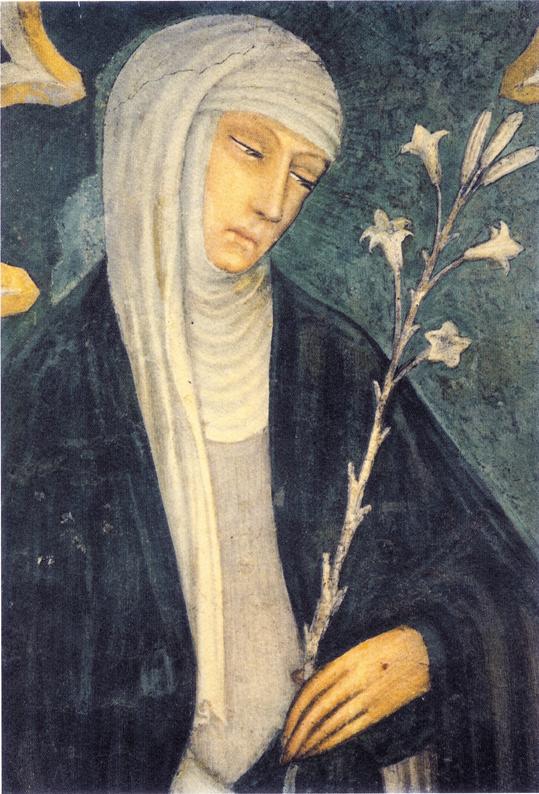
St Catherine of Siena

Source: Wikipedia
St Catherine of Siena's feast day is on April 29th. As that falls on a Sunday this year, the Sunday takes precedence so it won't be celebrated except by her Dominican family on Monday. Catherine was the youngest child in a large family of 25. At the age of six she had a vision in which Jesus appeared and blessed her. Her parents wanted her to marry, but she became a Dominican tertiary. She was a mystic and stigmatist. Received a vision in which she was in a mystical marriage with Christ, and the Infant Christ presented her with a wedding ring. Counselor to Pope Gregory XI and Pope Urban VI and worked to bring the papacy back from Avignon to Rome. She was proclaimed Doctor of the Church on 4 October 1970 by Paul VI.

It is fitting that the upcoming Vocations Sunday on the 29th of April is also the feast of St. Catherine of Siena. Her often quoted phrase: "If you are what you should be, you will set the world on fire" is a challenging invitation to each one of us!

Over at Pilgrims progress, Sr Louise has a reflection on Vocations Sunday and St Catherine of Siena.

The Dominican nuns in Drogheda have done a series of reflections on Catherine of Siena's as part of the novena seeking Catherine's intercession.

If you would like to read more of Catherine's writings they are available on Draw by Love.

11 Apr 2012

Have you been to Emmaus?

Courtesy of Pilgrims progress:

Literally, I haven’t been to Emmaus. But the moment I intend that question in a figurative sense. I do not refer to the Palestinian village several miles from Jerusalem, but I refer rather to our own Emmaus, because Emmaus is the place you go when there is nowhere else to go. Emmaus is the place of lost hopes, shattered dreams, and heavy hearts. Emmaus is the place you retreat to when you are bone-tired, beaten down, and broken up by the tragedies and disappointments of life. It may be a village, but it is often a state of mind, characterised by the absence of joy, the lost sense of meaning, the frequent loneliness of the human condition, and the seeming absurdity of life.

Have you been to Emmaus? It is the place you escape to when you are hurting and in need of healing, when you are crying and are in need of comfort, when you are exhausted and in need of renewal. If you have lived at all, I suspect you have been to Emmaus or maybe you are still there. The road to Emmaus is frequented by ordinarily men and women such as Cleopas and his unnamed companion, such as you and me.
Like the disciples of Emmaus, we, too, have our own ideas of Jesus Christ, his message and his church. We, too, are conditioned by our upbringing, early education, culture and life experience. The disciples could not recognise Jesus as long as their mindsets about who he was and what he was to do were in place. When Jesus demolished their blindness with his explanation of the Scriptures, their vision of him began to assume a more realistic tone. The price of recognizing Jesus is always the same: our idea of him, of the Church, of the spiritual journey, of God himself has to be shattered. To see with the eyes of faith we must be free of our culturally-conditioned mindsets. When we let go of our private and limited vision, He who has been hidden from us by our pre-packaged values and preconceived ideas causes the scales to fall from our eyes, just as He did with St. Paul. He was there all the time. Now at last we perceive his Presence. With the transformed vision of faith, we return to the humdrum routines and duties of daily life, but now, like Mary Magdalene, we recognize God giving himself to us in everyone and in everything.

Yes, Emmaus is a place where we need to go. Emmaus is a place of the heart. Walking to Emmaus is an exercise of the soul rather than of the legs. These two early disciples were exploring the depth of their own faith, or willingness to believe. Freely they shared their story even though they did not know how the story would end. Walking to Emmaus gives us a chance to know where we are rather than knowing where we would like to be. When we are walking to Emmaus the Lord can help us in our journey, because we are opened to guidance. Cleopas and his friend listen intently to our Lord's words: they wanted to continue their growth but were not sure what to do next. Their willingness to listen assured that they would find their way.
Sometimes we forget that we are on a journey. We want to know all there is to know, and fall into the trap of thinking that we know it all already. The two disciples had been willing to listen, and now they were given the gift of discernment. They now knew that what they had heard was another step on their spiritual journey. Their Lord had risen and they had spoken with Him and received bread by His hand. They then went to Jerusalem and met with the eleven. When the met with the eleven they were told that Jesus had risen and that He had appeared to Peter. After hearing this the two explained to the eleven what had happened to them. Here again the two were willing first to listen and then to speak; their openness to instruction increased their understanding. We can learn a lot from these two early disciples. We can learn to listen before we speak.

So where do you go for renewal and recovery? Many go to the church or the sanctuary where they have sensed God’s presence in the past. Some go to the beach. The mountains? To meet with friends? Sometimes, of course, old hopes must die before new hopes can be born to take their place and so we go from hope to hope. Sometimes an unrealistic hope must be abandoned before a more realistic hope one can be embraced. Maybe some of you have run out of hope and are walking a lonely road in search for it once again. The road to Emmaus may seem lonely because we are so absorbed by our own troubles, but it is a road that is crowded with fellow pilgrims, many of whom are hurting just as we are. Oh, we do well at hiding our hurts and disappointments but all of us have them!

So have you been to Emmaus? Well if you’ve never been there or if you find yourself today on the road to Emmaus, keep an eye out for the Stranger. He will be there and I assure you, you do not walk alone!

31 Mar 2012

From Ashes to Alleluia - Sr Louise O'Rourke PDDM

Talk for Ruah: 30th of March 2012
Divine Master Chapel of Adoration, Athlone
“From Ashes to Alleluia”


[From A Pilgrims Progress]

Dear God, we know that every journey begins with a first step. Be with us this evening as we take another step in our Lenten journey. We began this journey with the sign of ashes on our forehead, reminding us that this is no ordinary walk. We move one step forward in the promise of your light. We seek new meaning in the Easter that awaits us all. But first, we must walk with you to Jerusalem, to Calvary, to the Tomb and beyond.

Every religious experience begins with emptiness. We began the Lenten journey in the desert and we continue to walk, making the journey from Ashes to Alleluia. On Ash Wednesday we came forward to have ashes placed on our forehead and to hear the words “Remember you are dust and to dust you will return”.. The burnt palms, symbol of the joy and majesty which accompanied Jesus during his entrance into Jerusalem, become the dust and ashes placed on our forehead. Burned into our collective memory is the sight of the dust that chased people down the street as they fled in fear from the collapse of the Twin Towers of the World Trade Building in 2001. It was a dust that covered everything with a layer of doom. Dust which left us with a sober feeling of emptiness and futility. Dust which humbled us all, we were violated by it. The dust of Lent, the dust of the ashes in the sign of the cross is different. This dust leads to wholeness, and rather than run from it, we freely embrace it and are embraced by it.

I remember often raking out the fire at home and finding cinders among the dust and ashes which were still glowing, the fire could be re-lit from these burning cinders. We all know the story of Cinderella but maybe we never thought that it could give us a lesson in the theology of Lent. Cinderella is the young girl who literally sits in the ashes. As the fairytale continues, we see that before the glass slipper is placed on her foot, before the beautiful dress, the ball, the prince, the dance and marriage, there must first be a time of being humbled and sitting with herself. God can do the same with us, he can rake through the ashes of our life and find those burning cinders, that small spark which can be fanned into the Paschal fire which will herald Christ the Light, the Resurrected Lord, during the Easter Vigil. We will have our happy ever after ending, if we stay close to Him, we will receive the gift of his love and in return to be able to love Him and others with unconditional love.


When we fast or carry out Lenten penance we are encouraged, as the Gospel reminds us to “wash your face, put oil on your head so that your fasting may not be seen by others.” This is the paradox of Lent.

Yet, we are called to be expressive in our joy of knowing and following Christ. For some people, Lenten penance might actually mean being joyful as opposed to being moody or giving up chocolate or other such things. Jesus does not want us to go looking for suffering; he wants us to accept the suffering that confronts us as we live our lives according to Gospel values. Too often during Lent we pick our own suffering and our own crosses. You don’t have to raise your hands, but how many people have ‘given up’ chocolate, caffeine, alcohol, cigarettes , swearing for Lent? We tailor the crosses to fit our lives. There is a little story which illustrates this point perfectly: A man who went to America from Ireland would go to the Irish pub every Friday night. He would order three pints, one for himself, one for his brother in Ireland and one for his brother in England. The bartender thought this was a wonderful custom. Then one Friday night, the man came in and ordered just two pints. The bartender was curious but did not question it. Finally after three weeks of just two drinks, the bartender asked which brother had passed on to His heavenly reward. The man said, “No, they’re both fine, sure it’s myself that’s off the drink for Lent”.

During the Lenten season, we are allowed a glimpse of what exactly the Resurrection will bring. The 4th Sunday in Lent is known as Laetare Sunday, that is, Rejoicing or Exulting Sunday. The purple vestments are changed for a rose coloured one, flowers return to our altars. For that day, we have the preview of Easter joy. Is it not strange though to be talking about joy during Lent, as we enter Passion Week, are we not meant to be going around with sad faces, punishing ourselves and doing penance, downcast and depressed?


The message of the Holy Father for the 27th World Youth Day which is celebrated on Palm Sunday every year has as its theme: “Joy is at the heart of Christian experience”. The theme comes from St. Paul’s letter to the Philippians: “Rejoice in the Lord always” (Ph 4:4). In a world of sorrow and anxiety, joy is an important witness to the beauty and the reliability of Christian faith. As the hymn remind us “We are an Easter people, Alleluia is our song”.

The Pope writes and I paraphrase here: “Our hearts are made for joy. Though if we want to be filled with God, we have to first empty ourselves. Each day is filled with countless simple joys which are the Lord’s gift; the joy of living, the joy of nature, joy of a job well done, of helping others, of sincere and pure love. Yet any day we also face any number of difficulties. Deep down we also worry about the future, we begin to wonder if the full and lasting joy for which we long for might be an illusion and an escape from reality. The quest for joy can follow various paths, and some of these turn out to be mistaken, if not dangerous.” Too often, we dilute the gravity of sin because we fear that we will put people out of their comfort zones. Sin is serious precisely because it is the complete contrary of the Incarnation. The Incarnation of Jesus is the bridge between Heaven and earth, our link to the Father. Every time, ‘I’ become the centre of my life, I weaken that bridge, it becomes unsteady. When I sin, I remain on one side, Jesus on the other- God’s mercy through the Sacrament of Reconciliation reconstructs the bridge! From God’s mercy, joy is born, true joy comes from the experience of knowing that we are infinitely and uniquely loved by God. The Pope reminds us: “God offers us an unconditional acceptance which enables us to say
: I am loved, I have a place in the world and in history, I am personally loved by God. If God accepts me and loves me and I am sure of this, then I know clearly and with certainty that it is a good thing that I am alive.

T
o seek the Lord and find him in our lives also means accepting his word, which is joy for our hearts. The liturgy is a special place where the Church expresses the joy which she receives from the Lord and transmits it to the world. Every Sunday we celebrate the central mystery of salvation, which is the death and resurrection of Christ. Sunday is the day where we meet the Risen Christ, listen to his Word . We hear in Psalm 118, “This is the day the Lord has made, let us rejoice and be glad”. At the Easter vigil, the Church sings the Exultet, a hymn of joy for the victory of Jesus over sin and death. And our response: we live a life of love for him. As St. Therese of the Child Jesus, a young Carmelite, wrote, “Jesus, my joy is loving you”. Another Theresa, Mother Theresa of Calcutta similarly spoke about joy saying: “ Joy is a net of love by which you can catch souls. God loves a cheerful giver. Whoever gives with joy gives more.”


If we are to experience joy, we must also be generous. We cannot be content to give the minimum. Experiencing real joys means recognising the temptations which lead us away from it. Often our present society pressures us to seek immediate goals, achievements and pleasures. At times the path of Christian life is not easy and being faithful to the Lord’s love presents obstacles, occasionally we fall, we flirt with evil and panic only when it threatens to take over,. Sometimes in order to grow, we first need to fall apart. Yet God in his mercy never abandons us, he always offers us the possibility of returning to him. Sin has many names and even more faces, but in the end sin is always the same thing. It is our turning our back on God.

This Sunday we mark Palm Sunday or more correctly Passion Sunday, we will hear two Gospels, one of the triumphant entrance of Jesus into Jerusalem, accompanied by the rejoicing crowds. Not long after that same crowd will hand Jesus over and crucify him, as we will read in the second Gospel, the Passion and Death of Jesus according to the Gospel of St. Mark. We tend to misunderstand the ‘passion of Jesus’, identifying it with the pain of the physical sufferings which he endured on the road to his death. Jesus’ passion is more than this and can be understood as passio, that is, passivity, a certain submissive helplessness that Jesus had to undergo to fulfil the plan of the Father and bring eternal life for us. During Lent, we might have heard a lot about conversion. The Greek word for conversion, metanoia indicates a turn around, a change in direction. This Sunday, we too are called to turn around, to face towards Jerusalem and walk with Jesus. Are we prepared to face a completely new direction? The reality is, Jesus doesn’t want admirers, He wants followers.

After Palm Sunday, we continue in our Holy Week towards Holy Thursday where Jesus broke bread with his closest disciples and invites us to do ‘this in memory of him’. The Eucharist is not a private act of devotion meant to square our debts with God, but a call to and a grace for service. It is meant to send us out into the world ready to give expression to Christ’s hospitality, humility and love. He says to us: “Receive, give thanks, break and share”. Nourished by the bread of life, we as disciples, dare to walk the Way of Calvary with Him and live the Good Friday experience. There is a story told about St. Teresa of Avila. One day the devil appeared to her, disguised as Christ. However Teresa wasn’t fooled for a second. She immediately dismissed him. But before he left, the devil asked her, “How did you know? How were you so sure that I wasn’t Christ?” Her answer: “You didn’t have any wounds. Christ has wounds”. The proof of Jesus’ immense love for us was made visible on the Cross. The nails didn’t hold him there, his love did. When Jesus rises from the dead, the first thing he did was to show his disciples his wounds, glorified now, but extremely humiliating to him before he died. The wounds of the scars of love, scars that each one of us carries if we allow ourselves to love and be loved.

It is said that one day Michelangelo, strolling in a courtyard of Florence, saw a block of rough stone covered with dust and mud. He stopped suddenly to look at it and said: “An angel is hidden in this mass of stone. I want to bring him out!” And he began to work with his scalpel to give shape to the angel he had glimpsed. So it is with us. We are still masses of rough stone, with so much dirt and useless pieces. God the Father looks at us and says: “Hidden in this piece of stone is the image of my Son, I want to bring it out “.

Leonardo da Vinci once said, sculpture is the art of removing. Is it not true for our life? For us however it is not about the attaining an abstract beauty of building a beautiful statue, but about bringing to light and rendering ever more resplendent the image of God that sin tends continually to cover. We are God’s masterpiece, his work of art but he needs to chip away at us. Hidden in the ugliness of death and sin is the light of the Resurrection if we are willing to wait out Holy Saturday. Each of us must fight our own demons, struggle with our own sadness. The Resurrection gives to us the equally unbelievable possibility of the newness of live that forgiving and being forgiven brings. The Resurrection promises that things can always be new again .It’s never too late to start over, no betrayal is final, no sin is unforgivable. God never gives us on us, even if we give up on ourselves. Resurrection is not just a question of three days, after death, rising from the dead, but it is about the daily rising from the many mini-graves within which we so often find ourselves. The Resurrection teaches us how to live, again and again and again!

Conclusion:I leave you with the words of the Holy Father, this is my invitation to you as we enter into the holiest of weeks. “Dear friends, learn to see how God is working in your lives and discover him hidden within the events of daily life. Believe that he is always faithful to the covenant which he made with you on the day of your Baptism. Know God will n ever abandon you. Turn your eyes to him often. He gave his life on the cross because he loves you. Contemplation of this great love brings a hope and joy to our hearts that nothing can destroy. Christians can never be sad, for they have met Christ, who gave his life for them.”

7 Feb 2012

Praying with Icons: Vladimir's 'Our Lady of Tenderness'

From Sr Louise over at Pilgrims Progress:


Praying with icons


God is revealed not only by words to the ears but by images to the eyes aswell. Christ is not just the word (logos) of God but also the 'image' (eikon) of the unseen God. From there we receive the word 'icon' derived from the Greek. An icon is not a painting in the sense we normally regard pieces of art, although it is an image that is painted. An icon is a window into the divine whilst living everyday life and uniting it to the realm of God. Every brushstroke leaves an imprint which is the fruit of centuries of prayer. Icons are religious images that hover between two worlds, putting into colours and shapes what cannot be grasped by the intellect. They render the invisible visible.To the Christian, an icon is a constant reminder of God's presence in his church, his home and in his life.
You gaze on the icon, but it gazes on you too. When you are looking at someone you love, and they are looking at you, there is a lot that is communicated that cannot be put in words. We need to gaze truly conversational, truly loving images…images that will return our love. Father William Hart McNichols, icon writer

Here is a short reflection on Vladimir's 'Virgin of Tenderness'.
 
Continue reading HERE.

29 Jan 2012

Narnia, icons and Rublev's Trinity!

Guest post from Sr Mary Louise O'Rourke from her blog Pilgrims Progress


Those of you who know me know that I cultivate a special love for icons. In English the word icon can be used as a general term for an image. It is often used in connection with religious imagery, and the term iconography can relate to any consistent scheme of imagery, religious or secular. However, two modern secular applications of the word icon have gained wide currency.

First, in the world of fashion and entertainment, people can be described as icon if they epitomize certain trends in style or culture. Second, in the world of computers and electronic technology certain images on the screen are known as icons. You'll also know that my acquaintance with the modern applications of the word is more with the latter! Click on the icon and you enter a whole new world of information and imagery. This modern usage of the word icon has interesting parallels with the theological use of the term!

John Paul II in his encyclical "Duodecimum saeculum" wrote: "Just as the reading of material books allows the hearing of the living word of the Lord, so also the showing of the painted icon allows those who contemplate it to accede to the mystery of salvation by the sense of sight". Our first encounter with icons may not be easy, for they are seriously different from many of our assumptions about art and imagery.Icons are different, they are a non-naturalistic form of art. The intention behind the icon is to make the invisible visible. They are a door to another world, allowing us to enter more deeply into a living relationship with the Father, Son and Spirit. In the Apocalypse St. John says: "I looked, and lo, in heaven an open door!" (Rev 4:1). Through that door he enters into the heavenly worship and the place of revelation.

In C. S Lewis' The Lion, the Witch and the Wardrobe, the children enter the strange world of Narnia through the wardrobe. There is a change in levels of consciousness and perception which can only be communicated through the metaphors and imagery of transition. Sacred iconography uses its own language of symbols and imagery to take us deeper into the mystery of Christ.


I would like to share with you a short interpretation of this icon of the Trinity.This icon represents the scene described in Genesis 18, 1-5 where Abraham is visited by three angels at the oak of Mamre and had always been interpreted as a prefiguration of God in the Three persons. In fact if we look closely at the text it interchanges between the singular and the plural as if there were only one visitor.

The Father, the Son and the Holy Spirit (l-r) complete each other in an endless circle of loving communion. The bond of trust among them is transparent.
 
We can identify:

1)in the top left background- Abraham's house. Abraham and Sarah's hospitality to the angelic visitors is rewarded with the promise of an heir.

2) middle top background- the oak of Mamre. This may also recall the tree of the Cross. This is the transformation of the Tree of Death becoming the Tree of Life because of Jesus' willingness to trust the Father in all things.

3) on the top right background- the mountain. In the Bible mountain are usually symbols of a place of encounter, of a divine revelation, it is the place of theophany. Moses met his Lord there, Jesus went often to pray and was transfigured on the mountain.

The three faces are identical and each one wears a blue garment symbolizing divinity and recalling the idea of the heavens yet each one retains their uniqueness by wearing something of their own.

LEFT: The blue garment is almost hidden by the shimmering outer garment. This is the Father who cannot be seen by his creatures and must encounter him using the eyes of the Son. Both hands grasp the staff showing his dual authority over heaven and earth.

MIDDLE:The brown garment speaks of the earth - of His humanity. 'He humbled himself and became obedient even unto death on a cross.' The gold stripe speaks of kingship.

RIGHT:The green garment is a symbol of new life. The Spirit touches the table indicating the divine life of God.


The gesture of the hands in an icon is always to be noticed. Sometimes the simple gesture of pointing can draw attention to the person or the mystery that is at the heart of an icon. The hand raised in blessing in this icon belong to the central figure, the fingers extended so as to pronounce the blessing over the chalice. 'The blessing cup which we bless is communion is a sharing in the blood of Christ' (1 Cor 10,16). The three Persons united in this communion are united through the chalice which signifies the sacrament of the Eucharist and the mystery of the Incarnation.

 
PRAYER MOMENT:

Just think: the Father, the Son and the Spirit are looking towards the one who is contemplating the icon. They are looking at you, offering you a porthole into the cosmic movement of love which exist between them. Their hands bless you in your joys and in your worries. They ask you for the same hospitality which was offered to them by Abraham and Sarah, they await the hospitality in your heart. Each one is reclining slightly towards the other. Call to mind the beloved disciple John who rested upon the heart of Christ and acknowledge that you too have this privileged space. Enjoy the sense of profound peace that this scene can bring you.

20 Jun 2011

Here I am Lord, to do your will

On a sunny June Sunday afternoon (June 19th) on the banks of the majestic Shannon river, in the parish church dedicated to Ss Peter and Paul, Sr Louise O'Rourke made final perpetual profession as a Sister Disciple of the Divine Master in the presence of Bishop Christopher 'Christy' Jones, her family, sisters in religion, members of her home parish as well as many friends and well wishers. 

On the liturgical feast dedicated to Divine Love expressed in the mystery of the Blessed Trinity, in a liturgy full of symbolism and simplicity culminating with the invocation of the Holy Spirit and the intercession of the saints, Sr Louise made her final public step on a journey culminating in her professing the evangelical counsels of poverty, chastity and obedience.
Her journey to religious life has been a journey of exploration of love and the call to service. Previously we posted an article written by Sr Louise about her journey  - Wasted Life? - A reflection on religious profession - and in advance of the profession, the Westmeath Independent carried an interview with Sr Louise about her vocation experience. 

Regular listeners will know Sr Louise as our former Rome Correspondent who kept us informed of things roman during her time in the Eternal City.

In praise and glory of the Most Holy Trinity,
who consecrated me in Baptism and now calls me
to follow more closely Jesus Master,
Way, Truth and Life as his disciple,
I offer myself totally to God.
In your hands, Sr. Kathryn Mary Williams,
delegate of the Superior General,
before you, sisters and brothers,
I Sr. Mary Louise O’ Rourke, in full liberty,
make my vows of chastity, poverty and obedience
for my entire life according to the Rule of Life
of the Disciples of the Divine Master.
In communion with my sisters,
I commit myself to live in the Church, the charism of Fr. James Alberione
at the service of the Eucharist, the Priesthood and the Liturgy
for the coming of the Kingdom of God in the world.
I entrust myself to the intercession of Mary, Queen of Apostles,
of Saint Paul the Apostle and to the prayer of my sisters.
May God bring to fulfilment the work he has begun in me.
Amen

Ad multos annos Sr Mary Louise O'Rourke PDDM