Showing posts with label Women in Church History. Show all posts

10 May 2012

St Hildegard of Bingem named a Saint.....again


Even though Hildegard of Bingen was already on the list of Catholic saints, she had not been officially canonized. So to remove all doubt, Benedict XVI extended the liturgical cult of St. Hildegard of Bingen, to the Universal Church, which automatically inscribes her in the catalogue of saints.

Hildegard of Bingen was from Germany. She's mostly known for her religious visions and prophecies. She lived in the XI and XII century, but even so, her message is still quite alive. The Pope has talked about her and her message in two general audiences.

Also, in coming months, the Pope is considering declaring her a Doctor of the Church for her high intelligence and feminine sensibility.

St. Hildegard was one of the most active women of her time. She wrote about theology and morals, but also about medicine and science. She even found the time to compose 78 musical pieces.

In 2010, when he delivered a series of talks on the great thinkers who have shaped the thought of the Church, Pope Benedict devoted two consecutive public audiences to the thought of St. Hildegard of Bingen, noting that her vision was unusually “rich in theological content.” The Pope said that the German mystic’s keen interest in the sciences was a natural outgrowth of her spirituality, since in her eyes “all of creation was a symphony of the Holy Spirit, Who is in Himself joy and contentment.”   

7 Apr 2011

Benedict, Therese and "Ze Little Vay"!

With h/t to the Anchoress for the post title!


From Zenit:

Here is a translation of the Italian-language catechesis Benedict XVI gave today during the general audience held in St. Peter's Square. Continuing with the cycle of catecheses on Doctors of the Church, the Pope centered his meditation on the figure of St. Thérèse of Lisieux (1873-1897).

* * *

Dear Brothers and Sisters,

Today I would like to speak to you about St. Thérèse of Lisieux, [also known as] Thérèse of the Child Jesus and the Holy Face, who lived only 24 years in this world, at the end of the 19th century, leading a very simple and hidden life, but who after her death and the publication of her writings, became one of the best known and loved saints.

"Little Thérèse" has not failed to help the simplest souls, little ones, the poor, those who suffer and who pray to her, but she has also illumined the whole Church with her profound spiritual doctrine, to the point that, in 1997 the Venerable John Paul II wished to give her the title of doctor of the Church, adding it to the title of patroness of the missions, which Pius XI gave her in 1939. My beloved predecessor described her as an "expert in the scientia amoris" ("Novo Millennio Ineunte," 27).


Thérèse expresses this science, which sees the whole truth of the faith shine in love, primarily in the account of her life, published a year after her death with the title "Story of a Soul." The book immediately had great success. It was translated into many languages and spread throughout the world. I would like to invite you to rediscover this little-great treasure, this luminous commentary on the Gospel fully lived! "Story of a Soul," in fact, is a marvelous history of Love, recounted with such authenticity, simplicity and freshness, before which the reader cannot but be fascinated! But, what was this Love that filled Thérèse's whole life, from her childhood to her death? Dear friends, this Love has a Face, it has a Name, it is Jesus! The saint spoke continually of Jesus. Let us review, therefore, the great stages of her life, to enter into the heart of her doctrine.

2 Feb 2011

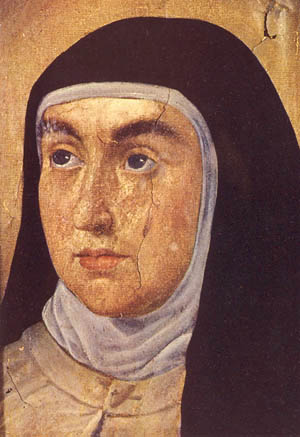
Pope Benedict XVI - St Teresa of Avila: Contemplative and Industrious

During his general audience, held this morning in the Paul VI Hall, the Pope spoke about St. Teresa of Avila, who lived from 1515 to 1582.

Teresa de Ahumada was born in the Spanish city of Avila, said Benedict XVI. Although as an adolescent she read works of profane literature which led her towards a life in the world, she later turned to spiritual works which "taught her meditation and prayer. At the age of twenty she entered the Carmelite convent of the Incarnation, also in Avila".

St. Teresa saw her struggle against her own physical ailments as "a struggle against her weakness and resistance before the call of God. ... In Lent 1554, at the age of thirty-nine, Teresa reached the pinnacle of her fight against her own debilities".

  "In parallel with the maturation of her interior life, the saint also began to give concrete form to her idea of reforming the Carmelite order. In 1562, with the support of Bishop Alvaro de Mendoza of Avila, she founded the first reformed Carmelite convent. ... Over the following years she continued to found new Carmelite convents, reaching a total of seventeen. Her meeting with St. John of the Cross proved fundamental and with him, in 1568, she founded the first convent of Discalced Carmelites, at Duruelo near Avila". Teresa died in 1582. She was beatified by Paul V in 1614 and canonised in 1622 by Gregory XV. In 1970 Servant of God Paul VI declared her a Doctor of the Church.

  The Holy Father noted how "Teresa of Avila had no academic education, however she always gave great weight to the teaching of theologians, men of letters and spiritual masters". Her major works include an autobiography in which she presents her soul to St. John of Avila, and the "Way of Perfection" intended as a spiritual guide for her own nuns. However, "St. Teresa's most famous mystical work is the 'Interior Castle'", said the Pope, in which "she codifies the possible development of Christian life towards perfection. ... To her activity as founder of the Reformed Carmelites, Teresa dedicated another work, the 'Book of Foundations'".

  Referring then to the spirituality of Teresa, the Holy Father made particular mention of her interest in "the evangelical virtues as the foundation of all Christian and human life". He also noted how she laid great emphasis on "profound harmony with the great biblical figures" and on "listening to the Word of God. ... The saint also highlights the importance of prayer", he said, "she teaches readers of her works to pray, and she herself prays with them".

  "Another question very dear to this saint was the centrality of Christ's humanity. ... This lay at the basis of the importance she attributed to meditation on the Passion, and to the Eucharist as the presence of Christ in the Church, for the life of all believers and as the heart of the liturgy. St. Teresa's love for the Church was unconditional", said the Pope, identifying another essential part of her doctrine in "perfection as the aspiration and final goal of all Christian life".

  The Holy Father concluded by saying that "St. Teresa of Avila is an authentic teacher of Christian life for the faithful in all times. In our society, often lacking in spiritual values, St. Teresa teaches us to be tireless witnesses of God, of His presence and His work. ... May the example of this profoundly contemplative and industrious saint, encourage us to dedicate adequate time to daily prayer, to openness to God in order to discover His friendship and so to discover true life. ... Time spent in prayer is not lost; it is a time in which we open the way to life, learning to love God and His Church ardently, and to show real charity towards our neighbours".

26 Jan 2011

Pope Benedict XVI - Joan of Arc: Bringing the light of the Gospel into history

We are going to start a new feature here on Sacred Space where we will bring you some points from the weekly general audience of the Holy Father which is held on a Wednesday. Pope Benedict XVI has been doing a series of talks on women down through the history of the church who have been held up as examples of christian virtue for followers to imitate. This weeks address is about St Joan of Arc. As time goes on we will go back and dig out some of the other talks for you as well. They provide an interesting insight to the role of women in the church.

VATICAN CITY, 26 JAN 2011 (VIS) - During this morning's general audience, celebrated in the Paul VI Hall in the presence of 3,000 people, Holy Father dedicated his catechesis to St. Joan of Arc (1412-1431), whom he described as "one of the 'strong women' who, at the end of the Middle Ages, fearlessly brought the splendid light of the Gospel into the complex events of history".

The life of Joan of Arc, who was born into a prosperous peasant family, took place in the context of the conflict between France and England known as the Hundred Years War. At the age of thirteen, "through the 'voice' of St. Michael the Archangel, Joan felt herself called by the Lord to intensify her Christian life and to act personally to free her people".

She made a vow of virginity and redoubled her prayers, participating in sacramental life with renewed energy. "This young French peasant girl's compassion and commitment in the face of her people's suffering were made even more intense through her mystical relationship with God. One of the most original aspects of her sanctity was this bond between mystical experience and political mission". said Benedict XVI.

Joan's activities began in early 1429 when, overcoming all obstacles, she managed to meet with the French Dauphin, the future King Charles VII. He had her examined by theologians of the University of Poitiers who "delivered a positive judgment, they discovered nothing bad in her, and found her to be a good Christian".

On 22 March of that year Joan dictated a letter to the King of England and his men, who were laying siege to the city of Orleans. "Hers was a proposal of authentic and just peace between two Christian peoples, in the light of the names of Jesus and Mary", said the Holy Father. But the offer was rejected and Joan had to fight for the liberation of the city. Another culminating moment of her endeavours came on 17 July 1429 when King Charles was crowned in Reims.

Joan's passion began on 23 May 1430 when she fell into the hands of her enemies at Compiegne and was taken to the city of Rouen. There a long and dramatic trial was held which concluded with her being condemned to death on 30 May 1431.

The trial was presided by two ecclesiastical judges, Bishop Pierre Cauchon and the inquisitor Jean le Maistre, but in fact it was conducted by a group of theologians from the University of Paris. These "French ecclesiastics, having made political choices opposed to those of Joan, were predisposed to hold negative views of her person and mission. The trial was a dark page in the history of sanctity, but also a shining page in the mystery of the Church which is, ... 'at the same time holy and always in need of being purified'".

"Unlike the saintly theologians who illuminated the University of Paris, such as St. Bonaventure, St. Thomas Aquinas and Blessed Duns Scotus, ... the judges were theologians who lacked the charity and humility to see the work of God in this young girl. Jesus' words come to mind, according to which the mysteries of God are revealed to those who have the hearts of children, but hidden from the wise and intelligent. Thus Joan's judges were radically incapable of understanding her, of seeing the beauty of her soul", the Pope said.

Joan died at the stake on 30 May 1431, holding a crucifix in her hands and invoking the name of Jesus. Twenty-five years later a trial of nullification, instituted by Pope Callixtus III, "concluded with a solemn sentence nullifying the condemnation and ... highlighting Joan of Arc's innocence and perfect faithfulness to the Church. Much later, in 1920, she was canonised by Pope Benedict XV".

"The Name of Jesus invoked by this saint in the last instants of her earthly life was as the continual breath of her soul, ... the centre of her entire life", the Holy Father explained. "This saint understood that Love embraces all things of God and man, of heaven and earth, of the Church and the world. ... Liberating her people was an act of human justice, which Joan performed in charity, for love of Jesus, hers is a beautiful example of sanctity for lay people involved in political life, especially in the most difficult situations".

"Joan saw in Jesus all the reality of the Church, the 'Church triumphant' in heaven and the 'Church militant' on earth. In her own words, 'Our Lord and the Church are one'. This affirmation ... takes on a truly heroic aspect in the context of the trial, in the face of her judges, men of the Church who persecuted and condemned her".

"With her shining witness St. Joan of Arc invites us to the highest degree of Christian life, making prayer the motif of our days, having complete trust in achieving the will of God whatever it may be, living in charity without favouritisms or limitations, and finding in the Love of Jesus, as she did, a profound love for His Church".