Showing posts with label Candlemas Day. Show all posts

2 Feb 2019

2nd February 2019 - Presentation of the Lord (Candlemas)

"Lord, now you let your servant go in peace,
your word has been fulfilled:
My own eyes have seen the salvation,
which you have prepared in the sight of every people:
a light to reveal you to the nations
and the glory of your people Israel"

On February 2, the Church in the west celebrates the feast of the Presentation of the Lord, also known as Candlemas. 

The feast was first observed in the Eastern Church as "The Encounter." In the sixth century, it began to be observed in the West: in Rome with a more penitential character and in Gaul (France) with solemn blessings and processions of candles, popularly known as "Candlemas." The Presentation of the Lord concludes the celebration of the Nativity and with the offerings of the Virgin Mother and the prophecy of Simeon, the events now point toward Easter.

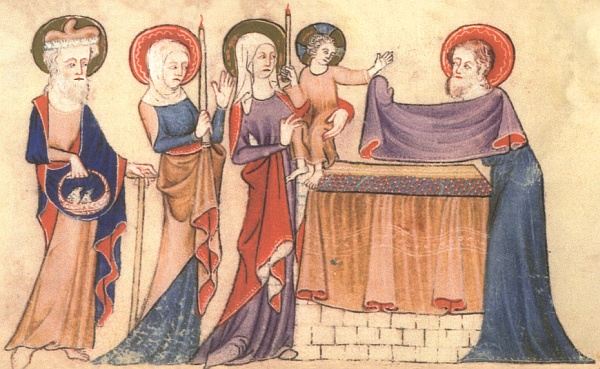
"In obedience to the Old Law, the Lord Jesus, the first-born, was presented in the Temple by his Blessed Mother and his foster father. This is another 'epiphany' celebration insofar as the Christ Child is revealed as the Messiah through the canticle and words of Simeon and the testimony of Anna the prophetess. Christ is the light of the nations, hence the blessing and procession of candles on this day. 

In the Middle Ages this feast of the Purification of the Blessed Virgin Mary, or 'Candlemas,' was of great importance. It is the day candles are incensed and blessed with holy water and later distributed to clergy and laity — a custom going back to the 11th century. Newly blessed candles from Candlemas will be used tomorrow for the Blessing of the Throats on the feast of St. Blaise. The light from blessed candles represents Jesus Christ, the Light of the World — “a light for revelation to the Gentiles and the glory of thy people, Israel,” as Simeon prayed when he took Jesus in his arms in the temple. 


Candlemas 
(1849) - Bl John Henry Newman

THE Angel-lights of Christmas morn,
Which shot across the sky,
Away they pass at Candlemas,
They sparkle and they die.

Comfort of earth is brief at best,
Although it be divine;
Like funeral lights for Christmas gone,
Old Simeon’s tapers shine.

And then for eight long weeks and more,
We wait in twilight grey,
Till the high candle sheds a beam
On Holy Saturday.

We wait along the penance-tide
Of solemn fast and prayer;
While song is hush’d, and lights grow dim
In the sin-laden air. {280}

And while the sword in Mary’s soul
Is driven home, we hide
In our own hearts, and count the wounds
Of passion and of pride.

And still, though Candlemas be spent
And Alleluias o’er,
Mary is music in our need,
And Jesus light in store.

2 Feb 2018

World Day of Prayer for Consecrated Life 2018


In 1997, Pope Saint John Paul II instituted a day of prayer for women and men in consecrated life. This celebration is attached to the Feast of the Presentation of the Lord on February 2nd. This Feast is also known as Candlemas Day; the day on which candles are blessed symbolizing Christ who is the light of the world. So too, those in consecrated life are called to reflect the light of Jesus Christ to all peoples.

***********************

Vatican News - Pope Francis celebrates the liturgy in St Peter’s Basilica on Friday with thousands of religious and members of Societies of Apostolic life. The announcement for this event contained the following reflection from the Holy Father: “A vocation is a gift we have received from the Lord, who fixed his gaze on us and called us, calling us to follow him in the consecrated life.”

2nd February 2018 - Feast of the Presentation of the Lord in the Temple


"Lord, now you let your servant go in peace,
your word has been fulfilled:
My own eyes have seen the salvation,
which you have prepared in the sight of every people:
a light to reveal you to the nations
and the glory of your people Israel"


On February 2, the Church in the west celebrates the feast of the Presentation of the Lord, also known as Candlemas. It is the day candles are incensed and blessed with holy water and later distributed to clergy and laity — a custom going back to the 11th century. Newly blessed candles from Candlemas will be used tomorrow for the Blessing of the Throats on the feast of St. Blaise. The light from blessed candles represents Jesus Christ, the Light of the World — “a light for revelation to the Gentiles and the glory of thy people, Israel,” as Simeon prayed when he took Jesus in his arms in the temple. 

In the archives over at Blue Eyed Ennis, one of Phil's great posts on the day available here.

 
And when the time came for their purification according to the law of Moses, they brought him up to Jerusalem to present him to the Lord (as it is written in the law of the Lord, "Every male that opens the womb shall be called holy to the Lord") and to offer a sacrifice according to what is said in the law of the Lord, "a pair of turtledoves, or two young pigeons." Now there was a man in Jerusalem, whose name was Simeon, and this man was righteous and devout, looking for the consolation of Israel, and the Holy Spirit was upon him. And it had been revealed to him by the Holy Spirit that he should not see death before he had seen the Lord's Christ. And inspired by the Spirit he came into the temple; and when the parents brought in the child Jesus, to do for him according to the custom of the law, he took him up in his arms and blessed God and said, "Lord, now lettest thou thy servant depart in peace, according to thy word; for mine eyes have seen thy salvation which thou hast prepared in the presence of all peoples, a light for revelation to the Gentiles, and for glory to thy people Israel."
And his father and his mother marveled at what was said about him; and Simeon blessed them and said to Mary his mother, "Behold, this child is set for the fall and rising of many in Israel, and for a sign that is spoken against (and a sword will pierce through your own soul also), that thoughts out of many hearts may be revealed."
And there was a prophetess, Anna, the daughter of Phan'u-el, of the tribe of Asher; she was of a great age, having lived with her husband seven years from her virginity, and as a widow till she was eighty-four. She did not depart from the temple, worshiping with fasting and prayer night and day. And coming up at that very hour she gave thanks to God, and spoke of him to all who were looking for the redemption of Jerusalem.
And when they had performed everything according to the law of the Lord, they returned into Galilee, to their own city, Nazareth. And the child grew and became strong, filled with wisdom; and the favor of God was upon him."


************************
In the account of Jesus’ Presentation in the Temple, wisdom is represented by two elderly persons, Simeon and Anna: persons docile to the Holy Spirit, led by him, inspired by him. The Lord granted them wisdom as the fruit of a long journey along the path of obedience to his law, an obedience which likewise humbles and abases, but which also lifts up and protects hope, making them creative, for they are filled with the Holy Spirit. They even enact a kind of liturgy around the Child as he comes to the Temple. Simeon praises the Lord and Anna “proclaims” salvation. As with Mary, the elderly man holds the Child, but in fact it is the Child who guides the elderly man. […] Mary, the young mother, and Simeon, the kindly old man, hold the Child in their arms, yet it is the Child himself who guides them both.
Here it is not young people who are creative: the young, like Mary and Joseph, follow the law of the Lord, the path of obedience. The elderly, like Simeon and Anna, see in the Child the fulfilment of the Law and the promises of God. And they are able to celebrate: they are creative in joy and wisdom. And the Lord turns obedience into wisdom by the working of his Holy Spirit.
– From the homily of Pope Francis on the feast of the Presentation of the Lord, 2015. 

2 Feb 2017

2nd February 2017 - Feast of the Presentation of the Lord


Lord, now you let your servant go in peace,
your word has been fulfilled:
My own eyes have seen the salvation,
which you have prepared in the sight of every people:
a light to reveal you to the nations
and the glory of your people Israel


On February 2, the Church in the west celebrates the feast of the Presentation of the Lord, also known as Candlemas. It is the day candles are incensed and blessed with holy water and later distributed to clergy and laity — a custom going back to the 11th century. Newly blessed candles from Candlemas will be used tomorrow for the Blessing of the Throats on the feast of St. Blaise. The light from blessed candles represents Jesus Christ, the Light of the World — “a light for revelation to the Gentiles and the glory of thy people, Israel,” as Simeon prayed when he took Jesus in his arms in the temple. 

Previous posts on Candlemass Day available HERE.

In the archives over at Blue Eyed Ennis, one of Phil's great posts on the day available here.


And when the time came for their purification according to the law of Moses, they brought him up to Jerusalem to present him to the Lord (as it is written in the law of the Lord, "Every male that opens the womb shall be called holy to the Lord") and to offer a sacrifice according to what is said in the law of the Lord, "a pair of turtledoves, or two young pigeons." Now there was a man in Jerusalem, whose name was Simeon, and this man was righteous and devout, looking for the consolation of Israel, and the Holy Spirit was upon him. And it had been revealed to him by the Holy Spirit that he should not see death before he had seen the Lord's Christ. And inspired by the Spirit he came into the temple; and when the parents brought in the child Jesus, to do for him according to the custom of the law, he took him up in his arms and blessed God and said, "Lord, now lettest thou thy servant depart in peace, according to thy word; for mine eyes have seen thy salvation which thou hast prepared in the presence of all peoples, a light for revelation to the Gentiles, and for glory to thy people Israel."
 
And his father and his mother marveled at what was said about him; and Simeon blessed them and said to Mary his mother, "Behold, this child is set for the fall and rising of many in Israel, and for a sign that is spoken against (and a sword will pierce through your own soul also), that thoughts out of many hearts may be revealed."
 
And there was a prophetess, Anna, the daughter of Phan'u-el, of the tribe of Asher; she was of a great age, having lived with her husband seven years from her virginity, and as a widow till she was eighty-four. She did not depart from the temple, worshiping with fasting and prayer night and day. And coming up at that very hour she gave thanks to God, and spoke of him to all who were looking for the redemption of Jerusalem.
 
And when they had performed everything according to the law of the Lord, they returned into Galilee, to their own city, Nazareth. And the child grew and became strong, filled with wisdom; and the favor of God was upon him."


Reflections:


2 Feb 2016

February 2nd 2016 - Feast of the Presentation of the Lord (World Day of Prayer for Consecrated Life)


Lord, now you let your servant go in peace,
your word has been fulfilled:
My own eyes have seen the salvation,
which you have prepared in the sight of every people:
a light to reveal you to the nations
and the glory of your people Israel

February 2nd is the feast of the Presentation of Jesus in the Temple, forty days after his birth when Mary and Joseph went up to Jerusalem to ransom him according to the Law of Moses.


The feast used to be known as the Feast of the Purification of the Blessed Virgin Mary and is more often known as Candlemass Day as tradition holds that all the candles to be used in the church for the coming year are blessed on this day.


Previous posts on Candlemass Day available HERE.
 
In the archives over at Blue Eyed Ennis, one of Phil's great posts on the day available here.


And when the time came for their purification according to the law of Moses, they brought him up to Jerusalem to present him to the Lord (as it is written in the law of the Lord, "Every male that opens the womb shall be called holy to the Lord") and to offer a sacrifice according to what is said in the law of the Lord, "a pair of turtledoves, or two young pigeons." Now there was a man in Jerusalem, whose name was Simeon, and this man was righteous and devout, looking for the consolation of Israel, and the Holy Spirit was upon him. And it had been revealed to him by the Holy Spirit that he should not see death before he had seen the Lord's Christ. And inspired by the Spirit he came into the temple; and when the parents brought in the child Jesus, to do for him according to the custom of the law, he took him up in his arms and blessed God and said, "Lord, now lettest thou thy servant depart in peace, according to thy word; for mine eyes have seen thy salvation which thou hast prepared in the presence of all peoples, a light for revelation to the Gentiles, and for glory to thy people Israel."
 
And his father and his mother marveled at what was said about him; and Simeon blessed them and said to Mary his mother, "Behold, this child is set for the fall and rising of many in Israel, and for a sign that is spoken against (and a sword will pierce through your own soul also), that thoughts out of many hearts may be revealed."
 
And there was a prophetess, Anna, the daughter of Phan'u-el, of the tribe of Asher; she was of a great age, having lived with her husband seven years from her virginity, and as a widow till she was eighty-four. She did not depart from the temple, worshiping with fasting and prayer night and day. And coming up at that very hour she gave thanks to God, and spoke of him to all who were looking for the redemption of Jerusalem.
 
And when they had performed everything according to the law of the Lord, they returned into Galilee, to their own city, Nazareth. And the child grew and became strong, filled with wisdom; and the favor of God was upon him."


Candlemass is also the World Day for Consecrated Life and this weekend just passed marked the closing events of the Year for Consecrated Life and also the special jubilee event for religious in Rome.
 

(Vatican Radio) - Pope Francis has called on consecrated men and women to make courageous and prophetic choices, to not be afraid of getting their hands dirty and of walking the geographical and existential peripheries of mankind today. The Pope was speaking to consecrated men and women during Mass in St. Peter's Basilica marking the end of the Year of Consecrated Life.

Continue reading here.


(VIS) - Extensive extracts of the Holy Father's extemporaneous address to the participants in the Jubilee of Consecrated Life, which took place on 1st February 2016 in the Paul VI Hall are available here.


2 Feb 2015

2nd February 2015 - Feast of the Presentation of the Lord in the Temple (World Day for Consecrated Life)


Lord, now you let your servant go in peace,
your word has been fulfilled:
My own eyes have seen the salvation,
which you have prepared in the sight of every people:
a light to reveal you to the nations
and the glory of your people Israel


February 2nd is the feast of the Presentation of Jesus in the Temple, forty days after his birth when Mary and Joseph went up to Jerusalem to ransom him according to the Law of Moses. The feast used to be known as the Feast of the Purification of the Blessed Virgin Mary and is more often known as Candlemass Day as tradition holds that all the candles to be used in the church for the coming year are blessed on this day.

Previous posts on Candlemass Day HERE.


Pope Francis' homily for the feast of the Presentation of the Lord and the beginning of the Year for Consecrated Life available from Vatican Radio HERE.

Limerick dioceses celebration at the Reparation Convent on 1st February can be seen HERE.


Archbishop Diarmuid Martin's homily for the Year for Consecrated Life

Archbishop Eamonn Martin's pastoral letter for the Year for Consecrated Life

Resource page for the Year for Consecrated Life from the website of the Irish Conference of Bishops

2 Feb 2013

Presentation of the Lord - Feb 2nd


The old man carried the child, but the child was the old man's Lord. The Virgin gave birth to the child yet remained a virgin for ever. She knelt in worship before her child
 
- Magnificat Antiphon Vespers I, Presentation of the Lord
(reflection here)


From For All Saints with further reflection:

"Everyone should be eager to joint the procession and to carry a light. Our lighted candles are a sign of the divine splendor of the one who comes to expel the dark shadows of evil and to make the whole universe radiant with the brilliance of his eternal light. Our candles also show how bright our souls should be when we go to meet Christ…So let us all hasten together to meet our God."

In his New Book of Festivals and Commemorations (pp. 70-71), Philip Pfatteicher writes:

The Gospels do not permit a bland and sentimental interpretation of the arrival of Christ. Simeon, with the infant Messiah in his arms and filled with the prophetic spirit, acknowledges not only the light to the nations but also the shadows that this light must necessarily cast. The long-awaited Messiah will achieve no easy triumph. He will be the center of storm and controversy that will reveal the secret disposition of many hearts and will bring piercing grief to his own mother. The Messiah, who comes to lead Israel to glory, mus go by the path of suffering, and his people must go with him along that same path.

Other posts from  the blog on Candlemass HERE

 
Young religious in Ireland at a gathering in Dublin
In 1997, John Paul II called for consecrated life to be promoted throughout the universal Church. He declared February 2, the feast of the Presentation of the Lord, to be observed as World Day for Consecrated Life (WDCL).

The celebration of World Day for Consecrated Life invites all the Church to reflect on the role of Consecrated Life within the Christian community. Those who choose to live a consecrated life do so for the sake of the gospel.

Some Christian women and men respond to God’s call to become followers of Jesus through profession of vows and a life dedicated to prayer and service. They live out the consecrated life in different ways. Religious sisters, nuns, brothers, religious priests, and monks consecrate their lives through their profession of the evangelical vows and live as part of a community. Single lay people may choose to be consecrated virgins and make private vows to the local bishop as they live out their vocation in various walks of life. Secular institutes are another form of living the consecrated life as single people. Those who become followers of Jesus through the consecrated life bless the Church.

30 Jan 2013

February 2nd - Feast of the Presentation of the Lord (Candlemas Day)


Simeon the Just
Andre Durand
Lord, now you let your servant go in peace,

your word has been fulfilled:

My own eyes have seen the salvation,

which you have prepared in the sight of every people:

a light to reveal you to the nations

and the glory of your people Israel
Febuary 2nd is the feast of the Presentation of Jesus in the Temple, forty days after his birth when Mary and Joseph went up to Jerusalem to ransom him according to the Law of Moses. The feast used to be known as the Feast of the Purification of the Blessed Virgin Mary and is more often known as Candlemas Day as tradition holds that all the candles to be used in the church for the coming year are blessed on this day.
You can read up on the history of the feast and other reflections on previous blog posts here and here.
Over at Blue Eyed Ennis, Phil has a wonderful round up of her own previous reflections on this feast and also some excellent links as well.
The feast day is also set aside as the Day for Consecrated Life celebrating all the men and women who faithfully live out their vowed lives consecrated to the Lord. Given the bad press that Irish religious have had over the last twenty years, perhaps days like this are a reminder to us how much we in Ireland owe to the many silent and now increasingly forgotten contributors who ran our hospitals, schools and social institutions where the State was unable or unwilling to do the same.

A documentary about three Irish Missionaries will be screened on RTE at 10.15pm on Thursday, 31st January. Film-maker Ruan Magan travels to some of the world's remotest regions to meet three missionaries who carry out their duties in some of the toughest circumstances on the planet. John Glynn, who carries out his work for We Care Foundation in Port Moresby, Papua New Guinea, Pat Murray, a Loreto sister who was employed in education in Ireland and is now in charge of Solidarity with South Sudan, and Pat Brennan, a Divine Word Missionary living in the Amazonian rain forest in Brazil, all tell their stories of endurance and faith in the face of extreme adversity


3 Feb 2012

Archbishop Martin homily for World Day of Prayer for Consecrated Life


DAY FOR CONSECRATED LIFE 2012

Homily Notes of Archbishop Martin at the Church of Our Lady of the Wayside,

Bluebell,

2nd February 2012

Source


One of the themes that run through this evening's readings on the Feast of the Purification is that of expectation. Ezekielspeaks of “the Lord who is coming” and of the appearance of “the covenant that you are longing for” As Jesus enters into the Temple he is greeted first of all by Simeon, one “who looked forward” to Israel’s comforting one on whom the Spirit rested and who watched and waited for the restoration of Israel. The second encounter is with the elderly woman Anna who appears almost just in passing and yet understands that this child was the one who realised the hopes of all who “looked forward to the deliverance of Jerusalem”. Both are presented to us in terms of prophecy. Prophecy is the gift not so much of foreseeing the future as if by some magical powers. No, the gift of prophecy is a gift for the present; it is the gift which enables us to recognise and understand and interpret the true the meaning of the present.

Like Simeon and Anna, the religious must be so focused on what expectation means in life, that they are in the forefront in recognising what, through Jesus, fulfillment and happiness mean in the present.

We celebrate the Day of Consecrated Life. We come to thank God for the gift to the Church of the prophetic witness of religious men and women. We come to pray that each of us will be so steeped in the hope we are called to, that we will be able to interpret what that call requires today and where it should be guiding our lives. We pray that individual religious and their communities will witness to what expectation and consolation and renewal mean today for God’s holy people and for the world in which we live.

We celebrate the Day of Consecrated life in 2012, the fiftieth anniversary of the convocation of the Second Vatican Council. I entered the seminary just one week before the opening of the Council. As a seventeen year old I was not sure what the Council would mean. Even the good Pope John XXII was obviously not sure: at the opening of the Council he spoke of possibly not completing its work in the few months of the opening session and even having to come back for a second session. In fact, the Council’s debate was to endure for four sessions.

I often say to people that I entered into Clonliffe in 1962 and that in 1969 I went back out into a different Ireland and a different Church. Certainly the Council changed the Church and perhaps very few other aspects of Church life changed in its externalities as religious life. I am sure that the more elderly among us would have some great stories of what it was like to live as a religious in those days before the Council and the great change and breath of fresh, renewing air that the Council brought with it.

But it would be important not to link the Council just with external change, just as it would be insufficient to identify renewal in the Church today just with external change in structures, no matter how necessary such change might be.

I read an article in these days which spoke about the various theological tensions that emerged during the Council. It said quite strikingly that the media categories of progressive and traditionalist actually got it wrong. The progressives, it said, were really the true traditionalists; they were the ones who want back deeply into the traditions of the Church and purified the Church from many empty practices which self-proclaimed traditionalists had canonised as tradition but which were not.

2 Feb 2012

February 2nd - Various bits and pieces


Feast of the Presentation of the Lord and World Day of Prayer for Consecrated Life


Today is the Feast of the Presentation of the Lord but it is also the World Day of Prayer for Consecrated Life which was instituted by Pope John Paul II as a day of prayer for women and men in consecrated life.  The Feast of the Presentation is also known as Candlemas Day; the day on which candles are blessed symbolizing Christ who is the light of the world. So too, those in consecrated life are called to reflect light of Jesus Christ to all peoples.

If you have a moment you might say a prayer for those that pray for the world and serve as consecrated men and women, that they may be strengthened in their own vocation and "that the Lord of the harvest might send labourers to his vineyard".


A round up of interesting links from around the web looking at the Feast day:


Capuchian Franciscans Vocations blog - World Day of Prayer for Consecrated Life

La Vita Monastica (The Monastic Life) is a photographic study of the cloistered community of Benedictine nuns at the Abbey of Regina Laudis in Bethlehem, Connecticut. The roots of The Abbey of Regina Laudis, founded in 1947, have their origin in the ancient Abbey of Notre Dame de Jouarre, which was founded in the 7th century and is located northeast of Paris


 Sacred Space 102fm - last years post

egregious twaddle - "Let us be made radiant"

The New York Times - Figures of an Infant Jesus, dressed for a feast day

While it is speculative, Fr Dwight Longenecker has an interesting piece on the role of Simeon and Anna in the Temple - Monks and Nuns in the Temple.

The Anchoress has a lovely reflection and other links on the feast day - Illumination: Feast of the Presentation.

From Irish Dominican Vocations an unusual flashmob in Paris - Brothers & Sister Act.

iBenedictine - Candlemas and Consecrated Life

Blue Eyed Ennis - Candlemas Day and More on More on the Presentation


1 Feb 2012

Feast of the Presentation of the Lord (Repost from 2011)


February 2nd is the Feast of the Presentation, often called Candlemas, which commemorates the purification of the Blessed Virgin Mary and the presentation of Christ in the temple, which took place 40 days after his birth as Jewish law required. Luke tells us, quoting Exodus 13:2,12, that Mary and Joseph took Jesus to Jerusalem because every firstborn child was to be dedicated to the Lord. They also went to sacrifice a pair of doves or two young pigeons, showing that Mary and Joseph were poor.

Once in the temple, Jesus was purified by the prayer of Simeon, in the presence of Anna the prophetess. Simeon, upon seeing the Messiah, gave thanks to the Lord, singing a hymn now called the Nunc Dimittis:

Lord, now you let your servant go in peace,
your word has been fulfilled:
My own eyes have seen the salvation,
which you have prepared in the sight of every people:
a light to reveal you to the nations
and the glory of your people Israel.

Simeon told Mary, "Behold, this child is set for the fall and rising of many in Israel, and for a sign that is spoken against, (and a sword will pierce through your own soul also), that thoughts out of many hearts may be revealed." Simeon thus foreshadowed the crucifixion and the sorrows of Mary at seeing the death of her Son.


The name Candlemas comes from the activities associated with the feast. It came to be known as the Candle Mass. In the Western Church, a procession with lighted candles is the distinctive rite. According to post Vatican-II discipline, (if possible) the beeswax candles are to be blessed somewhere other than where the Mass is held. Often your local parish will hand out candles, or you may bring your own, to be blessed before the procession. These may be saved for later use in your home. After an antiphon, during which the candles held by the people are lighted, there is a procession into the church. During the procession to the church, the Nunc Dimittis is sung, with the antiphon "Lumen ad revelationem" (Luke 2:32). This procession into the church for Mass commemorates Christ's entrance into the temple. Since Vatican II, the feast is reckoned a feast of the Lord (as opposed to a feast of Mary), and officially designated "The Presentation of the Lord."

The readings of the Mass of the Day are:
The reading from Malachi tells us that God will send his messenger to prepare the way and that, suddenly, the Lord himself will appear. This reminds us of John the Baptist’s preaching. St Paul, in the second reading from the letter to the Hebrews, tells us that Christ had to become human in order to fully represent us before God the Father. In our gospel passage from St Luke, we see Mary and Joseph going to the Temple with the infant Jesus to be purified. There, they meet Simeon and also Anna who both speak of the child as being salvation for all the nations. Simeon praises God and says that he can now rest in peace for he has seen the Saviour. Though he was the Son of God and himself God, Jesus was still brought up in the faith and with respect to the Law of Moses. (Reflection on readings from Irish Carmelites)

Further reflection here from Blue Eyed Ennis


History of the feast

Egeria, writing around AD 380, attests to a feast of the Presentation in the Jerusalem Church. It was kept on February 14th. The day was kept by a procession to the Constantinian basilica of the Resurrection, with a homily on Luke 2:22-39. However, the feast had no proper name at this point; it was simply called the 40th day after Epiphany. This shows that the Jerusalem church celebrated Jesus' birth on the Epiphany Feast (as is common in some Eastern Churches today). In regions where Christ's birth was celebrated on December 25th, the feast began to be celebrated on February 2nd, where it is kept in the West today. In 542, the Emperor Justinian introduced the feast to the entire Eastern Roman empire in thanksgiving for the end to a great pestilence afflicting the city of Constantinople. Perhaps this is when Pope Gregory I brought the feast to Rome. Either way, by the 7th century, it is contained in the Gelasianum Sacramentary. Pope Sergius (687-701) introduced the procession to the Candlemas service. The blessing of candles did not come into common use until the 11th century. While some scholars have asserted that the Candlemas feast was developed in the Middle Ages to counteract the pagan feasts of Imbolc and Lupercalia, many scholars reject this, based on Medieval documents. While the feast does coincide with these two pagan holidays, the origins of the feast are based in Scriptural chronology. Some superstitions developed about Candlemas, including the belief that if one does not take down Christmas decorations by Candlemas, traces of the holly and berries will bring about the death of the person involved. In past times, Candlemas was seen as the end of the Christmas season.

Candlemas Day was also the day when some cultures predicted weather patterns. Farmers believed that the remainder of winter would be the opposite of whatever the weather was like on Candlemas Day. An old English song goes:

If Candlemas be fair and bright,
Come winter, have another flight;
If Candlemas bring clouds and rain,
Go winter, and come not again.

Thus if the sun cast a shadow on Candlemas day, more winter was on the way; if there was no shadow, winter was thought to be ending soon. This practice led to the folklore behind "Groundhog's Day," which falls on Candlemas Day.

Today, the feast is still celebrated on February 14th in some Eastern Churches, including the Armenian Church, where the feast is called, "The Coming of the Son of God into the Temple." Most churches celebrate it on February 2nd.

And finally a Reading From a sermon by Saint Sophronius, bishop which is the suggested second reading from the Office of Readings for the feast:

Let us receive the light whose brilliance is eternal

In honour of the divine mystery that we celebrate today, let us all hasten to meet Christ. Everyone should be eager to join the procession and to carry a light.

Our lighted candles are a sign of the divine splendour of the one who comes to expel the dark shadows of evil and to make the whole universe radiant with the brilliance of his eternal light. Our candles also show how bright our souls should be when we go to meet Christ.

The Mother of God, the most pure Virgin, carried the true light in her arms and brought him to those who lay in darkness. We too should carry a light for all to see and reflect the radiance of the true light as we hasten to meet him.

The light has come and has shone upon a world enveloped in shadows; the Dayspring from on high has visited us and given light to those who lived in darkness. This, then, is our feast, and we join in procession with lighted candles to reveal the light that has shone upon us and the glory that is yet to come to us through him. So let us hasten all together to meet our God.

The true light has come, the light that enlightens every man who is born into this world. Let all of us, my brethren, be enlightened and made radiant by this light. Let all of us share in its splendour, and be so filled with it that no one remains in the darkness. Let us be shining ourselves as we go together to meet and to receive with the aged Simeon the light whose brilliance is eternal. Rejoicing with Simeon, let us sing a hymn of thanksgiving to God, the Father of the light, who sent the true light to dispel the darkness and to give us all a share in his splendour.

Through Simeon’s eyes we too have seen the salvation of God which he prepared for all the nations and revealed as the glory of the new Israel, which is ourselves. As Simeon was released from the bonds of this life when he had seen Christ, so we too were at once freed from our old state of sinfulness.

By faith we too embraced Christ, the salvation of God the Father, as he came to us from Bethlehem. Gentiles before, we have now become the people of God. Our eyes have seen God incarnate, and because we have seen him present among us and have mentally received him into our arms, we are called the new Israel. Never shall we forget this presence; every year we keep a feast in his honour.

The blessings of candles, symbolic of Christ the Light to all peoples, is observed on this feast is a poignant reminder that the great feast of the Incarnation of our Lord and Savior means something as it fails to reduce God-becoming man to sentiment or ethics. Taken by the faithful to their homes, the blessed candles are a reminder that Jesus Christ is indeed "Light from Light, True God from True God." The Presentation of the Lord in the Temple emphasizes in yet a more radical way the manifestation of the Christ child at Epiphany celebrated a few weeks ago. This feast, like the Christmas-Epiphany cycle, proclaims Jesus as Lumen gentium (the Light of the world). He is the true foundation of our lives. At the singing of the Canticle of Simeon (see above) the Church puts on our lips the words of Scripture instructing us that Jesus is "The light for the revelation of the Gentiles: and for the glory of Thy people Israel."

In a nutshell, the Church says of the observance of the feast of the Presentation:

"The feast of February 2 still retains a popular character. It is necessary, however, that such should reflect the true Christian significance of the feast. It would not be proper for popular piety in its celebration of this feast to overlook its Christological significance and concentrate exclusively on its Marian aspects. The fact that this feast should be "considered [...] a joint memorial of Son and Mother" would not support such an inversion. The candles kept by the faithful in their homes should be seen as a sign of Christ "the light of the world" and an expression of faith. (Directory on Popular Piety and the Liturgy, 123) (Reflection on Light from here)

28 Jan 2012

29th January 2012 - 4th Sunday in Ordinary Time

On this weeks programme we decided after receiving some requests to repeat the programme that was recorded for January 15th about St Ita of Kileedy which didn't go out. As well as hearing again the story of St Ita we also have a short reflection on this weeks gospel and then some information on the busy week ahead with the Saints of the Week.


This weeks podcast is available HERE.

  
St Ita of Kileedy - Co-Patron of the Diocese of Limerick (Repeat)
 
St Ita also known as the Brigid of Munster is associated with the parish of Kileedy and is one of the co-patrons of the diocese of Limerick. January 15th is her feast day, and on this weeks show, Michael Keating tells us about this extraordinary woman and her role on the development of the faith. This year St Ita's feast day falls on a Sunday in Ordinary time and as such is elevated to the rank of Solemnity in the Diocese of Limerick. Along with her life story, we discuss how she is a role model and especially how she is a role model for women. We discuss her links with Killeedy, her fostering of various Irish saints and her link with St. Brendan the Navigator. We look at her feast day and the 'high mass' in Raheenagh church on Sunday, January 15th followed by a social event in the evening. She is reportedly a good intercessor in terms of pregnancy and eye illnesses.

"St Ita, the patron saint of Killeedy, was born before 484AD in County Waterford, in the Tramore area. Her father was Cennfoelad or Confhaola and her mother was Necta. Cennfoelad was descended from Felim the lawgiver. Ita's name was originally Dorothea or Deirdre. She was a member of the Déisí tribe. Ita refused her father's wish that she should marry a local chieftain, as she believed that she had a calling from God and wanted to become a nun. To convince her father to change his mind, she fasted for three days and three nights. On the third night, God gave out to her father in his sleep. The next morning, Cennfoelad agreed that Ita could do as she wished. At the age of sixteen, Ita set off on her journey. Bishop (St.) Declan of Ardmore conferred the veil on her. Legend has it that Ita was lead to Killeedy by three heavenly lights. The first was at the top of the Galtee mountains, the second on the Mullaghareirk mountains and the third at Cluain Creadhail, which is nowadays Killeedy. Her sister Fiona also went to Killeedy with her and became a member of the community. Ita was welcomed to Killeedy by the local chieftain of the Ui Conaill Gabhra tribe. The chieftain wanted to give Ita a large trait of land but she only wanted a few acres as a garden for her community."

St Ita of course shares the patronage of the diocese with St Munchin whose feast day was January 3rd and once again we encourage you to invoke the intercession of our two diocesan patrons for the selection and consecration of a new bishop of the diocese of Limerick.


Further information about St Ita available on our other posts about the Foster Mother to the Saints of Ireland.
 
Gospel - Mark 1:21-28

"What do you want with us Jesus of Nazareth?"

The question posed this week by the evil spirit which possessed the man at the synagogue in Capernaum is the question we need to ask this week for each of us. Have sat down and made time and space for to hear the answer to each of us individually.


From Limerick Diocese weekly pastoral newsletter:

In this Sundays Gospel, Jesus speaks with authority in Capernaum. ... . How often have we wondered in these difficult past few years, 'where is our voice now? how can we face those who doubt us? can we ever speak with authority and power in Ireland again'?!?


Perhaps Jesus' authority has something to teach us this Sunday. If we are to be a people of God, and to speak with authority; perhaps we need to think less of others opinions of our church, and more about how we can be closer to God!

Jesus authority is grounded totally in his relationship with his Father. This is the only authority available to followers of Jesus Christ - the authority of relationship: a relationship of interdependence & trust

Our authority as church can never come from institution, from role, from title or from history. Our power to pray, bless and heal is not our own. It is Gods, and only when we really allow God to work through us and in us, can we speak and pray and bless with authority.

Like a newly married couple or a pregnant mother: Christians trust that we are loved. That love carries us, inspires us and sets us free to live in honest compassion and dignity. To speak as Jesus spoke. To love as God loves. To be inspired as the Spirit inspires.

Other reflections on this weeks gospel:
A Liturgical look at the month of February


As we enter the beginning of the month of February we take note of Pope Benedict XVI's prayer intentions for the month:


General: That all peoples may have access to water and other resources needed for daily life.

Missionary: That the Lord may sustain the efforts of health workers assisting the sick and elderly in the world's poorest regions.

From CatholicCulture.org:

The month of February is dedicated to the Holy Family. The first three and a half weeks of February fall within the liturgical season of Ordinary Time which is represented by the liturgical color green. Green, the symbol of hope, is the color of the sprouting seed and arouses in the faithful the hope of reaping the eternal harvest of heaven, especially the hope of a glorious resurrection. The remaining days of February are the beginning of Lent. The liturgical color changes to purple — a symbol of penance, mortification and the sorrow of a contrite heart.


Between the events which marked Christmas and the beginning of Christ's public life the Church has seen fit to recall the example of the Holy Family for the emulation of the Christian family. The Feast of the Presentation (February 2) or Candlemas forms a fitting transition from Christmas to Easter. The small Christ-Child is still in His Mother's arms, but already she is offering Him in sacrifice. February 21, Shrove Tuesday, will find us preparing for Ash Wednesday.

Though the shortest month of the year, February is rich in Liturgical activity, for it typically begins in one Liturgical Season (Ordinary Time), ends in another (Lent), and contains a feast (Presentation of our Lord) that bridges two other seasons (Christmas and Easter)! In addition, the faithful may receive in February three of the four major public sacramentals that the Church confers during the liturgical year: blessed candles, the blessing of throats and blessed ashes.


Saints of the Week

Psalter - Week 4
The feast is also known as Candlemas. In the old calendar before the reforms of the second Vatican Council it was called the Feast of the Purification of the Blessed Virgin Mary. It is also World Day for Consecrated Life. In 1997, Pope John Paul II created this day of thanksgiving and prayer for those of our sisters and brothers in Christ who have consecrated their lives to God. The celebration is linked to Candlemas Day. As candles are blessed to symbolize Christ who is the light of the world; so too, those in consecrated life are called to reflect light of Jesus Christ to all peoples.)