This week: The evocative rite of the Saturday of Light which announced the Orthodox Easter; the figure of St Joseph the Worker; the celebration for the Centenary of the birth of the Province of the Child Jesus of the Franciscan Sisters of the Immaculate Heart of Mary; the 44th edition of the Biblical-Theological Course held by the Studium Biblicum Franciscanum of Jerusalem and finally we take you on a different tour of the Holy City.
Showing posts with label Holy Land. Show all posts
Showing posts with label Holy Land. Show all posts
3 May 2019
Terra Sancta News 03/05/2019
This week: The evocative rite of the Saturday of Light which announced the Orthodox Easter; the figure of St Joseph the Worker; the celebration for the Centenary of the birth of the Province of the Child Jesus of the Franciscan Sisters of the Immaculate Heart of Mary; the 44th edition of the Biblical-Theological Course held by the Studium Biblicum Franciscanum of Jerusalem and finally we take you on a different tour of the Holy City.

24 Apr 2019
Holy Land Easter Message 2019 - lasting peace in Jerusalem and the world

Thirteen Patriarchs and Heads of Christian Churches in Jerusalem have issued an Easter Message praying for lasting peace throughout the world and urging that the multi-religious and multi-cultural status of Jerusalem be maintained
We, the Patriarchs and Heads of Churches in Jerusalem, bring you Easter greetings in the name of our Risen Lord and Saviour Jesus Christ. From the heart of Jerusalem and the center of the world we proclaim again: Christ is Risen; He is Risen Indeed, Alleluia! This Easter greetings have been handed over to us by our faithful fathers and mothers across the centuries. “He is not here. He has been raised…,” this was the announcement of the angel who appeared to the women at the tomb, and proclaimed that it is not death that has the final word, rather, it is the God of life.
Jesus said, “I came that they may have life, and have it abundantly.” (John 10.10). We, as people of faith, are called to walk in Jesus’ risen life; in abundance, not in scarcity. Through His life, death, and resurrection, Jesus brought about new creation and restored all things; including God’s image in human beings. The Feast of the Resurrection reminds us that human dignity is to be respected and honoured.
Human beings are created in God’s image, and therefore stand equal before God. Easter is a season where the human family is celebrated in the light of the divine life and abundance. Jerusalem, the city of the resurrection, is the beacon of hope and life. The empty tomb constantly reminds us of the events that took place in and around the holy city. Jesus came to offer abundant life in which sin and death are defeated. The city of life is also the city of peace and reconciliation. Therefore, the multi-religious and multi-cultural status of Jerusalem have to be maintained and all Abrahamic faiths may find it none other than the city of peace and tranquility. We continue to pray for a just and lasting peace in Jerusalem and throughout the world.
We are steadfast in praying for all regions of violence and distress, especially, violence against innocent people and places of worship. We also remember in our prayers all women and children who face violence and injustice throughout the globe. We call upon all people to respect the dignity of every human person and walk together toward wholeness and fullness of life.
We invite all our fellow Christians around the world in general, and our faithful people in the Holy Land and the wider Middle East in particular, to take strength in the Easter celebrations. May we all be witnesses to the resurrection through promoting the values of our Risen Lord, who is the Way, the Truth, and the Life, through active involvement in the life of the church and the wider society.
Christ is Risen; He is Risen Indeed, Alleluia! Alleluia! Alleluia!
Patriarchs and Heads of Churches in Jerusalem
Patriarch Theophilos III, Greek Orthodox Patriarchate
Patriarch Nourhan Manougian, Armenian Apostolic Orthodox Patriarchate
Archbishop Pierbattista Pizzaballa, Apostolic Administrator, Latin Patriarchate
Fr. Francesco Patton, ofm, Custos of the Holy Land
Archbishop Anba Antonious, Coptic Orthodox Patriarchate, Jerusalem
Archbishop Gabriel Daho, Syrian Orthodox Patriarchate
Archbishop Aba Embakob, Ethiopian Orthodox Patriarchate
Archbishop Yaser AL-Ayash, Greek-Melkite-Catholic Patriarchate
Archbishop Mosa El-Hage, Maronite Patriarchal Exarchate
Archbishop Suheil Dawani, Episcopal Church of Jerusalem and the Middle East
Bishop Ibrahim Sani Azar, Evangelical Lutheran Church in Jordan and the Holy Land
Bishop Pierre Malki, Syrian Catholic Patriarchal Exarchate
Most Rev. Krikor-Okosdinos Coussa, Armenian Catholic Patriarchal Exarchate
19 Mar 2019
31 Mar 2018
From Calvary to the Holy Sepulcher
The traditional funeral procession on Good Friday that commemorates the placing, anointing and burial of Jesus in the Sepulcher. A celebration that takes place only in Jerusalem.
On the evening of Good Friday, in the Basilica of the Holy Sepulcher, the Franciscans, together with local Christians and pilgrims, recalled the crucifixion, death and burial of Jesus. From Calvary to the Sepulcher.
(John 19:16-19)
After these events, Joseph of Arimathea, who was a secret disciple of Jesus for fear of the Jews, asked Pilate permission to take away the body of Jesus.
Pilate granted it. Then he went and took Jesus' body [down from the cross].
He was accompanied by Nicodemus, the man who earlier had visited Jesus at night. Nicodemus brought a mixture of myrrh and aloes, about one hundred pounds.
They then took the body of Jesus and wrapped it, with aromatic ois, in strips of linen: this was in accordance with Jewish burial customs.
The Custos of the Holy Land, Br. Francesco Patton, together with the authorities, the priest and the pilgrims, recalled the anointing of Jesus' body by Joseph of Arimathea and Nicodemus.
At the place where Jesus was crucified, there was a garden, and in the garden a new tomb, in which no one had ever been laid. Because it was the Jewish day of Preparation and since the tomb was nearby, they laid Jesus there.
After the final prayer in the Tomb of the Holy Sepulcher, everyone left silently.
On the evening of Good Friday, in the Basilica of the Holy Sepulcher, the Franciscans, together with local Christians and pilgrims, recalled the crucifixion, death and burial of Jesus. From Calvary to the Sepulcher.
(John 19:16-19)
After these events, Joseph of Arimathea, who was a secret disciple of Jesus for fear of the Jews, asked Pilate permission to take away the body of Jesus.
Pilate granted it. Then he went and took Jesus' body [down from the cross].
He was accompanied by Nicodemus, the man who earlier had visited Jesus at night. Nicodemus brought a mixture of myrrh and aloes, about one hundred pounds.
They then took the body of Jesus and wrapped it, with aromatic ois, in strips of linen: this was in accordance with Jewish burial customs.
The Custos of the Holy Land, Br. Francesco Patton, together with the authorities, the priest and the pilgrims, recalled the anointing of Jesus' body by Joseph of Arimathea and Nicodemus.
At the place where Jesus was crucified, there was a garden, and in the garden a new tomb, in which no one had ever been laid. Because it was the Jewish day of Preparation and since the tomb was nearby, they laid Jesus there.
After the final prayer in the Tomb of the Holy Sepulcher, everyone left silently.
16 Apr 2017
Easter Message of the Patriarchs and Heads of Churches in Jerusalem 2017

We, the Patriarchs and Heads of Churches in Jerusalem, join together in proclaiming the triumphant victory of our risen Lord and Saviour Jesus Christ from the dead. The message of Easter, which was first announced in Jerusalem, and has echoed down the centuries, now resounds again in Jerusalem, the city of the Resurrection.
This year we have witnessed the restoration of the Holy Aedicule in the Church of the Holy Sepulchre, two centuries after the last renovation, and almost one hundred years after steel girders were installed to support it. The completion of this challenging work is testament to the support from around the globe involved in the project, and to thank them for their prayers and support.
The service to celebrate the unveiling of the restored Holy Aedicule was a testimony to our spirit of Ecumenism and a celebration of our unity in Christ. We stood together, as one body, one voice, around the empty tomb. We stood as Christians united in offering hope, perseverance and determination to transform this world under the banner of Christ who conquered all evil through his Resurrection. The sacred history of Jerusalem, and particularly of the Holy Sepulchre, is a constant reminder for the whole world that in this place and at a certain time, the Resurrection was proclaimed for all people and for all time. The Resurrection inspires a resolute steadfastness in the living stones (local Christians) as living witnesses in the Holy Land.
It is our prayer that the hope established through our risen Lord will enlighten the leaders and nations of the whole world to see this light, and to perceive new opportunities to work and strive for the common good and recognize all as created equal before God. This light of Christ draws the whole human family towards justice, reconciliation and peace, and to pursue it diligently. It draws us all to be unified and to be at harmony with one another. The power and resonance of the Resurrection permeates all suffering, injustice and alienation, bringing forth hope, light and life to all.
Through the Resurrection and the empty tomb, we need to remember that pain, suffering, and death do not have the final word, it is God – who has the first word, and the last. This was the message of the Easter angel, who challenged the first disciples – both women and men – “Why do you look for the living among the dead? [Jesus] is not here, but has risen” (Luke 24.5).
Christ is risen. He is risen indeed. Alleluia!
(Easter 2017)
+Patriarch Theophilos III, Greek Orthodox Patriarchate
+Patriarch Nourhan Manougian, Armenian Apostolic Orthodox Patriarchate
+Archbishop Pierbattista Pizzaballa, Apostolic Administrator, Latin Patriarchate
+Fr. Francesco Patton, ofm, Custos of the Holy Land
+Archbishop Anba Antonious, Coptic Orthodox Patriarchate, Jerusalem
+Archbishop Swerios Malki Murad, Syrian Orthodox Patriarchate
+Archbishop Aba Embakob, Ethiopian Orthodox Patriarchate
+Archbishop Joseph-Jules Zerey, Greek-Melkite-Catholic Patriarchate
+Archbishop Mosa El-Hage, Maronite Patriarchal Exarchate
+Archbishop Suheil Dawani, Episcopal Church of Jerusalem and the Middle East
+Bishop Munib Younan, Evangelical Lutheran Church in Jordan and the Holy Land
+Bishop Pierre Malki, Syrian Catholic Patriarchal Exarchate
+Msgr. Georges Dankaye’, Armenian Catholic Patriarchal Exarchate
15 Apr 2017
Easter Vigil at the Holy Sepulchre - Homily of Archbishop Pizzaballa
The traditional Easter Vigil, through which Christians in all parts of the world penetrate the mystery of the resurrection of the Lord, entering into the joy of his glorious life, is celebrated in the early morning of Holy Saturday in Jerusalem. This Vigil, which the Church considers “the mother of all holy vigils”, is usually held at night, but here it is brought forward to the morning hours for reasons of local necessity according to the provisions of the status quo. The 19th-century liturgical arrangements which still govern in the church require this celebration as before the reform of the Holy Week liturgy by Pope Pius XII in 1955, the Easter Vigil was celebrated on Holy Saturday morning.The celebration takes place in the same place as the Anastasis, before the Aedicule of the Empty Tomb, discovered Easter morning by Mary Magdalene, and proclaims the gospel of the Lord who rose gloriously from the dead.

Easter Vigil
Dear brothers and sisters,
May the Lord give you peace!
We are gathered at the Great Celebration of the entire Liturgical Year. We should say gathered at the “night of nights” or “the great vigil”, but instead we are in the early hours of Saturday. The liturgy throughout the rest of the world on this day celebrates silence and waiting. In fact, there are no liturgical celebrations throughout the day. Around the world, the tomb of Christ and the mystery of his death are “guarded”, in a great and wonderful silence, but not like the watch guards of the Gospel that we just heard. There is no fear in us, not even a tremor (28:4), because in our heart we already know what awaits us. The whole Church is taking care of this waiting, in the certainty of the glorious day of resurrection. Therefore, it is an expectation filled with serene hope.
In Jerusalem we lose this moment of silence and waiting. We seem eager to rush at once towards the joy of the risen One. Besides, the entire Holy Week has been a race. From the Mount of Olives to the Holy City. From the Upper Room and to Gethsemane and from Gethsemane to Calvary and the Tomb, the Holy City liturgies make us run all over the city, like the disciples and the women of the Sepulcher, as if in wanting to stubbornly emphasize our belonging to these holy stones; liturgies spelled out by times and ancient and complicated processes that must fit our races to those of other Christian Churches that celebrate the same events in the same places, and also of the other non-Christian communities of Jerusalem, also here to pray in the House Prayer for all peoples, as the prophet Isaiah says (56:7).
I like to think, as partial justification for this racing and this impatience of ours, which cannot be otherwise, it cannot be but this way. Like two thousand years ago, so also today in the world one cannot have Easter, if it’s not first celebrated in Jerusalem. Christ rises in the world, in churches and men’s homes, after the Sign of the empty tomb is announced here in Jerusalem.
And now we come to the meaning of our celebration. What then are we celebrating today in this morning vigil?
We celebrate four Passovers, four passages: the exodus from Egypt and from our slavery; the passage of the Lord among His people as a sign of their release; we celebrate the Passover meal, the memorial by means of which the Jewish people to this day commemorate the salvific event (“With your loins girded, your shoes on your feet and your staff in your hand; you shall eat it in haste. It is the Lord’s Passover” Ex 12:11); we celebrate the Passover of Christ, His passage from this world to the Father (Jn 13:1) and finally celebrate the Passover of the Church in the sacrament of the Eucharist.
Moreover, the Word of God that we’ve heard, and the signs and symbols that we saw and which we will mention in this celebration place before us the whole history of salvation: the fire and the light, the water and the bread are accompanied by the contemplation of God’s work in us, from creation to the resurrection of Christ and up to the time of the Church, with the letter to the Romans.

Easter Vigil
Church of the Holy Sepulcher
Jerusalem, April 15, 2017
Dear brothers and sisters,
May the Lord give you peace!
We are gathered at the Great Celebration of the entire Liturgical Year. We should say gathered at the “night of nights” or “the great vigil”, but instead we are in the early hours of Saturday. The liturgy throughout the rest of the world on this day celebrates silence and waiting. In fact, there are no liturgical celebrations throughout the day. Around the world, the tomb of Christ and the mystery of his death are “guarded”, in a great and wonderful silence, but not like the watch guards of the Gospel that we just heard. There is no fear in us, not even a tremor (28:4), because in our heart we already know what awaits us. The whole Church is taking care of this waiting, in the certainty of the glorious day of resurrection. Therefore, it is an expectation filled with serene hope.
In Jerusalem we lose this moment of silence and waiting. We seem eager to rush at once towards the joy of the risen One. Besides, the entire Holy Week has been a race. From the Mount of Olives to the Holy City. From the Upper Room and to Gethsemane and from Gethsemane to Calvary and the Tomb, the Holy City liturgies make us run all over the city, like the disciples and the women of the Sepulcher, as if in wanting to stubbornly emphasize our belonging to these holy stones; liturgies spelled out by times and ancient and complicated processes that must fit our races to those of other Christian Churches that celebrate the same events in the same places, and also of the other non-Christian communities of Jerusalem, also here to pray in the House Prayer for all peoples, as the prophet Isaiah says (56:7).
I like to think, as partial justification for this racing and this impatience of ours, which cannot be otherwise, it cannot be but this way. Like two thousand years ago, so also today in the world one cannot have Easter, if it’s not first celebrated in Jerusalem. Christ rises in the world, in churches and men’s homes, after the Sign of the empty tomb is announced here in Jerusalem.
And now we come to the meaning of our celebration. What then are we celebrating today in this morning vigil?
We celebrate four Passovers, four passages: the exodus from Egypt and from our slavery; the passage of the Lord among His people as a sign of their release; we celebrate the Passover meal, the memorial by means of which the Jewish people to this day commemorate the salvific event (“With your loins girded, your shoes on your feet and your staff in your hand; you shall eat it in haste. It is the Lord’s Passover” Ex 12:11); we celebrate the Passover of Christ, His passage from this world to the Father (Jn 13:1) and finally celebrate the Passover of the Church in the sacrament of the Eucharist.
Moreover, the Word of God that we’ve heard, and the signs and symbols that we saw and which we will mention in this celebration place before us the whole history of salvation: the fire and the light, the water and the bread are accompanied by the contemplation of God’s work in us, from creation to the resurrection of Christ and up to the time of the Church, with the letter to the Romans.
22 Mar 2017
The Tomb of Christ Reopened in Jerusalem
This morning, the Greek Orthodox Patriarch of Jerusalem, Theophilos III, presided over the reopening of the shrine over the tomb of Christ within the Church of the Holy Sepulchre, after many months of restoration work. (The shrine is known as the Aedicule, from the Latin “aediculum - a small building,” and is contained within a large rotunda which forms the back half of the church.)
New Liturgical Movement notes that The Jerusalem Patriarchate has a fairly active Youtube channel, with the video below; go to after about 30 minutes of milling around, when there is some nice music, and representatives of the various communities that use the church speak, including the superior of the Holy Land Franciscans.
New Liturgical Movement notes that The Jerusalem Patriarchate has a fairly active Youtube channel, with the video below; go to after about 30 minutes of milling around, when there is some nice music, and representatives of the various communities that use the church speak, including the superior of the Holy Land Franciscans.
18 Nov 2016
14 Oct 2016
Franciscans in Syria
The Franciscans have been in Syria since 1217 - and they have no intention of leaving!
11 Jun 2016
A New Custos for the Holy Land
With the approval of the Holy See, the Order of Friars Minor (Franciscans) has appointed Father Francesco Patton as the new Custos of the Holy Land. Father Patton, who hails from northern Italy and has served as secretary of the order’s general chapter, succeeds Father Pierbattista Pizzaballa, who has served as Custos since 2004.
The Custos of the Holy Land is the Minister Provincial (i.e. the major superior) of the Friars Minor living throughout the Middle East. He has jurisdiction over the territories of Israel, Palestine, Jordan, Lebanon, Egypt (in part), Cyprus and Rhodes without counting the numerous houses or Commissariats in various parts of the world (worth mentioning are those in Rome and Washington).
The main task of the Custos, in addition to animating the life of the friars, is to coordinate and direct the reception of pilgrims who come to the Holy Land for pilgrimage and pray at the shrines of our Redemption. This task was bestowed by the Holy See over 600 years ago. The term used at those times to designate this task was "custody" of the holy places, from which derived the terms still in use "Custody" and "Custos ".
The Custos of the Holy Land is the Minister Provincial (i.e. the major superior) of the Friars Minor living throughout the Middle East. He has jurisdiction over the territories of Israel, Palestine, Jordan, Lebanon, Egypt (in part), Cyprus and Rhodes without counting the numerous houses or Commissariats in various parts of the world (worth mentioning are those in Rome and Washington).
The main task of the Custos, in addition to animating the life of the friars, is to coordinate and direct the reception of pilgrims who come to the Holy Land for pilgrimage and pray at the shrines of our Redemption. This task was bestowed by the Holy See over 600 years ago. The term used at those times to designate this task was "custody" of the holy places, from which derived the terms still in use "Custody" and "Custos ".
2 Apr 2016
The Easter Message of the Heads of Churches of Jerusalem

We the Patriarchs and Heads of Churches in Jerusalem, Convey our Easter greetings to all humanity and all creation, in the name of the Risen Lord- Jesus Christ.
Throughout our Lenten pilgrimage, the church invites us to join a journey of 'joyful sorrow'. During this time we travel a path of reflection, conversion, and preparation while we stand at the foot of the cross in anticipation of the light bursting forth, and turning sorrow into joy. This is the spiritual paradox of Holy Week, which draws us closer to God, and one another. Human suffering and agony are transformed into joy through the cross of Christ, where the divine and human realities meet and where Jesus overcomes death and suffering. Therefore the empty tomb here in Jerusalem is the embodiment of divine hope for all creation.
The Easter message is not exclusive to a specific race, people or nation. The day of the resurrection belongs to God because it is God's triumph over death offered to all creation, through the passion, death and resurrection of Jesus Christ. This universal act of salvation invites our world today to look upon the suffering and pain of many people across the globe with compassion and mercy. This approach will not be achieved through building walls of alienation, intolerance, or rejection. Rather our world needs to build bridges so that acceptance, friendship and hospitality can become true realities for those who suffer and those whose human dignity is denied and are exposed to so many calamities.
These expressions of our faith need to become realities for millions of refugees around the world today who are strangers in foreign lands, people who are victims of violence, intolerance, and discrimination, while others live under oppression and injustice in their own homelands. The power of the radiant light of Easter we pray must shine in all these places, and opens the eyes and hearts of the whole world to these realities. Living the risen life, we are called to be light and hope in these dark places.
Easter like many other Biblical events, has a special resonance for the people of this region. The empty tomb and its surroundings become the omphalos ('navel of the world'): reminding us of the permanent connection between God and his creation. The city of Jerusalem, as the city of the Resurrection, is the city of Hope for the region, and for the whole world. Today our hope lies in a just peace for the people of the Holy Land, and the whole of the Middle East, the city of peace deserves to live in peace through living together as people of God, who respect every human person. We believe that the light of Easter must surely shine on us all. God reconciled the world to himself in Jesus Christ, and we are called to the ministry of reconciliation as ambassadors for Christ in the world.
May the joy of Easter fill our minds with gladness, and banish sorrow from our hearts and from our lives. Christ is risen. He is risen indeed! Alleluia!
+Patriarch Theophilos III, Greek Orthodox Patriarchate
+Patriarch Fouad Twal, Latin Patriarchate
+Patriarch Nourhan Manougian, Armenian Apostolic Orthodox Patriarchate
+Fr. Pierbattista Pizzaballa, ofm, Custos of the Holy Land
+Archbishop Anba Antonious, Coptic Orthodox Patriarchate, Jerusalem
+Archbishop Swerios Malki Murad, Syrian Orthodox Patriarchate
+Archbishop Aba Embakob, Ethiopian Orthodox Patriarchate
+Archbishop Joseph-Jules Zerey, Greek-Melkite-Catholic Patriarchate
+Archbishop Mosa El-Hage, Maronite Patriarchal Exarchate
+Archbishop Suheil Dawani, Episcopal Church of Jerusalem and the Middle East
+Bishop Munib Younan, Evangelical Lutheran Church in Jordan and the Holy Land
+Bishop Pierre Malki, Syrian Catholic Patriarchal Exarchate
+Msgr. Georges Dankaye', Armenian Catholic Patriarchal Exarchate
26 Mar 2016
Good Friday 2016 at Golgotha

JERUSALEM – During the Easter Triduum, the Church relives the trial, crucifixion and burial of Jesus Christ. At Golgotha for Good Friday, the crowd gathers en masse to be closer to the location of the Cross in the Church of the Holy Sepulchre. Pictures of the ceremony of the Veneration of the Cross presided by His Beatitude Fouad Twal here.
“O Father, who willed to save mankind by the death of your Son on the cross, grant that we who have known on earth the mystery of his love, may be his witnesses, in our words and actions, in our daily lives,before all those whom you place on our path. Through Christ our Lord.
Amen.”
11 Apr 2015
Alleluia, Alleluia, Christ is Risen, Alleluia Alleluia - Easter Sunday again as the Orthodox Communities mark the Great Pascha

ALLELUIA, ALLELUIA !!!! CHRISTUS RESURREXIT, RESURREXIT VERES ALLELUIA, ALLELUIA!!!
ALLELUIA, ALLELUIA!!!! CHRIST IS RISEN, HE IS RISEN INDEED, ALLELUIA, ALLELUIA!!!
Let everyone share this feast of faith; let everyone enjoy the riches of goodness. Let none lament their poverty; for the universal kingdom has been revealed. Let none mourn their sins; for forgiveness has dawned from the grave. Let none fear death; for the Savior's death has set us free
- St John Chrysostom
- St John Chrysostom
This weekend the Latin church concludes the Octave of Easter - for eight days the Church has prolonged the joy and celebration of Easter Night so that liturgically we almost stop time to truly relish the joy of the Lord's Resurrection.
It therefore seems appropriate somehow that our sister churches in the Orthodox and Coptic traditions celebrate their Easter ceremonies this weekend with the marking of Pascha when "entire congregations previously waiting in darkness and filled with anticipation will light up, their faces shining with joy and hope. Together they will all chant in numerous languages, depending on geography and culture, the triumphant hymn familiar to young and old: "Christ is risen from the dead, trampling death by death, and granting life to those in the tombs."
It therefore seems appropriate somehow that our sister churches in the Orthodox and Coptic traditions celebrate their Easter ceremonies this weekend with the marking of Pascha when "entire congregations previously waiting in darkness and filled with anticipation will light up, their faces shining with joy and hope. Together they will all chant in numerous languages, depending on geography and culture, the triumphant hymn familiar to young and old: "Christ is risen from the dead, trampling death by death, and granting life to those in the tombs."
 |
| Patriarch Bartholomew |
Read the reflection of His All-Holiness Ecumenical Patriarch Bartholomew I, Archbishop of Constantinople and New Rome and spiritual leader for the world's 300 million Orthodox Christians on this great Christian festival HERE.
 |
| Patriarch Kirill |
You can read the homily of His Holiness, Kirill, Patriarch of Moscow and all the Rus, Primate of the Russian Orthodox Church HERE.
The Holy Fire ceremony from the Basilica of the Holy Sepulchre in Jerusalem has taken place:
From Wikipedia:
Orthodox tradition holds that the Holy Fire is a miracle that happens annually on the day preceding Orthodox Easter, in which a blue light emanates within Jesus Christ's tomb (usually rising from the marble slab covering the stone bed believed to be that upon which Jesus' body was placed for burial) now in the Holy Sepulchre, which eventually forms a column containing a form of fire, from which candles are lit, which are then used to light the candles of the clergy and pilgrims in attendance. The fire is also said to spontaneously light other lamps and candles around the church.Pilgrims and clergy claim that the Holy Fire does not burn them.
While the Patriarch is inside the chapel kneeling in front of the stone, there is darkness but far from silence outside. One hears a rather loud mumbling, and the atmosphere is very tense. When the Patriarch comes out with the two candles lit and shining brightly in the darkness, a roar of jubilation resounds in the Church.
The Holy Fire is brought to certain Orthodox countries, such as Greece by special flights, being received by church and state leaders.
The Orthodox hegumen Daniil (Daniel), who was present at the ceremony in 1106 AD, says that traditional beliefs "that the Holy Ghost descends upon the Holy Sepulchre in the form of a dove" and "that it is lightning from heaven which kindles the lamps above the Sepulchre of the Lord" are untrue, "but the Divine grace comes down unseen from heaven, and lights the lamps of the Sepulchre of our Lord."
Thousands of pilgrims gather in Jerusalem to partake and witness this annual miracle.
In 1238, Pope Gregory IX denounced the Holy Fire as a fraud and forbade Franciscans from participating in the ceremony.Information about Orthodox Easter Day and further information on the Orthodox celebration of Holy Week and Easter from BBC.
Reports on the Holy Fire from Jerusalem Post and Huffington Post
8 Apr 2015
"We are all Cleophas and Simeon!"

From Terra Sancta Blog:
This Monday, April 6, the pilgrims’ bus headed for Emmaus Qubeybeh for a Pontifical Mass followed by the blessing of the bread presided over by Pierbattista Pizzaballa, Custos of the Holy Land. As soon as the Israeli roadblock was left behind, the scenery changed: the winding road leading to the sanctuary of Emmaus alternates white stone houses and olive trees planted in a red ground. The sanctuary set amid the pastoral landscape offers a family atmosphere and a relaxing setting.
The Mass began to the song of the Alleluia. The prayers in Arabic, Latin, and Italian allowed the assembly to join together. “Christ will not abandon us, even in our times of doubt!” preached Brother Ramzi Sidawi, OFM. “We all made the journey of Cleophas and Simeon, we can all be in doubt. Let us walk with Him, in the Scriptures and in our daily journey based on our faith He will join us!”
After communion Father Custos blessed the bread and distributed it to every faithful, among them Maya, a young from the parish of Jerusalem. “Surely I am a local and the emotion may be less fresh than that of a pilgrim, she says, so I have to make the effort to put myself in his place. Pilgrims contribute to the faith of the local and our presence strengthens them. We feed one another. “
Brother Firas Hijazin, OFM explained that if he had to summarize the Holy Week in this Easter Monday it would be “a call for a new humanity: the world needs a new direction, because we live difficult times but we have to live them in hope, prayer and solidarity. This solidarity, he concluded, is manifested with the presence of pilgrims from around the world, because every Christian is the guardian of the Holy Land.”
The congregation was invited to lunch and to enjoy the weather. Some remained in the shade, others lay down on the grass, and others took advantage of the wonderful view from the terrace over the valleys towards the Mediterranean.
7 Apr 2015
4 Apr 2015
Easter Vigil at the Basilica of the Holy Sepulchre

You can read about the moving liturgy takes place in the spot where the glorious events we celebrate today here with photos.
24 May 2014
Pope Francis apostolic visit to the Holy Land 2014 - "Ut unum sint"
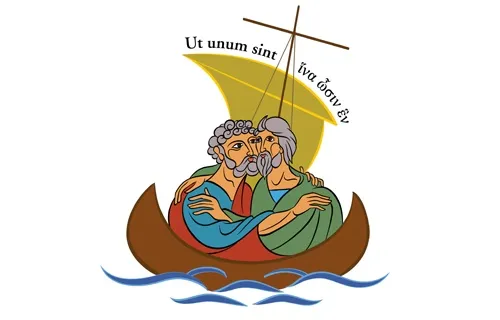
Pope Francis is enroute to Jordan and the beginning of a very busy three day visit to the Holy Land, in a visit that will focus on Christian unity. As Catholic News Service put it recently:
The Vatican has emphasized that the pope’s main purpose on the trip is to meet in Jerusalem with Ecumenical Patriarch Bartholomew of Constantinople, considered first among equals by Orthodox bishops. The official logo for the papal visit is an icon of the Apostles Peter and Andrew, patron saints of the churches of Rome and Constantinople, joined in a fraternal embrace.The pope will be visiting Jordan, Palestine and Israel and celebrate Mass in all three countries. He will meet a wide range of people, from heads of state and royalty to religious and refugees. It promises to be an extraordinary visit — in every sense of the term, a pilgrimage.
- Full schedule of the trip available here (and there will be links to speeches and addresses after the events at the same link)
- Missal of the Papal liturgies
This gives expression to the desire of the Lord at the Last Supper: “I ask not only on behalf of these, but also on behalf of those who will believe in me through their word, that they may all be one. As you, Father, are in me and I am in you, may they also be in us, so that the world may believe that you have sent me. The glory that you have given me I have given them, so that they may be one, as we are one, I in them and you in me, that they may become completely one, so that the world may know that you have sent me and have loved them even as you have loved me.” (John 17:20-23).
The logo also expresses this desire for unity, representing the embrace of Saint Peter and Saint Andrew, the first two disciples called by Jesus in Galilee. Saint Peter is the patron of the Church in Rome and Saint Andrew is the patron of the Church in Constantinople. In Jerusalem, in the Mother Church, they embrace. The two apostles are in a boat that represents the Church, whose mast is the Cross of the Lord. The sails of the boat are full of wind, the Holy Spirit, which directs the boat as it sails across the waters of this world.
The unity of Christians is a message of unity for all humanity, called to overcome the divisions of the past and march forward together towards a future of justice, peace, reconciliation, pardon and fraternal love.

Pope Francis (in what is becoming a personal tradition of this pontificate) made a private visit to the Roman Basilica of St. Mary Major on Friday morning to pray and entrust his Holy Land pilgrimage to Our Lady. After praying for 15 minutes before the image of the Madonna Salus Populi Romani, the Pope left a bouquet of roses in her honour.
Perhaps it would be helpful to join in prayer for the successful and safe conclusion of this pilgrimage:
Prayer for the pilgrimage of Pope Francis to the Holy LandHeavenly Father, you never tire of being compassionate and loving. The successor of St. Peter plans to visit the Holy Land sanctified by your Son’s birth, baptism, teaching, death and resurrection. Be with him, sanctify him, and bless him. Spread the mantle of your kindness over every stage of his pilgrimage among us, that one may see in him a believing pilgrim, a wise teacher, and a humble leader.Lord Jesus Christ, who prayed for the unity of your Church, saying: “May they all be one”, make the meeting in Jerusalem between the Holy Father and the Ecumenical Patriarch an incentive to increase our efforts for the unity of your children.Make the encounter of the Pope with the political authorities fruitful for justice and peace. Protect all the residents of this land and the adherents of the religions of the Middle East that they may be in accord, dialogue and cooperation for the achievement of full citizenship.Good Shepherd, whose image Pope Francis carries on his pectoral cross, walking in the spirit of humility with which you have graced him deepen within us the awareness of our Christian identity, that as true disciples, we may bear witness to your Good News and your resurrection in our churches, our society, and all the world, especially by serving the sick, the poor, and the refugees.Bless, Lord Most Holy, this fourth papal visit to our Holy Land, through the intercession of the Blessed Virgin Mary, St. Joseph, all the saints of the Holy Land, and the two new saints, John Paul II and John XXIII. Amen.
You can follow the Pope's visit on the following sites:
Official website of the visit from the Assembly of the Catholic Ordinaries (Bishops) of the Holy Land - good site with a lot of information and background about the situation of Christians in the Holy Land
Official website of the visit by Patriarch Bartholomew
CNEWA (Catholic Near East Welfare Association) - Apostles of Unity in the Holy Land
Vatican News
Vatican Radio Facebook page
Rome Reports
Franciscan Media Centre and Terra Sancta News
Whispers in the Loggia
Catholic News Agency
The Anchoress
19 Apr 2014
Easter Vigil at the Holy Sepelchre in Jerusalem
The organ breaks the silence of the basilica, along with the church bells and the joy of the resurrection that fill the church. It is Easter in Jerusalem. Christ rises here and now. Today, just like he did two thousand years ago.
The Great Easter Vigil, the “mother of all vigils,” as the liturgy reads, takes place on Saturday morning at the Holy Sepulcher. This year, it is taking place at dawn, with the first rays of the sun penetrating into the shrine, and it will coincide with the Orthodox Easter, whose rites are celebrated in the same basilica.
[Blog Editors Note: Unlike in the rest of the Latin Church because the rules and timetable of the liturgies at the Basilica of the Holy Sepelchre are governed by the 1853 Status Quo, the Latin liturgies follow an older timetable. In this case pre-1955 when Pius XII reformed the liturgies for Holy Week and moved the Easter Vigil from Holy Saturday morning back to Holy Saturday evening. However in Jerusalem, the older timetable has to be maintained.]
The light for the Easter candle is taken directly from the Sepulcher. The deacon hands it to Latin Patriarch Archbishop Fouad Twal, who presides over the celebration. Then, from that flame, the lamps and candles in front of the shrine and those of all the faithful are lit.
After a long series of readings for the Easter Vigil, it is the patriarch himself who reads the Gospel of the Resurrection, right in front of the door where the Empty Tomb is located. In the account according to Matthew, the women are the first to receive the announcement of the resurrection.
“This is the most important place for the Church, where the Church was born, and with the presence of women, the word is spread. And even today, the first person they say saw him was Mary Magdalene and I'm happy about that.”
"There is a message: He is not here; he is risen. Jerusalem continually calls us to go beyond ourselves, to bring this message that is the heart of the Gospel to the whole world.”
In the baptismal liturgy, with the blessing of water and sprinkling of the faithful, there is a sign of hope for the Holy Land.
H.B. FOUAD TWAL
Latin Patriarch of Jerusalem
“It is my wish for peace: for the local church, for all the people who live in the Holy Land, peace for everyone! And I hope that the Universal Church feels committed to this peace, to this Christian community and to this joy along with us.”
14 Apr 2014
Good Friday Collection in solidarity with Church in Holy Land

(Vatican Radio)
 Parishes around the world this week will be taking up the
traditional annual Good Friday Collection for the Church in the Holy Land.The
proceeds from the Good Friday Collection go to the Franciscan Custody of the
Holy Land. The Franciscans have been caring for the holy sites there since 1209.
They also assist the poor, run schools, provide scholarships, and conduct
pastoral ministries to keep Christianity alive in the land where it
originated.
Parishes around the world this week will be taking up the
traditional annual Good Friday Collection for the Church in the Holy Land.The
proceeds from the Good Friday Collection go to the Franciscan Custody of the
Holy Land. The Franciscans have been caring for the holy sites there since 1209.
They also assist the poor, run schools, provide scholarships, and conduct
pastoral ministries to keep Christianity alive in the land where it
originated.In his appeal to Catholics to donate generously this Good Friday, Cardinal Leonardo Sandri, Prefect of the Congregation for Eastern Churches, said “The Collection is still today the principal source which sustains the life and works of the region’s Christians.”
Cardinal Sandri described the current situation in the region, particularly the conflict in Syria, tensions in Egypt and between Israel and Palestine as “truly precarious.”
“Every day the Christians in various regions of the Middle East ask themselves whether they should remain or emigrate,” he noted. “They live in danger and often suffer violence only for the fact of professing the faith common to them and us.” The Collection helps Christians of many different denominations remain in the region as living witnesses to Christ.
A quick look at these Franciscan websites gives an idea about the kinds of services the Good Friday Collection helps provide: www.myfranciscan.org or www.custodia.org.
Social & Charitable Activities
In order to assist Christians to remain in the Holy Land, including the poor and young couples, the Franciscan Custody has built more than a thousand residential units in multiple locations – Bethlehem, Bethphage and Nazareth. In the Old City of Jerusalem about 80 homes have been rehabilitated for Christian families. Senior Care facilities have been built in Bethlehem and Nazareth. Medical assistance is provided for the needy.
Educational & Scientific Activities
To help over 10,000 pre-K through grade 12 students, the Franciscans operate and support schools open to all, regardless of religion or nationality. Muslim and Christian students, teachers and families get to know each other and live in harmony. University scholarships for 360 students prepare them to get jobs and remain in the Holy Land as part of living Catholic communities. Some 120 young men are preparing to be priests or brothers. Still others are pursuing advanced degrees in Biblical Studies and Archaeology and Theology. Franciscan archaeologists pursue ongoing research at the Holy Places including the new projects at Magdala, the home of St. Mary Magdalene.
Pastoral Activities
The Franciscans provide pastoral care in 29 parishes in the Holy Land offering Worship, Christian Formation, youth and family programs and new parish centers in Jericho and Cana.
Liturgical, Ecumenical and Communications Programs
The Franciscan Media Center tells the story of the Holy Land through multimedia distributed throughout the world in more than seven languages. The friars organize Liturgical Celebrations for the local Christians and Pilgrims and share with other Christian communities in the Holy Land in ongoing Ecumenical cooperation.
Subscribe to:
Posts (Atom)