Showing posts sorted by date for query holy week. Sort by relevance Show all posts

24 Aug 2019

25 August 2019 - A programme of reflections - Reflecting on the Mass with Fr Frank (Part 1); Reflection on "Mary Our Mother", Knock 2019 - Eucharistic Blessing & Healing Prayers

This week Fr Frank Duhig joins us to begin series of reflections on the Mass. He concludes his reflection with the last words of Jesus that are used at the beginning of each Mass ‘In the name of the Father and the son and the Holy Spirit’

You can listen to a podcast of the reflection of Fr Frank  excerpted from the programme HERE.

We also replay a reflection of ‘Mary our Mother’ which was originally broadcast in August 2017. Geraldine Creaton & Shane Ambrose share their thoughts on the role Mary plays as our protector and evangeliser.

You can listen to a podcast of the reflection of Geraldine  excerpted from the programme HERE.

We also include a recording made during the recent Knock Novena of the Eucharistic blessing and healing prayers

You can listen to a podcast of the Eucharistic Blessing and healing prayers excerpted from the programme HERE.

You can listen to the podcast of this week's full programme HERE.

21 Jul 2019

21 July 2019 - Cistercian Sisters of St. Mary's Abbey, Glencairn, Co. Waterford (Part I)

On this week's programme, we are broadcasting a repeat of one of our popular programme's which was originally broadcast on July 21st 2013. We are replaying part one of a two part special programme on the Cistercian nuns of St Mary's Abbey, Glencairn Co Waterford. Lorraine had a discussion about the Cistercian life and what it means to be an enclosed nun in Ireland today with Sr Sarah Branigan (Vocation Directoress) and Sr Michelle Slattery (Novice Mistress).

You can listen to the podcast of the programme HERE.

The Abbey's website is HERE and Facebook page HERE.

St Mary's Abbey - Glencairn

(Most of!) The community gather in our new refectory wing of the Abbey for a photo by Dan Linehan (Irish Examiner) - Taken from the Abbey website (glencairnabbey.org)
St Mary’s Abbey, Glencairn is the only Cistercian monastery for women in Ireland.  The monastery is located in the Blackwater Valley, about 3 miles upstream from Lismore, County Waterford.
"At the heart of the monastic life is the search for God; here at Glencairn, we seek God and follow Christ in a life of prayer and community, solitude and simplicity, work and hospitality. We follow the Rule of St Benedict, an ancient source of monastic wisdom that continues to guide many people in search of an authentic spiritual path in today’s world."
As the sisters outline the Cistercian Order arose as a reform movement within the Benedictine tradition in the 12th century who were seeking for a simpler way of life - a return to the deserts of the world to seek a space for God. 

The first Cistercian monastery was established in Citeaux, France in 1098 by Saints Robert, Alberic and Stephen and Sr Sarah tells us of the history of the early foundations. Early in the Cistercian tradition, women sought the Cistercian way of life and the first Cistercian monastery for women was in Tart, France, a daughter house of Citeaux, founded by St Stephen in 1125. St Malachy brought the Cistercians to Ireland in 1142, to Mellifont, County Louth. St Mary’s Abbey, Glencairn is the first Cistercian monastery for women in Ireland since the Reformation, founded in 1932 by Holy Cross Abbey, Stapehill, England. Today, there are 37 Cistercian nuns in the community of St Mary’s Abbey, Glencairn.

The life of the Cistercians is under pinned by a number of foundations including 
  • a zeal for the Opus Dei (the Work of God) which is the Liturgy of the Hours (a.k.a. the Divine Office) which is one of the focus' of St Benedict
  • the ethos of simplicity which defined Citeax with its emphasis on poverty, simplicity in liturgy, manual work and a guarded interaction with the secular world so as not to displace the main focus of their lives as being a constant search for God.
  • St Bernard and other writers of the Cistercian tradition have emphasised experiential quality of monastic life; effective spirituality stressing relationship with Christ; stressing fraternal communion and also a strong Marian devotion with the order and each abbey of the order under the patronage of Mary.

Sr Michelle takes us through the life of a novice as women discern whether they are called to the life of a cistercian nun with the community in Glencairn including what daily life is like, the study and prayer life undertaken. Sr Sarah then continues to share with is the meaning of the monastic vows stability, obedience and conversion of life as well as the day to day life at the abbey.

From the Abbey's website:


What is Cistercian Spirituality?

“Cistercian nuns seek God and follow Christ under a rule and an abbess in a stable community which is a school of mutual love”. These words, from the Constitutions of our Order, point to some key elements in our spirituality. 

Cistercian: “Cistercian” comes from the word Cîteaux, in Latin Cistercium, which means “marshy place” or “swampy place”. Cîteaux, in France, is where the Cistercian movement began in 1098, as a reform within the Benedictine monastic tradition.

Nuns and monks: there are both men and women Cistercians. We live in single-sex communities, but the two branches form one Order. There are Cistercian communities on all five continents: they follow the same lifestyle, adapted to local situations.

Seek God: the heart of monastic life is seeking God. From earliest times, some Christians have felt called to go apart to lead a life more intensely focused on God. They separated themselves from the distractions of regular society, and went away to a remote or isolated place more conducive to prayer and consciousness of God. There they devoted themselves to seeking God and union with God. The first people to practise this kind of lifestyle went literally into the desert, in Egypt. We follow in their footsteps, and so do not engage in any outside apostolate. The purpose of a Cistercian is to seek God.

Follow Christ: Cistercian life is a way of living the Gospel. A personal relationship with Jesus Christ is fundamental in each sister’s heart. Christ is our model: we strive to be conformed to him in his obedience, humility, patience and poverty. He is our King, whom we try to serve. And he is our Beloved: we seek intimate union with him in prayer.

Under a Rule…: this means the Rule of St Benedict, as interpreted by Cistercian tradition and contemporary understanding. There are three key elements in the monastic day according to this Rule:


(1) Liturgy: Seven times a day we meet in the church to celebrate the Liturgy of the Hours, consisting of psalms, Scripture readings, and prayers. By this we offer praise to God, we ourselves are sanctified, and we intercede for all people. We celebrate the Eucharist daily; it is the source of our communion with Jesus Christ and with one another.

(2) Lectio divina: quiet, meditative reading of the Word of God in Scripture, which leads to contemplative prayer and shapes us to live by the Gospel.

(3) Work: Through our work we support ourselves, and have something to share with the poor. In Glencairn we produce eucharist bread and greeting cards for sale, and we have a farm which is now mostly dedicated to tillage (barley) with some cattle. Other work includes care of the sick and guests, the upkeep of the monastery, administration and formation work, gardening, and many other tasks.
Living “under a Rule” means that our life is disciplined. The purpose of this discipline is to make us free: free from selfishness and unhealthy desires, free from things that do not help us on our journey to God; free to have hearts open to give and receive genuine love.

…and an abbess: the abbess is a central figure in the monastery. She is believed to act as Christ’s representative, and so ministers to the whole community with pastoral care, teaching the sisters by word and example, and encouraging them in their monastic vocation.

Community: Cistercians maintain a balance between solitude on the one hand, and community living on the other. Solitude and silence provide us with a climate for prayer and encounter with God. Community relationships are the place where love is put into action. Unity of spirit, sharing of goods, and bearing one another’s burdens are hallmarks of a Spirit-filled community.

Stability: we make a vow of stability, which means that we commit ourselves to live always in this particular community, and will not normally move to another one. Stability is the “for better, for worse” of monastic life. Our other vows are fidelity to monastic life, and obedience.

School of love: St Benedict called the monastery a “school of the Lord’s service.” The early Cistercians called it a “school of love”. On our spiritual journey we are always pupils. Learning to love with the heart and mind of Christ is an ongoing task, which will occupy us all the days of our life.


********

Some external Youtube videos on Glencairn.


An investigation by U.S. television producer Phil O'Connor into the decline of the Irish Church brought him, together with the Religion and Ethics team and camera crew to Ireland in late May of this year where they made a further television feature on contemporary monastic life as lived here at St Mary's Abbey.

Originally broadcast in the U.S. Sunday a.m. 24 July 2011 on PBS television on Religion and Ethics Newsweekly.


An audio slideshow by Irish Times photographer Bryan O'Brien featuring images of Theresa Kottayail from Kerala, India as she took her first vows as a junior professed sister in the enclosed Cistercian community of nuns at St Mary's Abbey, Glencairn, Lismore, Co.Waterford, Ireland in December 2011. She took the name Sr Robert and was the first sister from India to complete her novitiate in the rural Irish Abbey.


Gospel - Luke 10:38-42


Jesus entered a certain village, where a woman named Martha welcomed him into her home. She had a sister named Mary, who sat at the Lord’s feet and listened to what he was saying. But Martha was distracted by her many tasks; so she came to him and asked, “Lord, do you not care that my sister has left me to do all the work by myself? Tell her then to help me.” But the Lord answered her, “Martha, Martha, you are worried and distracted by many things; there is need of only one thing. Mary has chosen the better part, which will not be taken away from her.”
Reflections on this week's Gospel:

Word on Fire

English Dominicans 
Centre for Liturgy
Sunday Reflections 

Liturgical odds & ends

Liturgy of the Hours - Psalter Week 4


Saints of the Week
July 22nd - St. Mary Magdalene
July 23rd - St. Bridget of Sweden
July 24th - St. John Boste
July 25th - St. James the Greater, Apostle
July 26th - St. Joachim and St. Anne
July 27th - St. Pantaleon

30 Jun 2019

30th June 2019 - Fr. Donal Neary S.J. - The Sacred Heart of Jesus

On this week's programme our team is joined by Fr. Donal Neary S.J., Editor of The Sacred Heart Messenger, who speaks to us about the devotion to the Sacred Heart of Jesus and about The Sacred Heart Messenger. We also have our usual reflection on the Sunday Gospel.

You can listen to the podcast of this week's full programme HERE.

The Sacred Heart of Jesus 
Fr Donal reflects on the devotion to the Sacred Heart which goes back to the scene at Calvary when a sword pierced the Heart of Jesus. From the 17th Century the devotion to the Sacred Heart became more widespread after Sr Margaret Mary Alacoque had visions where Jesus showed her is heart that beats for everyone and loves everyone of us. The devotion to the Sacred Heart was very much part of people’s lives when they were unable to attend Mass. Fr Donal speaks of the Sacred Heart as that of a friend. Both the 1st Friday devotion & the ‘Holy Hour’ came about as a result of devotion to the Sacred Heart.

Fr Donal also spoke to us about the Sacred Heart Messenger of which he is editor. In 1858 Fr James Cullen started an ‘Apostleship of prayer’ magazine and from this beginning the Sacred Heart Messenger came about. With a monthly circulation of 45,000 copies, 80% of which sold through promoters, the magazine contains inspirational articles which support readers on their faith journey. As the cover of the magazine quotes – A modern message in a much-loved tradition. 

Copies of the Messenger are available at some shops and Church book stalls and can be sourced HERE or by writing to: 
37 Lr Leeson Street, Dublin, D02 W938, Ireland. Tel: 01 6767491. Email: sales@messenger.ie 

Icon of the Sacred Heart in Maryvale Institute, Birmingham, written by David Clayton

Novena Prayer to the Sacred Heart

(This  version of the novena prayer would be one of the best known as it was used by Padre Pio and was promoted during the promotion of the cause of St Pio. It is a prayer that can be used throughout the year and not just in the lead up to the Solemnity of the Sacred Heart. Indeed, St. Pio prayed this prayer every day.)

I. O my Jesus, you have said: "Truly I say to you, ask and you will receive, seek and you will find, knock and it will be opened to you." Behold I knock, I seek and ask for the grace of...... (here name your request)

Our Father... Hail Mary... Glory Be to the Father...
Sacred Heart of Jesus, I place all my trust in you.

II. O my Jesus, you have said: "Truly I say to you, if you ask anything of the Father in my name, he will give it to you." Behold, in your name, I ask the Father for the grace of.......(here name your request) 

Our Father... Hail Mary... Glory Be to the Father...
Sacred Heart of Jesus, I place all my trust in you.

III. O my Jesus, you have said: "Truly I say to you, heaven and earth will pass away but my words will not pass away." Encouraged by your infallible words I now ask for the grace of.....(here name your request) 

Our Father... Hail Mary... Glory Be to the Father...
Sacred Heart of Jesus, I place all my trust in you.

O Sacred Heart of Jesus, for whom it is impossible not to have compassion on the afflicted, have pity on us miserable sinners and grant us the grace which we ask of you, through the Sorrowful and Immaculate Heart of Mary, your tender Mother and ours.

Hail, Holy Queen...
St. Joseph, foster father of Jesus, pray for us. 

You can listen to a podcast of this reflection excerpted from the programme HERE.

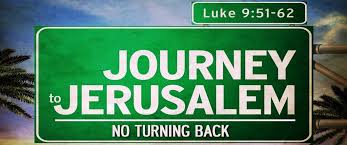
Gospel - Luke 9:51-62


As the time drew near for him to be taken up to heaven, Jesus resolutely took the road for Jerusalem and sent messengers ahead of him. These set out, and they went into a Samaritan village to make preparations for him, but the people would not receive him because he was making for Jerusalem. Seeing this, the disciples James and John said, ‘Lord, do you want us to call down fire from heaven to burn them up?’ But he turned and rebuked them, and they went off to another village.

As they travelled along they met a man on the road who said to him, ‘I will follow you wherever you go.’ Jesus answered, ‘Foxes have holes and the birds of the air have nests, but the Son of Man has nowhere to lay his head.’

Another to whom he said, ‘Follow me’, replied, ‘Let me go and bury my father first.’ But he answered, ‘Leave the dead to bury their dead; your duty is to go and spread the news of the kingdom of God.’

Another said, ‘I will follow you, sir, but first let me go and say goodbye to my people at home.’ Jesus said to him, ‘Once the hand is laid on the plough, no one who looks back is fit for the kingdom of God.’
Reflections on this week's gospel: 

Word on Fire

English Dominicans *
Centre for Liturgy
Sunday Reflections *

* In England & Wales the Solemnity of St. Peter and St. Paul is celebrated instead of the 13th Sunday in Ordinary Time.

Liturgical odds & ends

Liturgy of the Hours - Psalter Week 1


Saints of the Week
July 1st - St. Oliver Plunkett
July 2nd - St. Bernardino Realino
July 3rd - St. Thomas, Apostle
July 4th - St. Elizabeth of Portugal
July 5th - St. Anthony Mary Zaccaria
July 6th - St. Maria Goretti

23 Jun 2019

23rd June 2019 - Corpus Christi

On this week's programme Lorraine shares with us on the beautiful Solemnity of Corpus Christ. We also have our regular celestial guides and reflection on the Sunday Gospel.

You can listen to the podcast of this week's full programme HERE.

Corpus Christi


Lorraine shares with us some thoughts on the Solemnity of the Most Holy Body and Blood of Christ, which we know better as Corpus Christi. Lorraine begins by taking us through a history of the feast which owes its existence to Blessed Juliana of Liege, who began devotion to the Blessed Sacrament in around 1230. Largely through her insistence, in 1264 Pope Urban 1V commanded its observance by the universal church. While the Church celebrates the Institution of the Eucharist at the Last Supper on Holy Thursday because it falls within the solemn and reflective time of the Easter Triduum, Juliana wanted to encourage a joyful celebration of this great gift of our Divine Master to the Church and to the world.  

The Feast sums up three important confessions about our Faith. First is that God became physically present in the person of Christ, True God and True Man. Secondly, God continues to be present in His people as they form the Mystical Body of Christ in his church. And thirdly, the presence of God under the form of bread and wine is made available to us on the altar at Mass and preserved there for our nourishment and worship.

Lorraine also reflects on why the Real Presence of Jesus in the Blessed Sacrament is so important to us through the Eucharistic hymns of the Tantum Ergo, Ave Verum Corpus, and Godhead Here in Hiding (Adoro Te Devote). 


You can listen to a podcast of this reflection excerpted from the programme HERE.

Gospel - Luke 9:11-17

Jesus made the crowds welcome and talked to them about the kingdom of God; and he cured those who were in need of healing.
It was late afternoon when the Twelve came to him and said, ‘Send the people away, and they can go to the villages and farms round about to find lodging and food; for we are in a lonely place here.’ He replied, ‘Give them something to eat yourselves.’ But they said, ‘We have no more than five loaves and two fish, unless we are to go ourselves and buy food for all these people.’ For there were about five thousand men. But he said to his disciples, ‘Get them to sit down in parties of about fifty.’ They did so and made them all sit down. Then he took the five loaves and the two fish, raised his eyes to heaven, and said the blessing over them; then he broke them and handed them to his disciples to distribute among the crowd. They all ate as much as they wanted, and when the scraps remaining were collected they filled twelve baskets.
Reflections on this week's gospel:

Word on Fire

English Dominicans
Centre for Liturgy
Sunday Reflections

Liturgical odds & ends

Liturgy of the Hours - Psalter Week 4


Saints of the Week
June 24th - The Birthday of St. John the Baptist 
June 25th – St. William of Vercelli
June 26th – St. Anthelm
June 27th - St. Cyril of Alexandria
June 28th - The Most Sacred Heart of Jesus
June 29th - St. Peter and St. Paul

8 Jun 2019

9th June 2019 - Fr. Seamus Enright - Limerick’s Novena in Honour of Our Mother of Perpetual Help 2019

On this week's programme Fr. Seamus Enright C.Ss.R., Rector of the Redemptorist Community, Mount St. Alphonsus, Limerick joins John to speak about their upcoming Novena to Our Mother of Perpetual Help which takes place from June 14th - 22nd. We also have our regular celestial guides and reflection on the Sunday Gospel.

You can listen to the podcast of this week's full programme HERE.

The Saint Next Door: Living the Beatitudes
Fr. Seamus Enright C.Ss.R., Rector of the Redemptorist Community, Mount St. Alphonsus, Limerick shared with John a little about the history of the devotion to Our Lady under the title of Our Mother of Perpetual Help and where the original icon came from. He also explained that the Redemptorists have a papal mandate to promote devotion to Our Mother of Perpetual Help and how and when the Limerick Novena came about. 

The theme for this year's Novena is The Saint Next Door: Living the Beatitudes which is based on Pope Francis's Apostolic Exhortation on the call to holiness in today's world which is entitled Gaudete et Exsultate (Rejoice and Exult) available HERE. Holiness is not the reserve of clergy and religious. It is, in fact, the baptismal calling of each and every Christian. This theme will be unpacked by looking at holiness in the context of the beatitudes which are a portrait of Jesus and a depiction of a true disciple. 


You can listen to a podcast of this reflection excerpted from the programme HERE.

You can find out more details about the Novena and watch the Novena online on their website HERE.


Gospel - John 14:15-16,23-26

Jesus said to his disciples:
‘If you love me you will keep my commandments.
I shall ask the Father,
and he will give you another Advocate
to be with you for ever.

‘If anyone loves me he will keep my word,
and my Father will love him,
and we shall come to him and make our home with him.
Those who do not love me do not keep my words.
And my word is not my own:
it is the word of the one who sent me.
I have said these things to you while still with you;
but the Advocate, the Holy Spirit,
whom the Father will send in my name,
will teach you everything
and remind you of all I have said to you.
Reflections on this week's gospel:

Word on Fire

English Dominicans
Centre for Liturgy
Sunday Reflections

Liturgical odds & ends

Liturgy of the Hours - Psalter Week 2


Saints of the Week
June 10th – Mary, Mother of the Church
June 11th – St. Barnabas, Apostle
June 12th – 108 Blessed Polish Martyrs
June 13th – St. Anthony of Padua
June 14th – St. Davnet
June 15th – St. Abraham

26 May 2019

26th May 2019 - Fr. Luke McNamara OSB on The Acts of the Apostles

On this week's programme Fr. Luke McNamara OSB gives us an overview of The Acts of the Apostles. We also have our regular reflection on the Sunday Gospel as well as some liturgical odds and ends.

You can listen to the podcast of this week's full programme HERE.

The Acts of the Apostles


Fr. Luke McNamara OSB from Glenstal shares an overview of The Acts of the Apostles, beginning by highlighting it's intrinsic connection with the Gospel of St. Luke and why it is separated from St. Luke's Gospel in the arrangement of the books of the New Testament. Fr. Luke recommends that we read The Acts of the Apostles in one sitting or perhaps over two days so that we don't miss the connections between the various parts. Once we have a sense of the whole story of Acts, we will be able to have a better understanding of how the various accounts in Acts fit together. Fr. Luke then very helpfully unpacks The Acts of the Apostles for us, noting the work of the Holy Spirit so that one could suggest that that The Acts of the Apostles be known as The Acts of the Holy Spirit. Fr. Luke especially highlights the relevance of The Acts of the Apostles to our lives today.

You can listen to a podcast of this reflection excerpted from the programme HERE.

Gospel - John 14:23-29

Jesus said to his disciples:

‘If anyone loves me he will keep my word,
and my Father will love him,
and we shall come to him and make our home with him.

Those who do not love me do not keep my words.
And my word is not my own:
it is the word of the one who sent me.

I have said these things to you while still with you;
but the Advocate, the Holy Spirit,
whom the Father will send in my name,
will teach you everything and remind you of all I have said to you.

Peace I bequeath to you, my own peace I give you,
a peace the world cannot give,
this is my gift to you.

Do not let your hearts be troubled or afraid.
You heard me say: I am going away, and shall return.

If you loved me you would have been glad to know that I am going to the Father, for the Father is greater than I.

I have told you this now before it happens,
so that when it does happen you may believe.’

Reflections on this week's gospel:

Word on Fire

English Dominicans
Centre for Liturgy
Sunday Reflections

Liturgical odds & ends

Liturgy of the Hours - Psalter Week 2

First Saturday - June 1st

Pope's Intention for June 2019
Evangelisation – Priests: That priests, through the modesty and humility of their lives, commit themselves actively to a solidarity with those who are the most poor.

Saints of the Week
May 27th – St. Augustine of Canterbury
May 28th – Blessed Margaret Pole
May 29th – St. Paul VI
May 30th – St. Joan of Arc
May 31st – The Visitation of the Blessed Virgin Mary
June 1st – St. Justin Martyr

5 May 2019

5th May - Third Sunday of Easter - Bishop Leahy's Lenten Pastoral on Holiness (Continued)

On this week's programme the SS102fm team continue our reflection on Bishop Brendan Leahy's Lenten Pastoral Letter "This Is What God Wants Of Us – Our Holiness." We also have our usual reflection on the Sunday Gospel and local notices.

You can listen to the podcast of this weeks full programme HERE.

This is What God Wants of Us - Our Holiness


John and Lorraine continued our reflection on Bishop Brendan's pastoral letter "This is What God Wants of Us - Our Holiness." Of course, just because Lent is over and we are well into the season of Eastertide doesn't mean that we can forget about holiness! The call to holiness is both universal (meaning that we are all called to holiness) and ongoing. It is a life-long endeavour of saying 'yes' to God's grace. As Bishop Brendan succinctly puts it - holiness is "love lived to the full, love of God and one’s neighbour."

In this week's programme we look at the section on 'Why is holiness important?' Bishop Brendan suggests that although we may not be perfect, the overall trend of our life and our effort to be holy matters:  "Each

one of us not only has a mission but is a mission. God wants some particular aspect of the Gospel to shine
out in our lives. If we live our life living love to the full, that is, in holiness, God’s word gets pronounced, as it
were, more clearly to the benefit of many."

Bishop Brendan also invites us to reflect on the following question: "You might think of people you know who you consider holy and ask yourself what specific word does their life speak to you. Each of our lives is speaking a word to the world around us." So we invite you to do the same during the coming week. Think about what word you proclaim to the world and what words those who are holy proclaim to the world.


You can listen to the reflection excerpted from the main programme podcast HERE.

You can read the full Pastoral Letter HERE.

Gospel - John 21:1-19


Jesus showed himself again to the disciples. It was by the Sea of Tiberias, and it happened like this: Simon Peter, Thomas called the Twin, Nathanael from Cana in Galilee, the sons of Zebedee and two more of his disciples were together. Simon Peter said, ‘I’m going fishing.’ They replied, ‘We’ll come with you.’ They went out and got into the boat but caught nothing that night.

It was light by now and there stood Jesus on the shore, though the disciples did not realise that it was Jesus. Jesus called out, ‘Have you caught anything, friends?’ And when they answered, ‘No’, he said, ‘Throw the net out to starboard and you’ll find something.’ So they dropped the net, and there were so many fish that they could not haul it in. The disciple Jesus loved said to Peter, ‘It is the Lord.’ At these words ‘It is the Lord’, Simon Peter, who had practically nothing on, wrapped his cloak round him and jumped into the water. The other disciples came on in the boat, towing the net and the fish; they were only about a hundred yards from land.


As soon as they came ashore they saw that there was some bread there, and a charcoal fire with fish cooking on it. Jesus said, ‘Bring some of the fish you have just caught.’ Simon Peter went aboard and dragged the net to the shore, full of big fish, one hundred and fifty-three of them; and in spite of there being so many the net was not broken. Jesus said to them, ‘Come and have breakfast.’ None of the disciples was bold enough to ask, ‘Who are you?’; they knew quite well it was the Lord. Jesus then stepped forward, took the bread and gave it to them, and the same with the fish. This was the third time that Jesus showed himself to the disciples after rising from the dead.


After the meal Jesus said to Simon Peter, ‘Simon son of John, do you love me more than these others do?’ He answered, ‘Yes Lord, you know I love you.’ Jesus said to him, ‘Feed my lambs.’ A second time he said to him, ‘Simon son of John, do you love me?’ He replied, ‘Yes, Lord, you know I love you.’ Jesus said to him, ‘Look after my sheep.’ Then he said to him a third time, ‘Simon son of John, do you love me?’ Peter was upset that he asked him the third time, ‘Do you love me?’ and said, ‘Lord, you know everything; you know I love you.’ Jesus said to him, ‘Feed my sheep.


‘I tell you most solemnly,

when you were young
you put on your own belt
and walked where you liked;
but when you grow old
you will stretch out your hands,
and somebody else will put a belt round you
and take you where you would rather not go.’

In these words he indicated the kind of death by which Peter would give glory to God. After this he said, ‘Follow me.’


Reflections on this week's gospel:

Word on Fire

English Dominicans
Centre for Liturgy
Sunday Reflections

Liturgical odds & ends


Liturgy of the Hours - Psalter Week 3


Saints of the Week

May 6th - St. Dominic Savio
May 7th - St. Rose Venerini
May 9th - St. Pachomius
May 10th - St. Comgall
May 11th - St. Ignatius of Laconi