19 Apr 2014

Easter Vigil - "Where is my Galilee?" - Homily of Pope Francis

 
HOMILY OF POPE FRANCIS
THE EASTER VIGIL
ST PETER'S BASILICA
19 APRIL 2014
The Gospel of the resurrection of Jesus Christ begins with the journey of the women to the tomb at dawn on the day after the Sabbath. They go to the tomb to honour the body of the Lord, but they find it open and empty. A mighty angel says to them: “Do not be afraid!” (Mt 28:5) and orders them to go and tell the disciples: “He has been raised from the dead, and indeed he is going ahead of you to Galilee” (v. 7). The women quickly depart and on the way Jesus himself meets them and says: “Do not fear; go and tell my brothers to go to Galilee; there they will see me” (v. 10).

After the death of the Master, the disciples had scattered; their faith had been utterly shaken, everything seemed over, all their certainties had crumbled and their hopes had died. But now that message of the women, incredible as it was, came to them like a ray of light in the darkness. The news spread: Jesus is risen as he said. And then there was his command to go to Galilee; the women had heard it twice, first from the angel and then from Jesus himself: “Let them go to Galilee; there they will see me”.

Galilee is the place where they were first called, where everything began! To return there, to return to the place where they were originally called. Jesus had walked along the shores of the lake as the fishermen were casting their nets. He had called them, and they left everything and followed him (cf. Mt 4:18-22).

To return to Galilee means to re-read everything on the basis of the cross and its victory. To re-read everything – Jesus’ preaching, his miracles, the new community, the excitement and the defections, even the betrayal – to re-read everything starting from the end, which is a new beginning, from this supreme act of love.

For each of us, too, there is a “Galilee” at the origin of our journey with Jesus. “To go to Galilee” means something beautiful, it means rediscovering our baptism as a living fountainhead, drawing new energy from the sources of our faith and our Christian experience. To return to Galilee means above all to return to that blazing light with which God’s grace touched me at the start of the journey. From that flame I can light a fire for today and every day, and bring heat and light to my brothers and sisters. That flame ignites a humble joy, a joy which sorrow and distress cannot dismay, a good, gentle joy.

In the life of every Christian, after baptism there is also a more existential “Galilee”: the experience of a personal encounter with Jesus Christ who called me to follow him and to share in his mission. In this sense, returning to Galilee means treasuring in my heart the living memory of that call, when Jesus passed my way, gazed at me with mercy and asked me to follow him. It means reviving the memory of that moment when his eyes met mine, the moment when he made me realize that he loved me.

Today, tonight, each of us can ask: What is my Galilee? Where is my Galilee? Do I remember it? Have I forgotten it? Have I gone off on roads and paths which made me forget it? Lord, help me: tell me what my Galilee is; for you know that I want to return there to encounter you and to let myself be embraced by your mercy.

The Gospel of Easter is very clear: we need to go back there, to see Jesus risen, and to become witnesses of his resurrection. This is not to go back in time; it is not a kind of nostalgia. It is returning to our first love, in order to receive the fire which Jesus has kindled in the world and to bring that fire to all people, to the very ends of the earth.

“Galilee of the Gentiles” (Mt 4:15; Is 8:23)! Horizon of the Risen Lord, horizon of the Church; intense desire of encounter.... Let us be on our way!

The Easter Proclamation (Exsultet)


The Exsultet, sometimes seen as "Exultet" and also referred to as the Praeconium Paschale, is an ancient chant sung during the Easter Vigil. It is traditionally sung by the deacon after the Paschal candle has been lit and the clergy have processed to the altar. The lighted Paschal candle contains a twofold symbolism. First, it represents the pillar of fire that went before the Israelites during their flight from Egypt. Second, it represents Christ, who is the light of the world. The procession likewise has a twofold meaning. It symbolizes the journey of the Israelites out of Egypt, and also the arrival of Christ who is the Savior of the world. The Exsultet sings of this symbolism and recalls for us the history of our salvation; from the fall of Adam, to the events of that first Passover held by Moses and the Israelites, and then finally the events of that last Passover at which Jesus suffered, died, rose from the dead and by which mankind was redeemed. The tone of the hymn is very much one of joy at having received so great a gift as our redemption and eternal life.

From EWTN: This triumphant hymn and wonderful sacramental is the prelude to the Easter solemnities. It is a majestic proclamation of the Resurrection of Christ, a dramatic invitation to heaven and earth to join with the Church in joy and jubilation. It is the rite of sanctification of light and night, of place and time, of priest and faithful for the celebration of the Resurrection of our Lord. In itself, it is a symbolic representation of the Resurrection of Christ, a sacramental, preparing for and anticipating the re-enactment of the Resurrection in the eucharistic Sacrifice. This Easter-sacramental is a jewel of the liturgy, brilliant in content and composition, in its symbolism and efficacy. The hymn is filled with profound theology, radiant with youthful enthusiasm, flowing in the most solemn rhythms of the psalms, resounding in the most jubilant cadences of Gregorian chant. This sacramental, based on the ritual of the Old Testament and containing as it does venerable relics of apostolic tradition, reflects and transmits to us an echo of the glorified joy of early Christianity.

You can continue reading about the history and theology HERE.


Exult, let them exult, the hosts of heaven,
exult, let Angel ministers of God exult,
let the trumpet of salvation
sound aloud our mighty King's triumph!

Be glad, let earth be glad, as glory floods her,
ablaze with light from her eternal King,
let all corners of the earth be glad,
knowing an end to gloom and darkness.

Rejoice, let Mother Church also rejoice,
arrayed with the lightning of his glory,
let this holy building shake with joy,
filled with the mighty voices of the peoples.

(Therefore, dearest friends,
standing in the awesome glory of this holy light,
invoke with me, I ask you,
the mercy of God almighty,
that he, who has been pleased to number me,
though unworthy, among the Levites,
may pour into me his light unshadowed,
that I may sing this candle's perfect praises).

(Deacon: The Lord be with you.
People: And with your spirit.)
Deacon: Lift up your hearts.
People: We lift them up to the Lord.
Deacon: Let us give thanks to the Lord our God.
People: It is right and just.

It is truly right and just,
with ardent love of mind and heart
and with devoted service of our voice,
to acclaim our God invisible, the almighty Father,
and Jesus Christ, our Lord, his Son, his Only Begotten.

Who for our sake paid Adam's debt to the eternal Father,
and, pouring out his own dear Blood,
wiped clean the record of our ancient sinfulness.

These, then, are the feasts of Passover,
in which is slain the Lamb, the one true Lamb,
whose Blood anoints the doorposts of believers.

This is the night,
when once you led our forebears, Israel's children,
from slavery in Egypt
and made them pass dry-shod through the Red Sea.

This is the night
that with a pillar of fire
banished the darkness of sin.

This is the night
that even now throughout the world,
sets Christian believers apart from worldly vices
and from the gloom of sin,
leading them to grace
and joining them to his holy ones.

This is the night
when Christ broke the prison-bars of death
and rose victorious from the underworld.

Our birth would have been no gain,
had we not been redeemed.
O wonder of your humble care for us!
O love, O charity beyond all telling,
to ransom a slave you gave away your Son!

O truly necessary sin of Adam,
destroyed completely by the Death of Christ!

O happy fault
that earned for us so great, so glorious a Redeemer!

O truly blessed night,
worthy alone to know the time and hour
when Christ rose from the underworld!

This is the night
of which it is written:
The night shall be as bright as day,
dazzling is the night for me, and full of gladness.

The sanctifying power of this night
dispels wickedness, washes faults away,
restores innocence to the fallen, and joy to mourners,
drives out hatred, fosters concord, and brings down the mighty.

On this, your night of grace, O holy Father,
accept this candle, a solemn offering,
the work of bees and of your servants' hands,
an evening sacrifice of praise,
this gift from your most holy Church.

But now we know the praises of this pillar,
a flame divided but undimmed,
which glowing fire ignites for God's honour,
a fire into many flames divided,
yet never dimmed by sharing of its light,
for it is fed by melting wax,
drawn out by mother bees
to build a torch so precious.

O truly blessed night,
when things of heaven are wed to those of earth,
and divine to the human.

Therefore, O Lord,
we pray you that this candle,
hallowed to the honour of your name,
may persevere undimmed,
to overcome the darkness of this night.
Receive it as a pleasing fragrance,
and let it mingle with the lights of heaven.
May this flame be found still burning
by the Morning Star:
the one Morning Star who never sets,
Christ your Son,
who, coming back from death's domain,
has shed his peaceful light on humanity,
and lives and reigns for ever and ever.
Amen.

Holy Saturday - "He was crucified, died and was buried; he descended to the dead."

"He was crucified, died and was buried.
He descended to the dead.............."
 
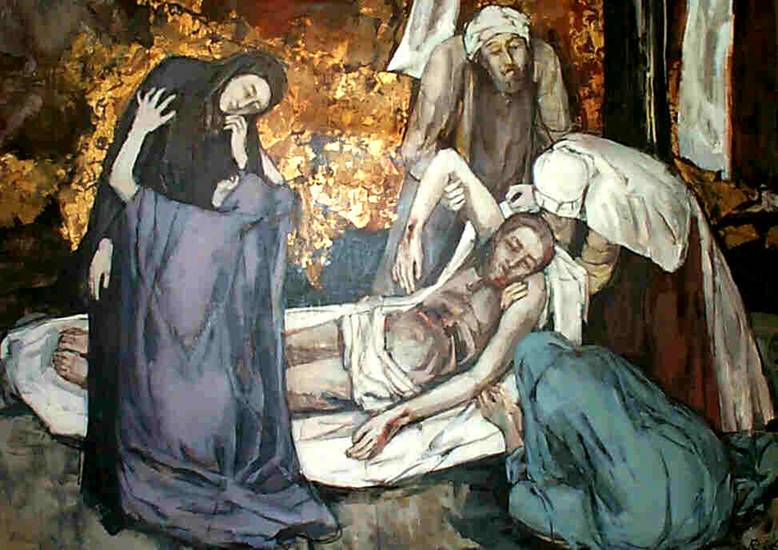
Holy Saturday, Sabbatum Sanctum in Latin, is the last day of Holy Week, and the 40th day of the traditional Lenten fast, although Lent ends liturgically on the evening of Holy Thursday. The evening of Holy Saturday begins the third and final day of the Paschal Triduum. In the Latin Church, no Masses are celebrated on Holy Saturday, and the day is essentially a sparse time of reflection upon Christ's death and burial in anticipation of the Great Vigil of Easter (Paschal Vigil). The vigil usually begins the night of Holy Saturday, lasting until Easter morning. Very little happens on Holy Saturday, that is until the beginning of the Great Paschal Vigil.


“For they did not yet understand the scripture that he had to rise from the dead.” (John 20:9)
On Good Friday, the impossible happened. God Himself was executed by His creatures. On Easter Sunday, this same God, our Lord Jesus Christ, rose from the dead, victorious over the power of the grave. In so doing, he defeated death for the same creatures who had put Him to death. Christians marvel at and meditate upon these events, and indeed draw our very life from their historic and transcendent reality. It is common, and entirely appropriate, for us to see our own spiritual defeats and victories as little Good Fridays and Easter Sundays. Though we face suffering and tragedy, we believe that God will bring great good out of evil. We know that the Resurrection brings meaning and hope to every difficult situation.
- Continue reading HERE.


A reading from an ancient homily for Holy Saturday

The Lord's descent into hell

"What is happening? Today there is a great silence over the earth, a great silence, and stillness, a great silence because the King sleeps; the earth was in terror and was still, because God slept in the flesh and raised up those who were sleeping from the ages. God has died in the flesh, and the underworld has trembled.
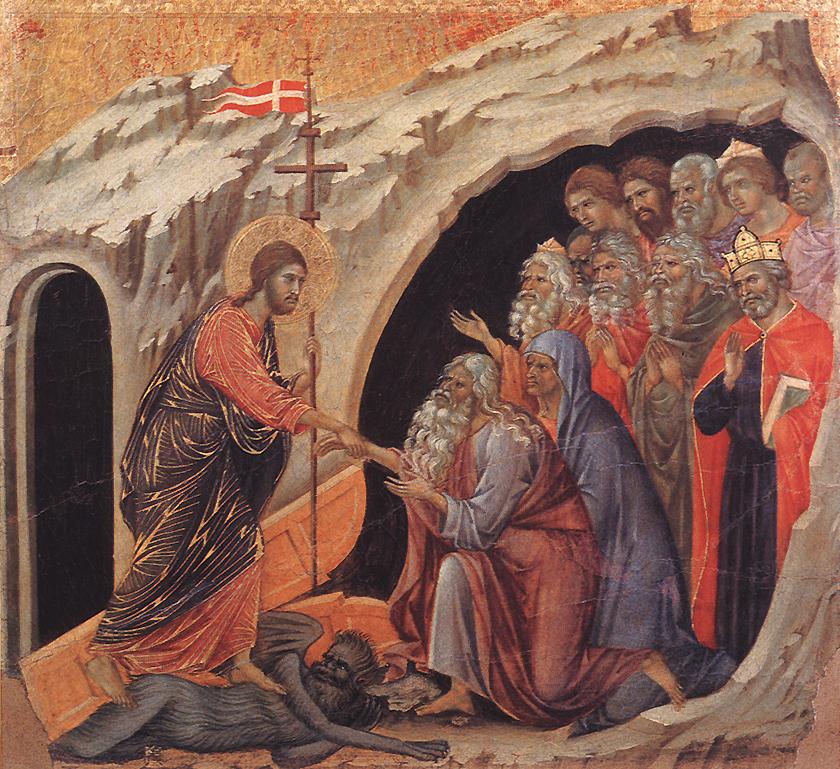
Truly he goes to seek out our first parent like a lost sheep; he wishes to visit those who sit in darkness and in the shadow of death. He goes to free the prisoner Adam and his fellow-prisoner Eve from their pains, he who is God, and Adam's son.
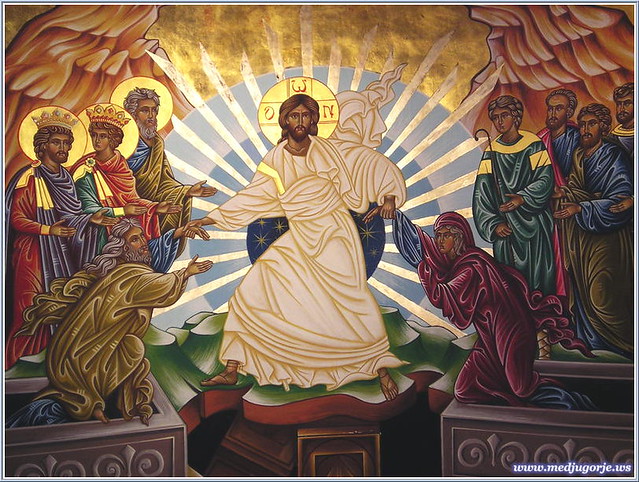
The Lord goes in to them holding his victorious weapon, his cross. When Adam, the first created man, sees him, he strikes his breast in terror and calls out to all: 'My Lord be with you all.' And Christ in reply says to Adam: ‘And with your spirit.’ And grasping his hand he raises him up, saying: ‘Awake, O sleeper, and arise from the dead, and Christ shall give you light.

‘I am your God, who for your sake became your son, who for you and your descendants now speak and command with authority those in prison: Come forth, and those in darkness: Have light, and those who sleep: Rise.

‘I command you: Awake, sleeper, I have not made you to be held a prisoner in the underworld. Arise from the dead; I am the life of the dead. Arise, O man, work of my hands, arise, you who were fashioned in my image. Rise, let us go hence; for you in me and I in you, together we are one undivided person.

‘For you, I your God became your son; for you, I the Master took on your form; that of slave; for you, I who am above the heavens came on earth and under the earth; for you, man, I became as a man without help, free among the dead; for you, who left a garden, I was handed over to Jews from a garden and crucified in a garden.

‘Look at the spittle on my face, which I received because of you, in order to restore you to that first divine inbreathing at creation. See the blows on my cheeks, which I accepted in order to refashion your distorted form to my own image.

'See the scourging of my back, which I accepted in order to disperse the load of your sins which was laid upon your back. See my hands nailed to the tree for a good purpose, for you, who stretched out your hand to the tree for an evil one.


`I slept on the cross and a sword pierced my side, for you, who slept in paradise and brought forth Eve from your side. My side healed the pain of your side; my sleep will release you from your sleep in Hades; my sword has checked the sword which was turned against you.

‘But arise, let us go hence. The enemy brought you out of the land of paradise; I will reinstate you, no longer in paradise, but on the throne of heaven. I denied you the tree of life, which was a figure, but now I myself am united to you, I who am life. I posted the cherubim to guard you as they would slaves; now I make the cherubim worship you as they would God.

"The cherubim throne has been prepared, the bearers are ready and waiting, the bridal chamber is in order, the food is provided, the everlasting houses and rooms are in readiness; the treasures of good things have been opened; the kingdom of heaven has been prepared before the ages." 


From the Catechism of the Catholic Church
Jesus "descended into the lower parts of the earth. He who descended is he who also ascended far above all the heavens." The Apostles' Creed confesses in the same article Christ's descent into hell and his Resurrection from the dead on the third day, because in his Passover it was precisely out of the depths of death that he made life spring forth:
Christ, that Morning Star, who came back from the dead, and shed his peaceful light on all mankind, your Son who lives and reigns for ever and ever. Amen.
The frequent New Testament affirmations that Jesus was "raised from the dead" presuppose that the crucified one sojourned in the realm of the dead prior to his resurrection.This was the first meaning given in the apostolic preaching to Christ's descent into hell: that Jesus, like all men, experienced death and in his soul joined the others in the realm of the dead. But he descended there as Savior, proclaiming the Good News to the spirits imprisoned there.

Scripture calls the abode of the dead, to which the dead Christ went down, "hell" - Sheol in Hebrew or Hades in Greek - because those who are there are deprived of the vision of God. Such is the case for all the dead, whether evil or righteous, while they await the Redeemer: which does not mean that their lot is identical, as Jesus shows through the parable of the poor man Lazarus who was received into "Abraham's bosom" "It is precisely these holy souls, who awaited their Savior in Abraham's bosom, whom Christ the Lord delivered when he descended into hell." Jesus did not descend into hell to deliver the damned, nor to destroy the hell of damnation, but to free the just who had gone before him."The gospel was preached even to the dead." The descent into hell brings the Gospel message of salvation to complete fulfillment.

This is the last phase of Jesus' messianic mission, a phase which is condensed in time but vast in its real significance: the spread of Christ's redemptive work to all men of all times and all places, for all who are saved have been made sharers in the redemption. Christ went down into the depths of death so that "the dead will hear the voice of the Son of God, and those who hear will live."Jesus, "the Author of life", by dying destroyed "him who has the power of death, that is, the devil, and [delivered] all those who through fear of death were subject to lifelong bondage." Henceforth the risen Christ holds "the keys of Death and Hades", so that "at the name of Jesus every knee should bow, in heaven and on earth and under the earth."


The twentieth-century theologian Hans Urs von Balthasar wrote a work entitled Mysterium Paschale in which he attempts to come to grips with the experience of Christ on Good Friday, Holy Saturday, and Easter Sunday. The thesis of the book is that Christ, in order to redeem man from the punishment of sin, must take on sin and all of its consequences and must rise from those consequences on Easter in his return to the Father.

The most striking chapter of the book, and certainly the one that has received the most attention, is his description of Holy Saturday. For Balthasar the experience of Holy Saturday is preeminently about the credal phrase descendit ad inferna (Christ’s descent into Hell). While belief in the statement is a matter of dogmatic obedience, the Church has not been clear on exactly what Christ’s going to Hell entailed. Balthasar’s thesis hinges on two given facts. First, in order to redeem man Christ must take on the penalty of death merited by man’s sin. Second, the penalty for sin is not just death of the body, but also death of the soul.

The experience of Hell is that of abandonment by God. More precisely, the soul has chosen to separate itself from God in the very act of sin. God is both our efficient and final cause, so eternity spent in the absence of this God is greater than any suffering of which we can conceive, and certainly greater than any physical suffering.

Because Christ in his saving act must go through the entire experience of death, with the eventual result of its conquering, he must not only suffer and die a bodily death, but also must suffer a spiritual death, a death that is the complete abandonment by God. The whole idea becomes more profound when we consider that Jesus is God. As such, his “closeness” to the Father is perfect, and certainly much more intense than our own relationship with the Father. While two separate Trinitarian Persons, they are in fact one God. In this sense, Christ has a much greater loss when he is abandoned by the Father in Hell than any non-divine man could experience. (Note that only in a Trinitarian theology can we even begin to grapple with the idea of God being abandoned by God.)

Another way of looking at this is that Jesus, as true man, must experience the full depth and breadth of the human condition, and as perfect man will experience this depth and breadth in a manner more perfect than the rest of us. The human condition in its positive aspect is an original union with God, of which Jesus experiences in a far more perfect manner than we. In its negative aspect, the human condition is the abandonment of God in death caused by both original and personal sin, a death that only begins with the destruction of the body, but continues in the destruction of the soul in every way except its annihilation. Jesus, as perfect man, experiences the depths of Hell in a manner more perfectly terrible than even the souls of the damned.

As Christians, we have become accustomed to thinking about the sufferings of Christ on Good Friday. On Holy Saturday, we at times become a bit more human-centered, perhaps reflecting on the emptiness and confusion the disciples would have felt as people who did not yet fully understand the significance of the prior day’s events. Perhaps, however, we should keep our gaze on Christ, knowing that the sufferings he is experiencing today are infinitely greater than those of Good Friday. The height of his Good Friday sufferings occurs in his shout from the Cross, “My God, my God, why have you abandoned me!” This is the beginning of His Hell, and today is a long and arduous experience of this abandonment – and all of this He did for us.
More debate about Van Balthasar's views on Holy Saturday here.